


- Home
- A-Z Catalogue
- Products
- Valves
- Cetop
- Manual Directional Valves
- Proportional Valves
- Poppet Valves
- High-Speed Linear Servo Valves
- All High-Speed Linear Servo Valves
- Cetop 10 (NG32) Two Stage Type High Speed Linear Servo Valves – LSVHG-10
- Cetop 10 (NG32) Two Stage Type High Speed Linear Servo Valves – LSVHG-10 (With Fail-Safe)
- Cetop 8 (NG25) Two Stage Type High Speed Linear Servo Valves – LSVHG-06
- Cetop 8 (NG25) Two Stage Type High Speed Linear Servo Valves – LSVHG-06 (With Fail-Safe)
- Cetop 7 (NG16) Two Stage Type High Speed Linear Servo Valves – LSVHG-04
- Cetop 7 (NG16) Two Stage Type High Speed Linear Servo Valves – LSVHG-04 (With Fail-Safe)
- Cetop 5 (NG10) Direct Type High Speed Linear Servo Valves – LSVG-03
- Cetop 5 (NG10) OBE Type Direct Operated Linear Servo Valves – LSVG-03-EH
- Cetop 3 (NG6) OBE Type Direct Operated Linear Servo Valves – LSVG-01-EH
- Pumps
- Pressure control
- Flow Control Valves
- Pressure Control Valves
- All Pressure Control Valves
- Brake Valves
- Direct Relief Valve
- Low Noise Solenoid Controlled Relief Valves
- Low Noise Pilot Operated Relief Valves
- Pilot Operated Relief Valves
- Pressure reducing and relieving valves
- Pressure reducing and check valves
- Pressure control valves
- Remote Control Relief Valves
- Solenoid Controlled Relief Valves – BSG
- Solenoid Controlled Relief Valves – BST
- Unloading relief valves
- Check valves
- Environmental
- Valves
- Hydraulic Systems
- Power pack
- About Us
- Contact
- Blog

Why Does My Exhaust End Pipe Turn Black?
A black mark on an Exhaust End Pipe can look alarming, especially when the rest of the car appears clean. Often, the residue is dry soot from combustion, and a light coating may be normal. The engine burns fuel and air, then sends exhaust gases through the tailpipe; small carbon particles can collect around its cooler outlet. Short trips, cold starts, and frequent stop-and-go driving may make the deposit more noticeable. That matters. The color alone, however, cannot confirm a fault.
Look closely at the texture and the car’s behavior. Dry, powdery soot is different from a wet, oily film, which may need prompt attention. A sudden increase in deposits, poor fuel economy, rough idling, smoke, or a warning light deserves a proper check. Possible causes can include an overly rich fuel mixture, a sensor issue, or engine wear, but these signs are not a diagnosis. Not always. Even a clean-looking pipe does not prove every system is working perfectly. Vehicle design, fuel type, and driving habits all affect what appears at the outlet. Note when the discoloration began and whether it wipes away easily; those small details can help a technician. If symptoms accompany the soot, consult the owner’s manual and have a qualified mechanic inspect the vehicle. A little soot may be ordinary. A changing pattern is worth questioning.
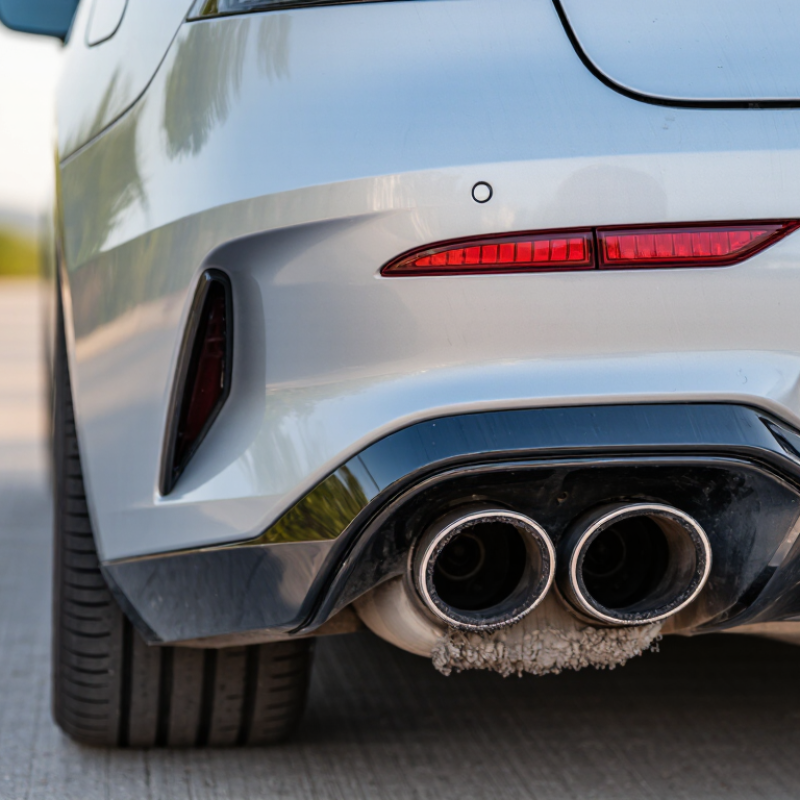
Table of Contents [Hide]
Combustion Basics: Gasoline’s Stoichiometric Air–Fuel Ratio Is About 14.7:1
Gasoline’s ideal stoichiometric air–fuel ratio is about 14.7 parts air to one part fuel by mass. At this point, oxygen and fuel are present in roughly the amounts needed for complete combustion. It is a useful reference, not a fixed setting. The exact ratio can shift with fuel composition, including ethanol content. Engine computers also adjust fueling as conditions change. During a cold start or hard acceleration, the mixture may be richer than 14.7:1. Under some steady driving conditions, it may be leaner.
A black exhaust end pipe can collect soot when combustion is rich or incomplete. Short trips often contribute: the engine may spend little time fully warm, and moisture can leave dark deposits near the outlet. A thin, dry coating alone does not prove a fault. Look at the pattern. Heavy, quickly returning soot, poor fuel economy, rough running, or dark smoke deserves attention from a qualified technician. A clean-looking pipe is not a guarantee, either. Modern engine controls can keep emissions low while deposits still form over time. Check the pipe only after it has cooled; exhaust parts can stay hot. The 14.7:1 figure helps explain combustion, but it cannot diagnose an engine by itself.





