


- Home
- A-Z Catalogue
- Products
- Valves
- Cetop
- Manual Directional Valves
- Proportional Valves
- Poppet Valves
- High-Speed Linear Servo Valves
- All High-Speed Linear Servo Valves
- Cetop 10 (NG32) Two Stage Type High Speed Linear Servo Valves – LSVHG-10
- Cetop 10 (NG32) Two Stage Type High Speed Linear Servo Valves – LSVHG-10 (With Fail-Safe)
- Cetop 8 (NG25) Two Stage Type High Speed Linear Servo Valves – LSVHG-06
- Cetop 8 (NG25) Two Stage Type High Speed Linear Servo Valves – LSVHG-06 (With Fail-Safe)
- Cetop 7 (NG16) Two Stage Type High Speed Linear Servo Valves – LSVHG-04
- Cetop 7 (NG16) Two Stage Type High Speed Linear Servo Valves – LSVHG-04 (With Fail-Safe)
- Cetop 5 (NG10) Direct Type High Speed Linear Servo Valves – LSVG-03
- Cetop 5 (NG10) OBE Type Direct Operated Linear Servo Valves – LSVG-03-EH
- Cetop 3 (NG6) OBE Type Direct Operated Linear Servo Valves – LSVG-01-EH
- Pumps
- Pressure control
- Flow Control Valves
- Pressure Control Valves
- All Pressure Control Valves
- Brake Valves
- Direct Relief Valve
- Low Noise Solenoid Controlled Relief Valves
- Low Noise Pilot Operated Relief Valves
- Pilot Operated Relief Valves
- Pressure reducing and relieving valves
- Pressure reducing and check valves
- Pressure control valves
- Remote Control Relief Valves
- Solenoid Controlled Relief Valves – BSG
- Solenoid Controlled Relief Valves – BST
- Unloading relief valves
- Check valves
- Environmental
- Valves
- Hydraulic Systems
- Power pack
- About Us
- Contact
- Blog

Why Choose Steel Casing Pipe for Global Projects?
Global projects demand materials that perform reliably across soil conditions, climates, and supply chains. Steel Casing Pipe remains a practical choice for road crossings, rail corridors, utility tunnels, water wells, and trenchless installations. Its high strength supports installation beneath heavy traffic and helps protect cables, pipelines, and communication networks. The World Steel Association’s World Steel in Figures 2024 reports approximately 1.89 billion tonnes of crude steel production in 2023. This large industrial base supports broad sourcing options and consistent manufacturing capacity. That matters when projects span several countries.
Standards also provide a measurable foundation. ASTM A252 addresses steel pipe piles, while ASTM A139 and EN 10219 may apply to specific welded pipe applications. Engineers must confirm the correct standard, wall thickness, weld quality, coating, and end preparation. A strong pipe is not enough. The Global Infrastructure Hub’s Global Infrastructure Outlook estimated that global infrastructure investment needs could reach about $94 trillion by 2040. Such demand increases pressure to select durable, maintainable materials rather than temporary solutions. Steel can be fabricated to project-specific diameters and transported in manageable sections. Field crews can weld, coat, inspect, and install it using established procedures.
Still, steel is not automatically the best answer. Corrosive groundwater, stray current, and poor coating practices can shorten service life. Designers should assess soil resistivity, operating loads, cathodic protection, and lifecycle costs before approval. In my experience, small specification gaps create expensive delays. Careful inspection matters. A qualified supplier, traceable mill certificates, dimensional checks, and non-destructive testing can turn Steel Casing Pipe from a basic component into dependable global infrastructure.
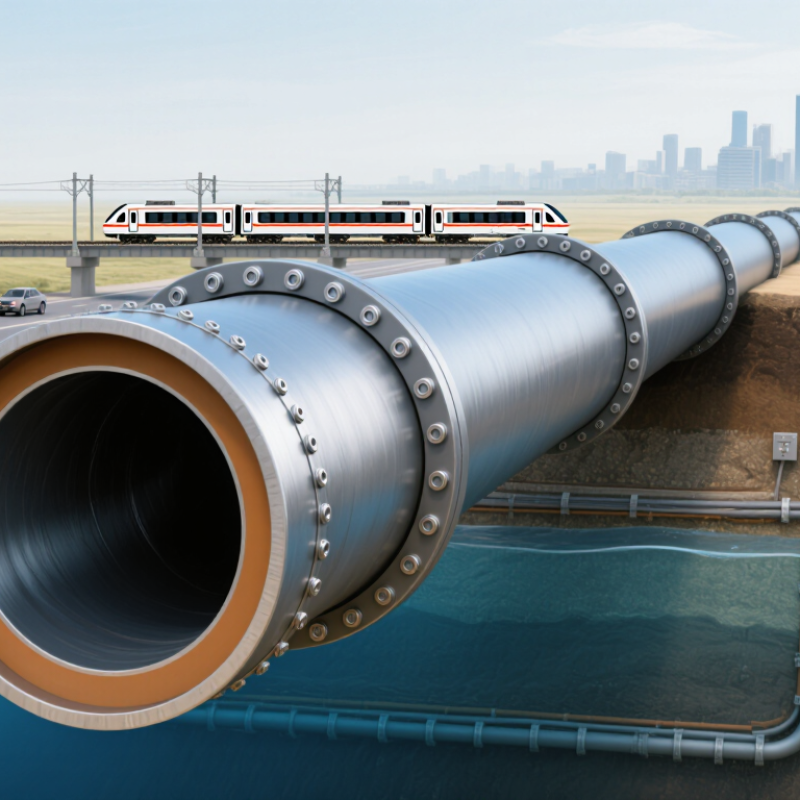
Table of Contents [Hide]
What Is Steel Casing Pipe and Where Is It Used?
Steel casing pipe is a protective steel sleeve installed around pipelines, utilities, wells, and underground crossings.
It creates a strong barrier between the working pipe and surrounding soil. In road or railway crossings, crews often push or bore the casing beneath the surface. The carrier pipe then passes through it, supported by spacers. This method reduces excavation, traffic disruption, and exposure to unstable ground.
Its uses vary by project. Water wells use casing to stabilize drilled formations and prevent wall collapse. Oil and gas wells use multiple casing strings to isolate pressure zones. Underground utility projects use casing beneath highways, railways, and rivers.
API Specification 5CT and ISO 11960 define important requirements for well casing and tubing.
For municipal planning, the U.S. Environmental Protection Agency estimated a 20-year drinking-water infrastructure need of approximately 625 billion dollars in its 2023 survey.
That figure shows why durable underground materials remain important.
Steel also offers high load resistance and predictable fabrication. The World Steel Association reported global crude steel production of about 1.89 billion tonnes in 2023. Supply is extensive, but availability does not guarantee suitability.
Wall thickness, coating, weld quality, soil chemistry, and installation loads still require engineering review. Steel casing is not always the cheapest choice. Poor corrosion planning can erase its expected service life.
That uncomfortable detail deserves attention.





