


- Home
- A-Z Catalogue
- Products
- Valves
- Cetop
- Manual Directional Valves
- Proportional Valves
- Poppet Valves
- High-Speed Linear Servo Valves
- All High-Speed Linear Servo Valves
- Cetop 10 (NG32) Two Stage Type High Speed Linear Servo Valves – LSVHG-10
- Cetop 10 (NG32) Two Stage Type High Speed Linear Servo Valves – LSVHG-10 (With Fail-Safe)
- Cetop 8 (NG25) Two Stage Type High Speed Linear Servo Valves – LSVHG-06
- Cetop 8 (NG25) Two Stage Type High Speed Linear Servo Valves – LSVHG-06 (With Fail-Safe)
- Cetop 7 (NG16) Two Stage Type High Speed Linear Servo Valves – LSVHG-04
- Cetop 7 (NG16) Two Stage Type High Speed Linear Servo Valves – LSVHG-04 (With Fail-Safe)
- Cetop 5 (NG10) Direct Type High Speed Linear Servo Valves – LSVG-03
- Cetop 5 (NG10) OBE Type Direct Operated Linear Servo Valves – LSVG-03-EH
- Cetop 3 (NG6) OBE Type Direct Operated Linear Servo Valves – LSVG-01-EH
- Pumps
- Pressure control
- Flow Control Valves
- Pressure Control Valves
- All Pressure Control Valves
- Brake Valves
- Direct Relief Valve
- Low Noise Solenoid Controlled Relief Valves
- Low Noise Pilot Operated Relief Valves
- Pilot Operated Relief Valves
- Pressure reducing and relieving valves
- Pressure reducing and check valves
- Pressure control valves
- Remote Control Relief Valves
- Solenoid Controlled Relief Valves – BSG
- Solenoid Controlled Relief Valves – BST
- Unloading relief valves
- Check valves
- Environmental
- Valves
- Hydraulic Systems
- Power pack
- About Us
- Contact
- Blog

Why Choose Galvanized Grating for Global Projects?
Global infrastructure demands materials that remain dependable beyond the factory gate. Galvanized Grating offers a practical answer for platforms, walkways, drainage covers, and industrial floors. Its zinc coating protects steel from moisture, abrasion, and many atmospheric contaminants. That protection matters at ports, wastewater plants, bridges, and remote energy sites.
Tom Langill, former Technical Director of the American Galvanizers Association, describes the process clearly: “Galvanizing is a metallurgical process, not a paint process.” This distinction explains its value. Hot-dip galvanizing bonds zinc to steel through a controlled reaction. The resulting coating supports long service life and visible protection. Small scratches may also receive sacrificial protection from surrounding zinc.
Global projects require more than attractive specifications. Engineers must consider drainage, ventilation, coating thickness, loading, transport, installation, and local environmental exposure. Standards such as ISO 1461 can help verify coating requirements. Yet compliance alone does not guarantee success. Poorly designed connections can trap water. Incorrect openings can complicate galvanizing. These details deserve attention before fabrication begins.
There is no perfect material. Galvanized Grating can require careful handling, and severe chemical environments may demand additional guidance. Its surface may also change appearance over time. That is not necessarily failure. It is often the natural development of a protective zinc patina.
When properly designed and inspected, Galvanized Grating combines strength, slip resistance, drainage, and corrosion protection. The strongest choice is not always the cheapest purchase. It is the option that performs reliably after installation, under weather, traffic, maintenance, and time.
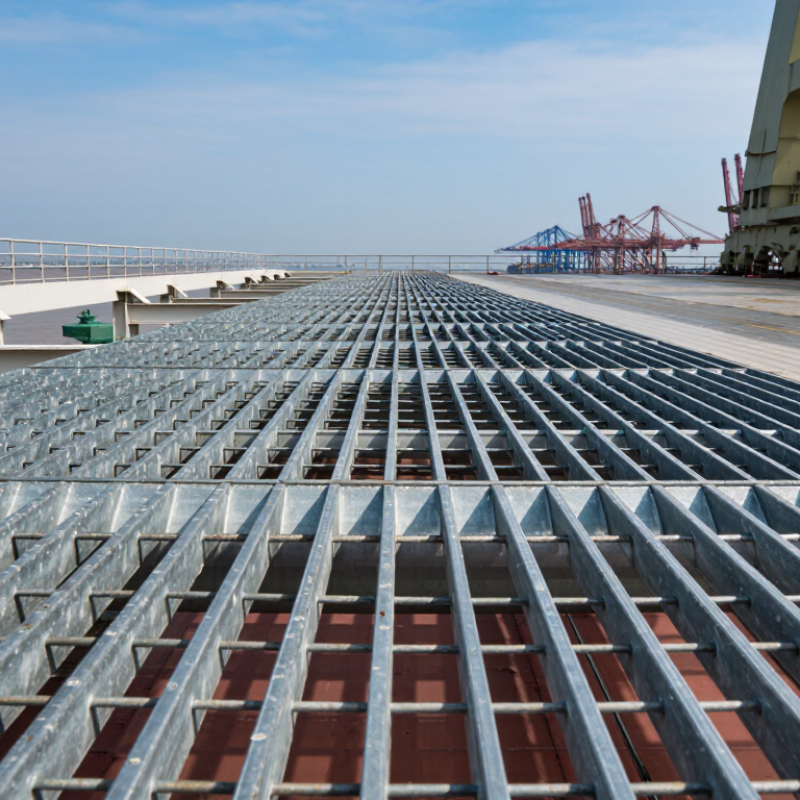
Table of Contents [Hide]
What Is Galvanized Grating?
Galvanized grating is a rigid, open grid made from steel bearing bars and cross bars. The steel carries weight, while the spaces allow water, air, and light to pass through. After fabrication, the grating is usually immersed in molten zinc. This hot-dip process forms a protective zinc layer on exposed steel surfaces. Zinc acts as a barrier and provides sacrificial protection when minor scratches appear. That detail matters on outdoor platforms, drainage covers, stairs, and industrial walkways.
For global projects, specifications should begin with loads, spans, openings, and local conditions. An engineer may select different bar sizes for a maintenance platform and a vehicle-access trench. Surface choice also matters. Plain surfaces suit many dry areas, while serrated surfaces can improve grip in wet conditions. Measurements must follow the project’s adopted standard, not a copied drawing from another region. Steel grades, zinc thickness, tolerances, and welding details need written verification. Clear documentation reduces disputes between fabricators, inspectors, and installation teams.
In practice, galvanized grating is durable, but it is not maintenance-free. Cut edges, trapped debris, and contact with dissimilar metals can create weak points. Inspectors should check drainage, fasteners, welds, and coating damage after installation. Repair methods must match the specified corrosion-protection system. Field experience shows that good grating can fail early when water cannot escape. That lesson is easy to overlook. Galvanized steel also has limits in severe chemical or high-temperature environments. Testing actual site conditions is wiser than assuming one coating fits every country.