


- Home
- A-Z Catalogue
- Products
- Valves
- Cetop
- Manual Directional Valves
- Proportional Valves
- Poppet Valves
- High-Speed Linear Servo Valves
- All High-Speed Linear Servo Valves
- Cetop 10 (NG32) Two Stage Type High Speed Linear Servo Valves – LSVHG-10
- Cetop 10 (NG32) Two Stage Type High Speed Linear Servo Valves – LSVHG-10 (With Fail-Safe)
- Cetop 8 (NG25) Two Stage Type High Speed Linear Servo Valves – LSVHG-06
- Cetop 8 (NG25) Two Stage Type High Speed Linear Servo Valves – LSVHG-06 (With Fail-Safe)
- Cetop 7 (NG16) Two Stage Type High Speed Linear Servo Valves – LSVHG-04
- Cetop 7 (NG16) Two Stage Type High Speed Linear Servo Valves – LSVHG-04 (With Fail-Safe)
- Cetop 5 (NG10) Direct Type High Speed Linear Servo Valves – LSVG-03
- Cetop 5 (NG10) OBE Type Direct Operated Linear Servo Valves – LSVG-03-EH
- Cetop 3 (NG6) OBE Type Direct Operated Linear Servo Valves – LSVG-01-EH
- Pumps
- Pressure control
- Flow Control Valves
- Pressure Control Valves
- All Pressure Control Valves
- Brake Valves
- Direct Relief Valve
- Low Noise Solenoid Controlled Relief Valves
- Low Noise Pilot Operated Relief Valves
- Pilot Operated Relief Valves
- Pressure reducing and relieving valves
- Pressure reducing and check valves
- Pressure control valves
- Remote Control Relief Valves
- Solenoid Controlled Relief Valves – BSG
- Solenoid Controlled Relief Valves – BST
- Unloading relief valves
- Check valves
- Environmental
- Valves
- Hydraulic Systems
- Power pack
- About Us
- Contact
- Blog

Why Choose a Fuel Generator for Reliable Power?
When the grid fails, a Fuel Generator can keep essential operations moving. Lights stay on. Pumps continue running. Data servers avoid an abrupt shutdown. In a hospital, workshop, or remote construction site, those minutes matter.
Power-generation specialist Tom Linebarger has stated, “Reliable power begins with disciplined preparation, not the generator alone.” That principle deserves attention. A dependable Fuel Generator requires correct sizing, clean fuel, a tested transfer switch, and scheduled maintenance. Diesel models often provide strong endurance under heavy loads. Natural-gas units can offer convenient fuel access where pipelines remain available. The best choice depends on load demands, runtime, weather, noise limits, and local regulations.
Details reveal reliability. A technician should inspect coolant levels, battery terminals, belts, exhaust paths, and fuel filters. Load-bank testing can expose weaknesses before an outage does. Cold mornings also matter. A generator may start perfectly in a warm warehouse but struggle outdoors during winter. That possibility is easy to overlook.
No generator is flawless. Fuel can degrade. Batteries can fail. Operators can misunderstand the control panel. These risks require honest planning, not optimistic assumptions. Qualified professionals should verify installation and grounding requirements under applicable standards, such as ISO 8528 or NFPA 110 where relevant. A Fuel Generator is not merely an engine in a metal enclosure. It is part of a complete power strategy, and that strategy needs regular review.
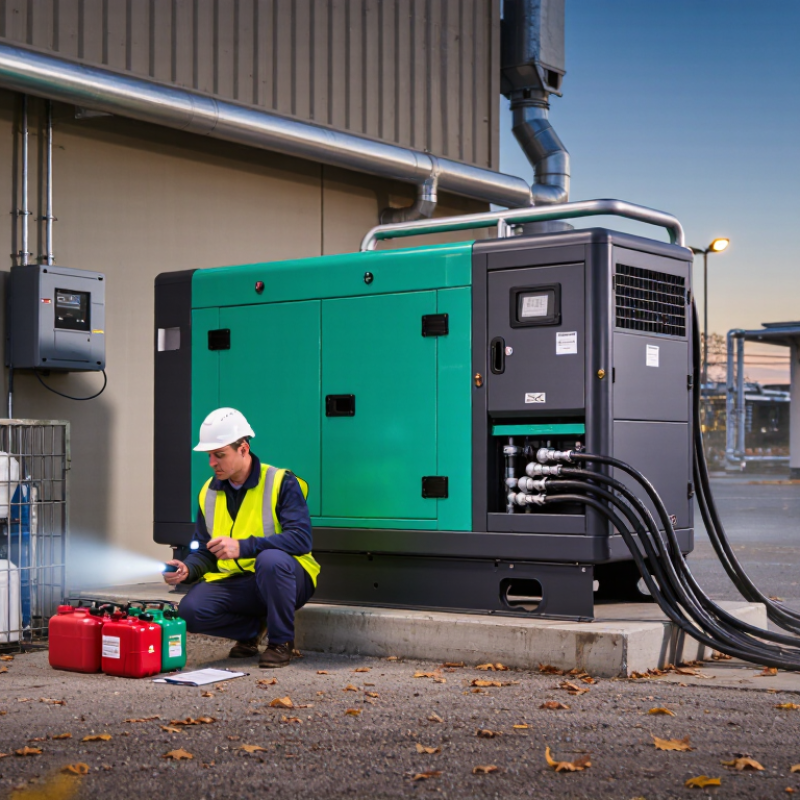
Table of Contents [Hide]
Fuel Generator Fundamentals: How Combustion Produces Electrical Power
A fuel generator turns stored chemical energy into electricity through a sequence of mechanical steps. Fuel burns inside an engine, releasing heat and expanding gases that push a piston. The piston turns a crankshaft, which spins the rotor inside an alternator. As the rotor moves past the stator’s windings, changing magnetic fields induce electrical current. In simple terms, combustion makes motion; the alternator makes power.
The output depends on more than the engine’s rated capacity. A refrigerator, for example, may draw extra current when its compressor starts, so its brief surge matters. Check the generator’s continuous and peak ratings before connecting appliances, and avoid loading it beyond its limits. Small details count. Keep the unit outdoors, away from doors and windows, because exhaust can contain carbon monoxide. Follow the manual for grounding and maintenance, too. Clean air filters and fresh fuel help the engine run steadily, though fuel can degrade during storage. I still find the relationship between engine speed and output easy to underestimate: a generator is a machine with moving parts, heat, vibration, and wear, not just a socket that happens to produce electricity.