


- Home
- A-Z Catalogue
- Products
- Valves
- Cetop
- Manual Directional Valves
- Proportional Valves
- Poppet Valves
- High-Speed Linear Servo Valves
- All High-Speed Linear Servo Valves
- Cetop 10 (NG32) Two Stage Type High Speed Linear Servo Valves – LSVHG-10
- Cetop 10 (NG32) Two Stage Type High Speed Linear Servo Valves – LSVHG-10 (With Fail-Safe)
- Cetop 8 (NG25) Two Stage Type High Speed Linear Servo Valves – LSVHG-06
- Cetop 8 (NG25) Two Stage Type High Speed Linear Servo Valves – LSVHG-06 (With Fail-Safe)
- Cetop 7 (NG16) Two Stage Type High Speed Linear Servo Valves – LSVHG-04
- Cetop 7 (NG16) Two Stage Type High Speed Linear Servo Valves – LSVHG-04 (With Fail-Safe)
- Cetop 5 (NG10) Direct Type High Speed Linear Servo Valves – LSVG-03
- Cetop 5 (NG10) OBE Type Direct Operated Linear Servo Valves – LSVG-03-EH
- Cetop 3 (NG6) OBE Type Direct Operated Linear Servo Valves – LSVG-01-EH
- Pumps
- Pressure control
- Flow Control Valves
- Pressure Control Valves
- All Pressure Control Valves
- Brake Valves
- Direct Relief Valve
- Low Noise Solenoid Controlled Relief Valves
- Low Noise Pilot Operated Relief Valves
- Pilot Operated Relief Valves
- Pressure reducing and relieving valves
- Pressure reducing and check valves
- Pressure control valves
- Remote Control Relief Valves
- Solenoid Controlled Relief Valves – BSG
- Solenoid Controlled Relief Valves – BST
- Unloading relief valves
- Check valves
- Environmental
- Valves
- Hydraulic Systems
- Power pack
- About Us
- Contact
- Blog

Why Choose an Off Road Forklift for Rough Terrain?
Choosing an Off Road Forklift begins with the ground beneath the tires. Mud, gravel, ruts, slopes, and unfinished surfaces can quickly expose the limits of warehouse equipment. Rough-terrain models use larger pneumatic tires, stronger frames, increased ground clearance, and stabilizing systems. These features help operators move pallets across construction sites, farms, lumber yards, and outdoor storage areas.
The need is substantial. The U.S. Occupational Safety and Health Administration reports approximately 85 forklift-related workplace fatalities and 35,000 serious injuries annually. OSHA also stresses operator training, workplace evaluation, and equipment inspection. ANSI/ITSDF B56.6, the safety standard for rough-terrain forklift trucks, reinforces these responsibilities. A capable machine cannot correct poor load balance or excessive speed.
Brian Feehan, president of the Industrial Truck Association, has expressed a useful principle: “The right truck begins with the application.” That idea matters here. A 5,000-pound capacity rating means little on a steep, wet access road. Load center, attachment choice, tire condition, visibility, and turning space matter more than a brochure headline.
Field experience can be humbling. A forklift may cross loose stone easily in the morning, then struggle after rain softens the same route. That uncertainty deserves attention. Buyers should compare terrain data, duty cycles, and maintenance records before choosing. Reports from OSHA and the World Industrial Truck Statistics organization provide valuable context, but market figures vary by region and equipment definition. An Off Road Forklift is not automatically safer. It becomes safer when its design matches the site, the load, and the operator’s training.
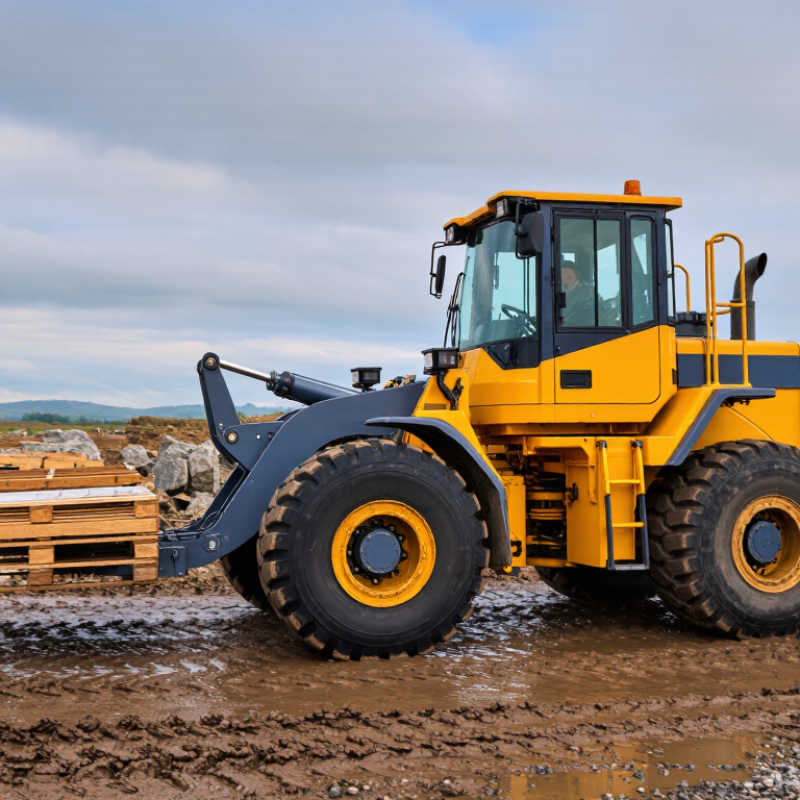
Table of Contents [Hide]
What Is an Off-Road Forklift?
An off-road forklift is a powered industrial truck built for uneven outdoor surfaces. Unlike warehouse forklifts, it uses large pneumatic tires, higher ground clearance, and stronger frames. Many models include a rough-terrain mast, four-wheel drive, and hydraulic leveling. These features help the truck cross gravel, mud, packed soil, and temporary construction routes.
Its purpose is practical. It can unload timber beside a site road or place heavy materials near a building foundation. ANSI/ITSDF B56.6 sets safety requirements for rough-terrain forklift design and operation. OSHA reports that forklifts cause about 85 workplace deaths and 35,000 serious injuries in the United States each year. The numbers deserve attention. A rough surface can hide soft ground, steep slopes, or loose debris. Even experienced operators can misjudge stability.
Tips: Check tire pressure, ground conditions, and rated capacity before use. Keep the load low and travel slowly on slopes. A spotter helps near blind corners. Do not treat four-wheel drive as unlimited traction. It is easy to overestimate it. Operators should follow site training and the manufacturer’s load chart, while supervisors should record changing terrain conditions. A short pre-shift inspection may prevent a costly mistake.