


- Home
- A-Z Catalogue
- Products
- Valves
- Cetop
- Manual Directional Valves
- Proportional Valves
- Poppet Valves
- High-Speed Linear Servo Valves
- All High-Speed Linear Servo Valves
- Cetop 10 (NG32) Two Stage Type High Speed Linear Servo Valves – LSVHG-10
- Cetop 10 (NG32) Two Stage Type High Speed Linear Servo Valves – LSVHG-10 (With Fail-Safe)
- Cetop 8 (NG25) Two Stage Type High Speed Linear Servo Valves – LSVHG-06
- Cetop 8 (NG25) Two Stage Type High Speed Linear Servo Valves – LSVHG-06 (With Fail-Safe)
- Cetop 7 (NG16) Two Stage Type High Speed Linear Servo Valves – LSVHG-04
- Cetop 7 (NG16) Two Stage Type High Speed Linear Servo Valves – LSVHG-04 (With Fail-Safe)
- Cetop 5 (NG10) Direct Type High Speed Linear Servo Valves – LSVG-03
- Cetop 5 (NG10) OBE Type Direct Operated Linear Servo Valves – LSVG-03-EH
- Cetop 3 (NG6) OBE Type Direct Operated Linear Servo Valves – LSVG-01-EH
- Pumps
- Pressure control
- Flow Control Valves
- Pressure Control Valves
- All Pressure Control Valves
- Brake Valves
- Direct Relief Valve
- Low Noise Solenoid Controlled Relief Valves
- Low Noise Pilot Operated Relief Valves
- Pilot Operated Relief Valves
- Pressure reducing and relieving valves
- Pressure reducing and check valves
- Pressure control valves
- Remote Control Relief Valves
- Solenoid Controlled Relief Valves – BSG
- Solenoid Controlled Relief Valves – BST
- Unloading relief valves
- Check valves
- Environmental
- Valves
- Hydraulic Systems
- Power pack
- About Us
- Contact
- Blog

Why Choose an ACB Breaker for Global Power Systems?
Selecting an ACB Breaker for global power systems requires more than comparing interrupting ratings. Engineers must examine voltage levels, prospective short-circuit currents, ambient temperatures, installation altitude, and maintenance capabilities. A breaker that performs reliably in a European data center may need different settings in a humid coastal plant or a high-altitude mine.
Dr. Arun K. Sharma, a power-distribution engineer with extensive low-voltage switchgear experience, states, “An ACB earns trust when its protection settings match the real network, not merely the catalogue.” This practical view reflects the purpose of IEC 60947-2: equipment must be evaluated within its intended electrical conditions. It also reminds designers that certification alone does not guarantee a suitable installation.
An ACB Breaker offers several advantages for international projects. Its adjustable long-time, short-time, instantaneous, and earth-fault protection can support coordination across complex distribution boards. Withdrawable designs can simplify inspection and replacement. Electronic trip units may also provide event records, helping maintenance teams investigate overloads before damage spreads.
Yet the choice is not automatically correct. A sophisticated breaker can fail to deliver value when settings are poorly calculated or maintenance access is ignored. Small details matter. Cable length matters. Dust matters. Human judgment still matters.
Global projects also face inconsistent documentation, local practices, and supply-chain limitations. Engineers should verify type-test evidence, spare-part availability, installation clearances, and after-sales support. A careful selection process may take longer, but it reduces nuisance trips, unplanned downtime, and unsafe troubleshooting. There is no perfect universal solution. The strongest decision connects proven technology with the actual behavior of the power system.
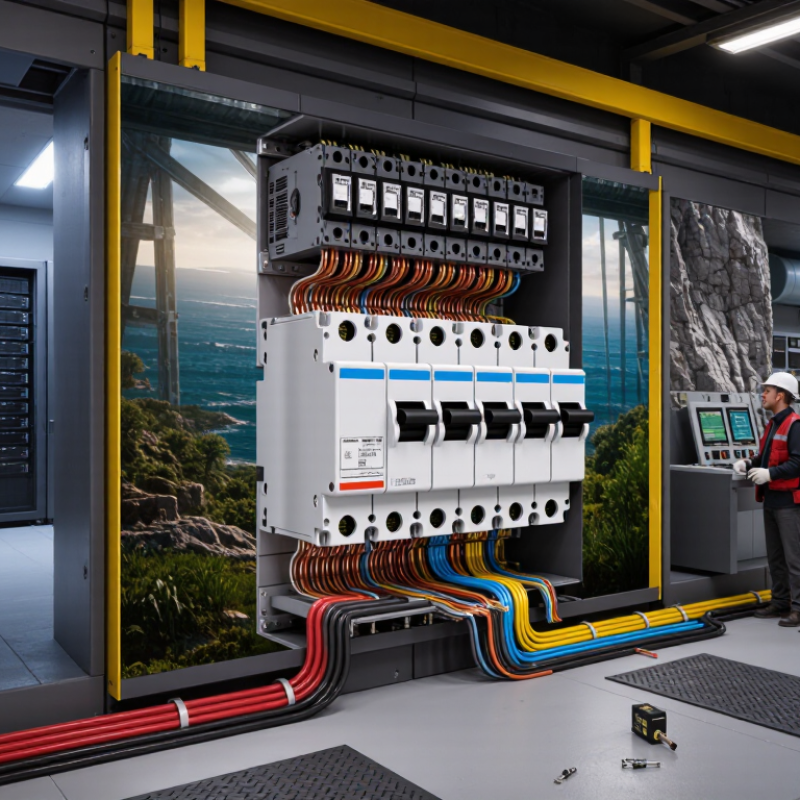
Table of Contents [Hide]
ACB Breaker Fundamentals and Operating Principles
Why Choose an ACB Breaker for Global Power Systems?
An ACB, or air circuit breaker, protects low-voltage distribution boards by interrupting fault current in air. During normal operation, fixed contacts carry load current with limited voltage drop. When a short circuit appears, sensors detect abnormal current. An electronic trip unit then commands the mechanism to open. Arc runners and splitter plates divide, cool, and extinguish the arc. Air does the work.
That sequence is simple, but coordination is not. Trip settings must match cable capacity, transformer impedance, and downstream breaker curves. Otherwise, a feeder fault may disconnect an entire floor. IEC 60947-2 defines important requirements, including rated performance, testing, and short-circuit verification. Engineers should compare Icu, Ics, short-time withstand current, and endurance ratings with the installation study. These values are not interchangeable.
Global demand makes this discipline more important. The IEA Electricity 2024 report expects electricity demand to grow by an average 3.2% annually from 2024 to 2026. Its Renewables 2024 report also forecasts around 5,500 GW of new renewable capacity by 2030. More sources create more switching and protection challenges. ACBs offer adjustable protection, high current capacity, and practical isolation for large boards. Draw-out designs can simplify inspection and replacement. Field commissioning often reveals one weakness: settings are copied instead of calculated. That assumption fails. An ACB is not automatically the best choice. It can be oversized, expensive, or poorly coordinated without a careful study.





