


- Home
- A-Z Catalogue
- Products
- Valves
- Cetop
- Manual Directional Valves
- Proportional Valves
- Poppet Valves
- High-Speed Linear Servo Valves
- All High-Speed Linear Servo Valves
- Cetop 10 (NG32) Two Stage Type High Speed Linear Servo Valves – LSVHG-10
- Cetop 10 (NG32) Two Stage Type High Speed Linear Servo Valves – LSVHG-10 (With Fail-Safe)
- Cetop 8 (NG25) Two Stage Type High Speed Linear Servo Valves – LSVHG-06
- Cetop 8 (NG25) Two Stage Type High Speed Linear Servo Valves – LSVHG-06 (With Fail-Safe)
- Cetop 7 (NG16) Two Stage Type High Speed Linear Servo Valves – LSVHG-04
- Cetop 7 (NG16) Two Stage Type High Speed Linear Servo Valves – LSVHG-04 (With Fail-Safe)
- Cetop 5 (NG10) Direct Type High Speed Linear Servo Valves – LSVG-03
- Cetop 5 (NG10) OBE Type Direct Operated Linear Servo Valves – LSVG-03-EH
- Cetop 3 (NG6) OBE Type Direct Operated Linear Servo Valves – LSVG-01-EH
- Pumps
- Pressure control
- Flow Control Valves
- Pressure Control Valves
- All Pressure Control Valves
- Brake Valves
- Direct Relief Valve
- Low Noise Solenoid Controlled Relief Valves
- Low Noise Pilot Operated Relief Valves
- Pilot Operated Relief Valves
- Pressure reducing and relieving valves
- Pressure reducing and check valves
- Pressure control valves
- Remote Control Relief Valves
- Solenoid Controlled Relief Valves – BSG
- Solenoid Controlled Relief Valves – BST
- Unloading relief valves
- Check valves
- Environmental
- Valves
- Hydraulic Systems
- Power pack
- About Us
- Contact
- Blog

Why Choose a Fingerprint Smart Lock for Your Business?
A business key can disappear quietly. A shared PIN can travel farther than intended. For offices, clinics, warehouses, and rental properties, managing who enters each door is a daily operational task—not just a security concern.
Verizon’s 2024 Data Breach Investigations Report analyzed 10,626 confirmed breaches and found that 68% involved a non-malicious human element, such as mistakes or social engineering. This does not mean a fingerprint lock prevents data breaches. It does underline why clear access procedures matter. NIST’s Digital Identity Guidelines also treat biometrics as one part of authentication, rather than a standalone secret. That guidance concerns digital identity, not commercial door-lock certification, but it offers a useful design principle: biometrics work best alongside sound controls.
A Fingerprint smart lock can make routine entry simpler by linking access to enrolled users instead of easily shared keys or codes. Managers may be able to add or remove access when staff roles change, while entry records can help clarify who used a door and when. Yet convenience is not the whole story. Wet hands, worn fingerprints, sensor placement, power loss, and rushed enrollment can all affect the experience. A fingerprint can fail at the worst moment.
Choosing a system therefore means checking more than its advertised speed. Review its backup entry method, user-management features, data-handling practices, durability, and support. Match those details to the doors, staff routines, and privacy needs of your business. The right choice is practical, but never automatic.
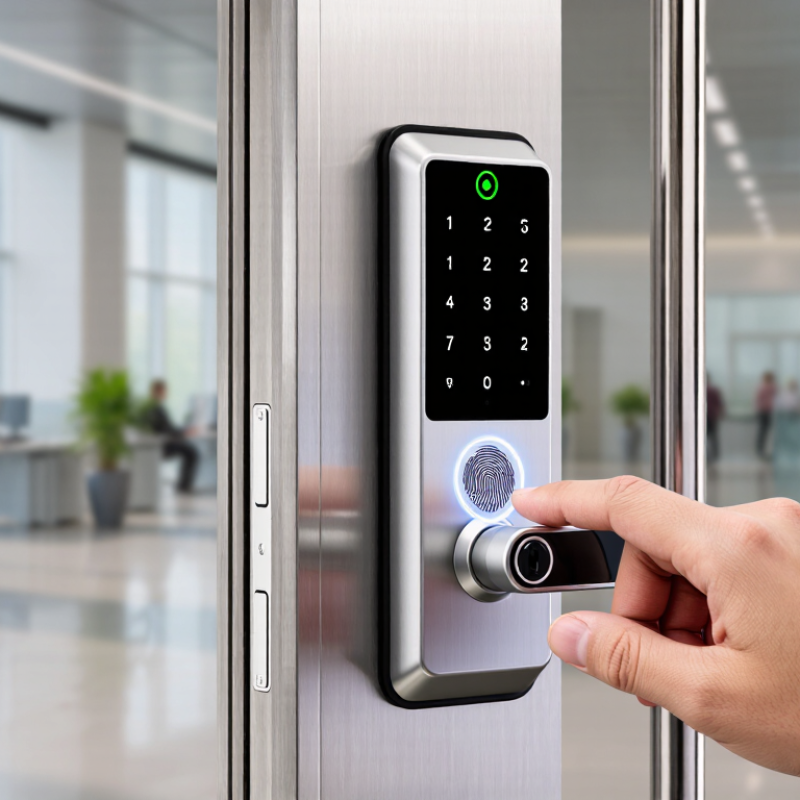
Table of Contents [Hide]
Fingerprint Smart Locks Defined: Sensors, Templates, and Door Controllers
A fingerprint smart lock turns a person’s touch into an access decision. During enrollment, a sensor reads ridge patterns from a finger. It converts selected features into a digital template, rather than relying on a password someone can forget. Sensor quality matters. Dust, moisture, worn skin, or a rushed touch can affect a reading. Small detail, real impact.
At the door, the sensor compares a fresh scan with enrolled templates. A door controller then checks the result and signals the lock to open or stay secured. The exact design varies: some systems keep matching data within the lock, while others use a connected controller. Businesses should ask where templates are stored, how access is removed when staff leave, and what happens during a power or network failure. These details are easy to overlook.
In daily use, clear enrollment instructions and a clean reader can reduce failed scans. A side entrance exposed to rain may need different planning from a dry office lobby. Keep a suitable backup entry method for people whose fingerprints cannot be read consistently. Fingerprints are convenient, but not infallible. I would also test the lock during busy arrival periods; a device that works in a quiet demonstration may slow a queue at 8 a.m. A practical setup balances quick entry with careful control of who can enter.





