


- Home
- A-Z Catalogue
- Products
- Valves
- Cetop
- Manual Directional Valves
- Proportional Valves
- Poppet Valves
- High-Speed Linear Servo Valves
- All High-Speed Linear Servo Valves
- Cetop 10 (NG32) Two Stage Type High Speed Linear Servo Valves – LSVHG-10
- Cetop 10 (NG32) Two Stage Type High Speed Linear Servo Valves – LSVHG-10 (With Fail-Safe)
- Cetop 8 (NG25) Two Stage Type High Speed Linear Servo Valves – LSVHG-06
- Cetop 8 (NG25) Two Stage Type High Speed Linear Servo Valves – LSVHG-06 (With Fail-Safe)
- Cetop 7 (NG16) Two Stage Type High Speed Linear Servo Valves – LSVHG-04
- Cetop 7 (NG16) Two Stage Type High Speed Linear Servo Valves – LSVHG-04 (With Fail-Safe)
- Cetop 5 (NG10) Direct Type High Speed Linear Servo Valves – LSVG-03
- Cetop 5 (NG10) OBE Type Direct Operated Linear Servo Valves – LSVG-03-EH
- Cetop 3 (NG6) OBE Type Direct Operated Linear Servo Valves – LSVG-01-EH
- Pumps
- Pressure control
- Flow Control Valves
- Pressure Control Valves
- All Pressure Control Valves
- Brake Valves
- Direct Relief Valve
- Low Noise Solenoid Controlled Relief Valves
- Low Noise Pilot Operated Relief Valves
- Pilot Operated Relief Valves
- Pressure reducing and relieving valves
- Pressure reducing and check valves
- Pressure control valves
- Remote Control Relief Valves
- Solenoid Controlled Relief Valves – BSG
- Solenoid Controlled Relief Valves – BST
- Unloading relief valves
- Check valves
- Environmental
- Valves
- Hydraulic Systems
- Power pack
- About Us
- Contact
- Blog

Why Choose a Custom Sewer Jetter for Your Business?
A sewer-cleaning business rarely gets the same call twice. One morning, a crew may face grease near a restaurant; that afternoon, roots in a long municipal lateral. A standard jetter can handle routine work, but its hose length, water capacity, pressure, and vehicle setup may not suit every route. Fit matters. A Custom Sewer Jetter can be configured around the jobs your team actually performs, rather than forcing every job into one setup.
The need for dependable wastewater infrastructure is substantial. The U.S. Environmental Protection Agency’s 2022 Clean Watersheds Needs Survey estimated $630.1 billion in documented water-quality infrastructure needs over 20 years. That figure does not measure demand for sewer jetters. It does, however, show the scale of investment and maintenance facing water systems. For contractors, readiness matters. A unit with the right tank size, hose reel, and controls can reduce avoidable setup delays at the curb. It may also help crews respond to different pipe conditions without carrying equipment they rarely use.
Customization is not automatically the better choice. A larger tank can add weight, and higher pressure is not a substitute for sound operating judgment. The right specification starts with job records: common pipe diameters, typical run lengths, water access, and the space available on each vehicle. Ask manufacturers for clear performance data and service support, then compare those details with your crew’s experience. Small details count. A reel that reaches the work area safely can matter more than an impressive headline specification. Before investing, be honest about what your business needs—and what it may be overbuilding.
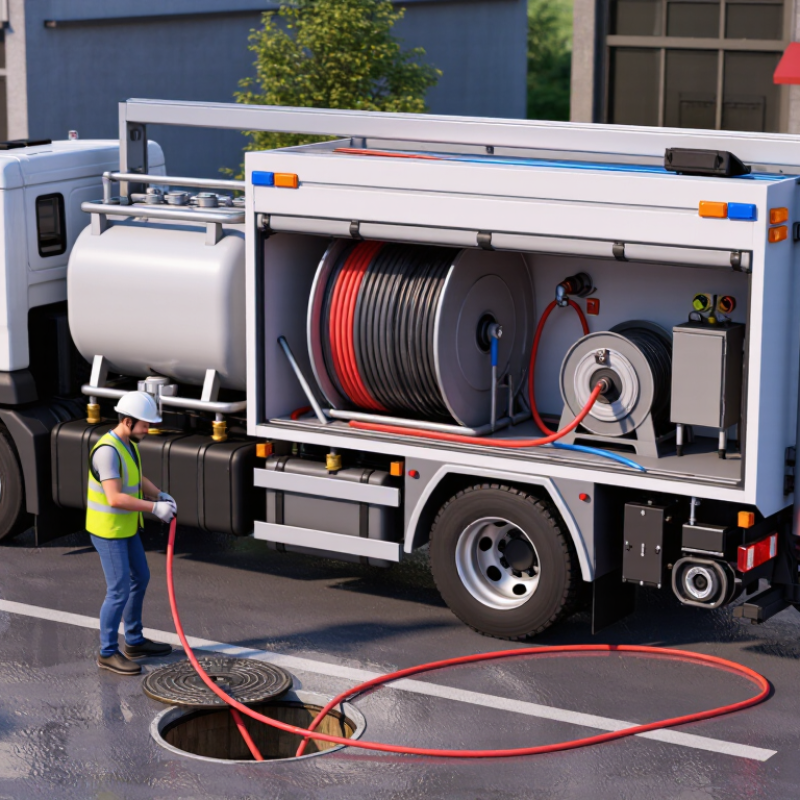
Table of Contents [Hide]
What a Custom Sewer Jetter Is and How It Works
A custom sewer jetter is a vehicle- or trailer-mounted system configured for a particular crew’s pipe sizes, access points, and cleaning needs. It typically combines a water tank, high-pressure pump, hose reel, and interchangeable nozzles. The pump sends water through the hose; forward-facing jets break up obstructions, while rear-facing jets help move the nozzle through the pipe and flush loosened material toward the access point.
Not magic. Nozzle choice and water flow matter as much as pressure.
Customization may involve tank capacity, hose length, pump output, and controls that operators can manage safely from the work area. A narrow nozzle can suit a small lateral, while a different setup may be needed for longer runs or heavier deposits.
The US Environmental Protection Agency’s 2022 Clean Watersheds Needs Survey estimated $630.1 billion in wastewater, stormwater, and related infrastructure needs over 20 years. The American Society of Civil Engineers’ 2021 Report Card gave wastewater infrastructure a D+ grade. These figures show the scale of maintenance needs, but they do not mean jetting can repair damaged pipe.
In practice, crews should match the setup to the line and inspect conditions before choosing a cleaning approach. Excessive pressure can damage vulnerable pipes or connections, so operators need training and equipment guidance. A custom configuration can improve reach and reduce unnecessary setup changes.
Still, it is not a substitute for inspection, and that distinction is easy to miss.





