


- Home
- A-Z Catalogue
- Products
- Valves
- Cetop
- Manual Directional Valves
- Proportional Valves
- Poppet Valves
- High-Speed Linear Servo Valves
- All High-Speed Linear Servo Valves
- Cetop 10 (NG32) Two Stage Type High Speed Linear Servo Valves – LSVHG-10
- Cetop 10 (NG32) Two Stage Type High Speed Linear Servo Valves – LSVHG-10 (With Fail-Safe)
- Cetop 8 (NG25) Two Stage Type High Speed Linear Servo Valves – LSVHG-06
- Cetop 8 (NG25) Two Stage Type High Speed Linear Servo Valves – LSVHG-06 (With Fail-Safe)
- Cetop 7 (NG16) Two Stage Type High Speed Linear Servo Valves – LSVHG-04
- Cetop 7 (NG16) Two Stage Type High Speed Linear Servo Valves – LSVHG-04 (With Fail-Safe)
- Cetop 5 (NG10) Direct Type High Speed Linear Servo Valves – LSVG-03
- Cetop 5 (NG10) OBE Type Direct Operated Linear Servo Valves – LSVG-03-EH
- Cetop 3 (NG6) OBE Type Direct Operated Linear Servo Valves – LSVG-01-EH
- Pumps
- Pressure control
- Flow Control Valves
- Pressure Control Valves
- All Pressure Control Valves
- Brake Valves
- Direct Relief Valve
- Low Noise Solenoid Controlled Relief Valves
- Low Noise Pilot Operated Relief Valves
- Pilot Operated Relief Valves
- Pressure reducing and relieving valves
- Pressure reducing and check valves
- Pressure control valves
- Remote Control Relief Valves
- Solenoid Controlled Relief Valves – BSG
- Solenoid Controlled Relief Valves – BST
- Unloading relief valves
- Check valves
- Environmental
- Valves
- Hydraulic Systems
- Power pack
- About Us
- Contact
- Blog

Why Is Air Monitoring Important for Global Buyers?
Air quality is no longer only a local facility concern. For global buyers, it can influence worker safety, product consistency, delivery confidence, and supplier reputation. Air Monitoring provides measurable evidence about conditions inside factories, warehouses, laboratories, and loading areas. A clear dashboard may show particulate matter, volatile organic compounds, humidity, temperature, or carbon dioxide levels. These details turn vague concerns into reviewable business information.
Yet monitoring is not a magic solution. Sensors can drift, sampling points can miss a busy production corner, and one clean reading cannot represent an entire shift. Buyers should ask how instruments are calibrated, where they are installed, who reviews alerts, and how records are retained. Reliable programs usually combine suitable technology, trained personnel, documented procedures, and independent verification when risks are significant. This supports practical decisions, such as improving ventilation before a shipment is delayed or protecting sensitive goods from excess moisture.
Real purchasing experience reveals a common weakness: suppliers may present impressive charts without explaining unusual gaps. Buyers should examine trends, maintenance logs, corrective actions, and local operating conditions. Small details matter. A blocked inlet matters. So does a door left open near a sensor. Air Monitoring becomes valuable when its data is understood, questioned, and connected to responsible action. It cannot remove every uncertainty, but it can make hidden risks easier to see.
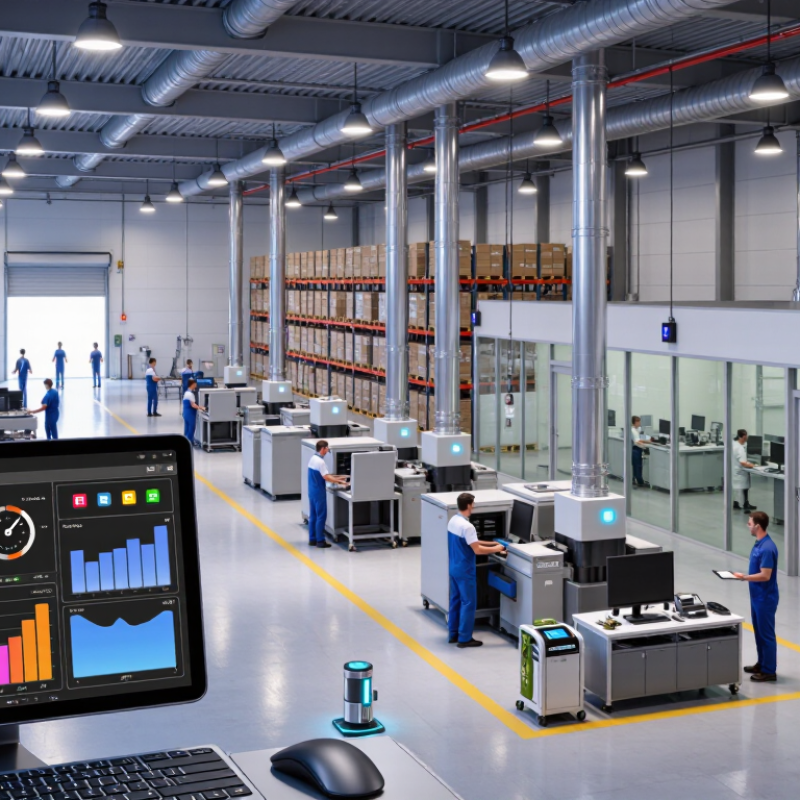
Table of Contents [Hide]
Air Monitoring Defined: PM2.5, PM10, VOCs, CO₂, and Dust
Why Is Air Monitoring Important for Global Buyers?
Air monitoring turns an invisible risk into procurement evidence. For global buyers, key measures include PM2.5, PM10, VOCs, CO₂, and dust. PM2.5 can enter deep lung tissue. PM10 is larger, but still affects the respiratory system. The WHO 2021 Air Quality Guidelines recommend annual limits of 5 µg/m³ for PM2.5 and 15 µg/m³ for PM10. WHO reported 4.2 million premature deaths from ambient air pollution in 2019. That makes sensor data more than a technical detail.
VOCs may come from paints, adhesives, plastics, cleaning products, and stored materials. Some cause irritation; others require compound-specific assessment. Total VOC readings help identify changes, but they cannot identify every hazard. For formaldehyde, WHO’s indoor air quality guidance recommends 0.1 mg/m³ over 30 minutes. CO₂ is different. It mainly indicates ventilation performance, not complete air safety. Dust monitoring adds practical insight. Particles may settle on cartons, filters, and machinery before buyers notice them. One uncomfortable lesson remains: low CO₂ does not prove low VOCs.
Tips: Request time-stamped data, calibration records, and sampling maps. Place monitors near breathing zones, not only near exhaust vents. Compare readings across shifts and seasons. Do not treat one clean afternoon as proof. Sampling choices can quietly distort purchasing decisions.





