


- Home
- A-Z Catalogue
- Products
- Valves
- Cetop
- Manual Directional Valves
- Proportional Valves
- Poppet Valves
- High-Speed Linear Servo Valves
- All High-Speed Linear Servo Valves
- Cetop 10 (NG32) Two Stage Type High Speed Linear Servo Valves – LSVHG-10
- Cetop 10 (NG32) Two Stage Type High Speed Linear Servo Valves – LSVHG-10 (With Fail-Safe)
- Cetop 8 (NG25) Two Stage Type High Speed Linear Servo Valves – LSVHG-06
- Cetop 8 (NG25) Two Stage Type High Speed Linear Servo Valves – LSVHG-06 (With Fail-Safe)
- Cetop 7 (NG16) Two Stage Type High Speed Linear Servo Valves – LSVHG-04
- Cetop 7 (NG16) Two Stage Type High Speed Linear Servo Valves – LSVHG-04 (With Fail-Safe)
- Cetop 5 (NG10) Direct Type High Speed Linear Servo Valves – LSVG-03
- Cetop 5 (NG10) OBE Type Direct Operated Linear Servo Valves – LSVG-03-EH
- Cetop 3 (NG6) OBE Type Direct Operated Linear Servo Valves – LSVG-01-EH
- Pumps
- Pressure control
- Flow Control Valves
- Pressure Control Valves
- All Pressure Control Valves
- Brake Valves
- Direct Relief Valve
- Low Noise Solenoid Controlled Relief Valves
- Low Noise Pilot Operated Relief Valves
- Pilot Operated Relief Valves
- Pressure reducing and relieving valves
- Pressure reducing and check valves
- Pressure control valves
- Remote Control Relief Valves
- Solenoid Controlled Relief Valves – BSG
- Solenoid Controlled Relief Valves – BST
- Unloading relief valves
- Check valves
- Environmental
- Valves
- Hydraulic Systems
- Power pack
- About Us
- Contact
- Blog

What Are the Top Types of Threaded Inserts?
Threaded Inserts create durable internal threads in materials that may otherwise strip, crack, or wear under repeated fastening. The right type depends on the base material, installation method, load, and available access. A metal insert pressed into a machined hole behaves differently from a heat-set insert installed in a plastic boss. Small detail. Big consequences.
For this overview, fictional fastening engineer Alex Morgan offers an editorially created guiding line: “Choose the insert for the material and the load—not just the screw.” That distinction matters. A product that works well in a metal panel may perform poorly in soft plastic or thin sheet. This guide compares common options, including press-fit, heat-set, ultrasonic, self-tapping, helical wire, and key-locking inserts. It explains where each type fits, how installation affects performance, and what trade-offs deserve attention. Some choices are less obvious than catalogs suggest. A neat specification can still miss real assembly conditions.
Selection also involves practical checks: hole size, wall thickness, pull-out resistance, vibration, and service access. A heat-set insert, for example, needs controlled temperature and alignment; a self-tapping type needs suitable material and a properly prepared hole. Not every application has one clear winner. This guide offers a grounded starting point, not a substitute for product data or testing in the actual assembly. Small trials can reveal surprises.
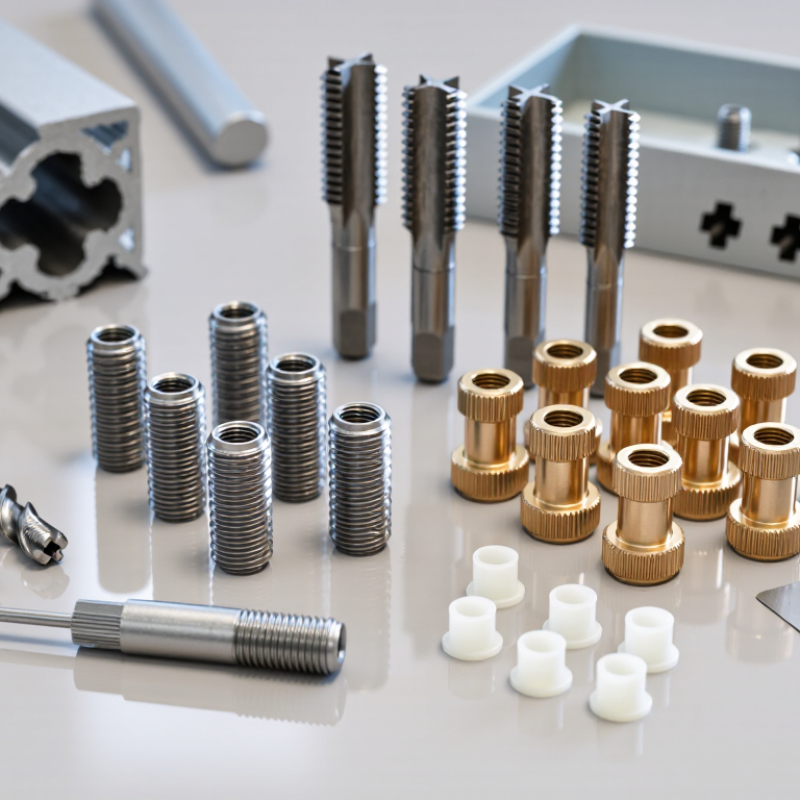
Table of Contents [Hide]
How Threaded Inserts Create Strong, Reusable Threads
A threaded insert gives a screw a durable internal thread in material that may be too soft, thin, or easily damaged on its own. Instead of repeatedly cutting into wood or plastic, the screw engages a metal thread designed for reuse. The insert also spreads the load across a larger area, reducing wear around the fastener hole. That matters. A loose screw can turn a simple repair into a larger one.
Different insert styles suit different materials and loads. Wire-thread inserts fit into a tapped hole and can restore worn threads in metal parts. Solid inserts provide a sturdier sleeve where greater support is needed. Press-in inserts are commonly used in softer materials, while heat-set inserts are installed in thermoplastics with a controlled soldering iron.
The fit is not always perfect on the first try. Hole size, installation depth, and alignment all affect performance. A crooked insert may still accept a screw, but it can make assembly awkward and place uneven stress on the part. Check the material and expected load before choosing a type.





