


- Home
- A-Z Catalogue
- Products
- Valves
- Cetop
- Manual Directional Valves
- Proportional Valves
- Poppet Valves
- High-Speed Linear Servo Valves
- All High-Speed Linear Servo Valves
- Cetop 10 (NG32) Two Stage Type High Speed Linear Servo Valves – LSVHG-10
- Cetop 10 (NG32) Two Stage Type High Speed Linear Servo Valves – LSVHG-10 (With Fail-Safe)
- Cetop 8 (NG25) Two Stage Type High Speed Linear Servo Valves – LSVHG-06
- Cetop 8 (NG25) Two Stage Type High Speed Linear Servo Valves – LSVHG-06 (With Fail-Safe)
- Cetop 7 (NG16) Two Stage Type High Speed Linear Servo Valves – LSVHG-04
- Cetop 7 (NG16) Two Stage Type High Speed Linear Servo Valves – LSVHG-04 (With Fail-Safe)
- Cetop 5 (NG10) Direct Type High Speed Linear Servo Valves – LSVG-03
- Cetop 5 (NG10) OBE Type Direct Operated Linear Servo Valves – LSVG-03-EH
- Cetop 3 (NG6) OBE Type Direct Operated Linear Servo Valves – LSVG-01-EH
- Pumps
- Pressure control
- Flow Control Valves
- Pressure Control Valves
- All Pressure Control Valves
- Brake Valves
- Direct Relief Valve
- Low Noise Solenoid Controlled Relief Valves
- Low Noise Pilot Operated Relief Valves
- Pilot Operated Relief Valves
- Pressure reducing and relieving valves
- Pressure reducing and check valves
- Pressure control valves
- Remote Control Relief Valves
- Solenoid Controlled Relief Valves – BSG
- Solenoid Controlled Relief Valves – BST
- Unloading relief valves
- Check valves
- Environmental
- Valves
- Hydraulic Systems
- Power pack
- About Us
- Contact
- Blog

What Are Zinc Die Cast Parts Used For?
Zinc Die Cast Parts appear in products people handle every day, though they often remain hidden inside the finished item. A compact door lock, a laptop hinge, and a vehicle sensor housing may all rely on zinc components. The process forces molten zinc alloy into a steel die, shaping fine details quickly and consistently. That makes it useful for complex, high-volume parts with thin walls and smooth surfaces. Small parts matter.
Casting researcher John Campbell’s published principles can be paraphrased this way: “Sound castings depend on sound metal and controlled flow.” It is a useful reminder, not a substitute for engineering checks. Alloy choice, die design, cooling, and inspection all affect the result. A part may look clean yet still need testing for strength, fit, or performance under heat and vibration.
This guide explores where Zinc Die Cast Parts are used, from automotive fittings and electrical connectors to appliance controls, furniture hardware, and consumer electronics. It also considers why manufacturers choose zinc, and where its limits matter. Zinc can support detailed shapes and efficient production, but it is not automatically the best material for every application. That point is easy to miss. Real parts face wear, changing temperatures, and assembly tolerances; design choices should reflect those conditions.
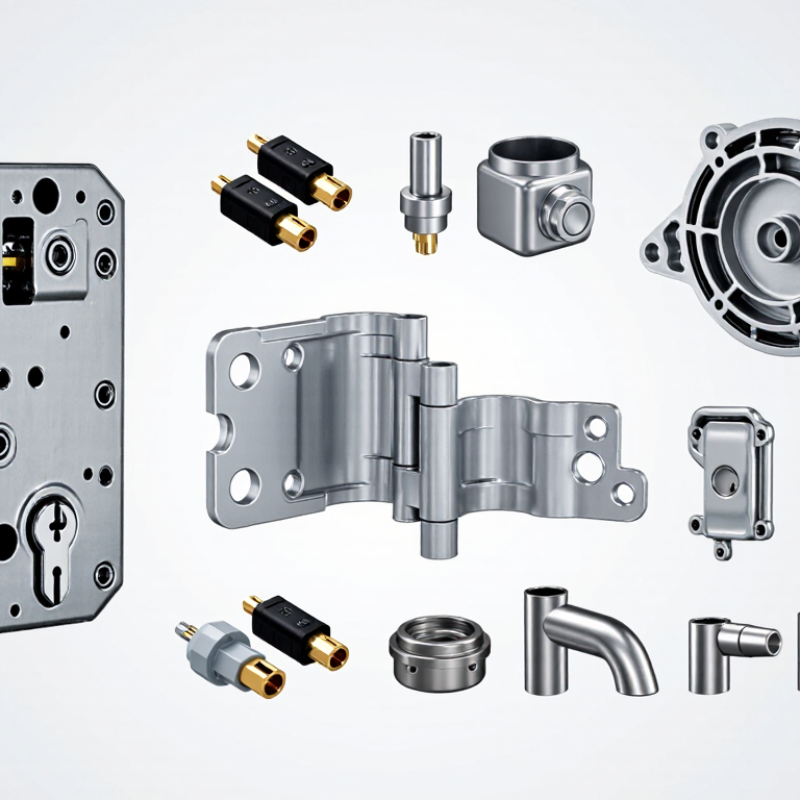
Table of Contents [Hide]
Zinc Die Cast Parts in Automotive Systems
What Are Zinc Die Cast Parts Used For?
Zinc Die Cast Parts in Automotive Systems
In automotive systems, zinc die cast parts often support compact mechanisms that need accurate shapes and repeatable dimensions. Examples include door-lock housings, seat-adjustment components, HVAC control parts, connector shells, and mounting brackets. A carefully formed housing can hold small moving pieces in alignment, even when space behind a door panel is tight. Zinc alloys also accept finishing treatments that help protect surfaces and improve appearance.
These parts are useful, but they do not fit every job. Designers consider load, temperature, vibration, and exposure to moisture before selecting an alloy and finish. A bracket near a hot engine area may need a different material. Thin walls and complex shapes can reduce weight and combine several features in one casting, yet porosity or uneven coating can affect performance. Real production requires inspection, not just a good-looking drawing. Even a small dimensional mismatch can make an assembly feel rough.
Tips: Check critical dimensions, coating coverage, and moving-part fit during evaluation. Ask how the component performs under vibration and temperature changes. A clean sample is helpful, but it may not reveal every production issue.





