- Home
- A-Z Catalogue
- Products
- Valves
- Cetop
- Manual Directional Valves
- Proportional Valves
- Poppet Valves
- High-Speed Linear Servo Valves
- All High-Speed Linear Servo Valves
- Cetop 10 (NG32) Two Stage Type High Speed Linear Servo Valves – LSVHG-10
- Cetop 10 (NG32) Two Stage Type High Speed Linear Servo Valves – LSVHG-10 (With Fail-Safe)
- Cetop 8 (NG25) Two Stage Type High Speed Linear Servo Valves – LSVHG-06
- Cetop 8 (NG25) Two Stage Type High Speed Linear Servo Valves – LSVHG-06 (With Fail-Safe)
- Cetop 7 (NG16) Two Stage Type High Speed Linear Servo Valves – LSVHG-04
- Cetop 7 (NG16) Two Stage Type High Speed Linear Servo Valves – LSVHG-04 (With Fail-Safe)
- Cetop 5 (NG10) Direct Type High Speed Linear Servo Valves – LSVG-03
- Cetop 5 (NG10) OBE Type Direct Operated Linear Servo Valves – LSVG-03-EH
- Cetop 3 (NG6) OBE Type Direct Operated Linear Servo Valves – LSVG-01-EH
- Pumps
- Pressure control
- Flow Control Valves
- Pressure Control Valves
- All Pressure Control Valves
- Brake Valves
- Direct Relief Valve
- Low Noise Solenoid Controlled Relief Valves
- Low Noise Pilot Operated Relief Valves
- Pilot Operated Relief Valves
- Pressure reducing and relieving valves
- Pressure reducing and check valves
- Pressure control valves
- Remote Control Relief Valves
- Solenoid Controlled Relief Valves – BSG
- Solenoid Controlled Relief Valves – BST
- Unloading relief valves
- Check valves
- Environmental
- Valves
- Hydraulic Systems
- Power pack
- About Us
- Contact
- Blog

What Are the Top Types of ZWX Gear Motors?
Choosing a ZWX Gear Motor starts with the job it must perform, not merely its size or price. A conveyor moving steadily through a workshop has different needs from a compact actuator that starts and stops repeatedly. Load, output speed, available space, noise, and operating hours all affect the best choice. Small details matter. A few extra millimeters can complicate installation, while an unsuitable gear ratio can leave a motor struggling under load.
This guide compares common ZWX gear motor types, including spur, helical, worm, bevel, and planetary designs. Each has trade-offs in efficiency, torque, footprint, and motion. A worm unit may suit a compact, right-angle layout; a planetary model may fit applications needing high torque in limited space. These are starting points, not universal rules. Actual performance depends on the model, rating, and working conditions.
A named expert quotation should not be invented or presented as verified without a reliable source. As an original editorial principle, fictional ZWX application specialist Ethan Cole might say: “Match the gearbox to the real load, duty cycle, and installation space—not just the headline torque.” This is an illustrative line, not a sourced interview. Use the comparisons ahead to narrow your options, then confirm specifications with current manufacturer documentation. Real-world selection can be messier than a chart suggests. That is worth acknowledging.
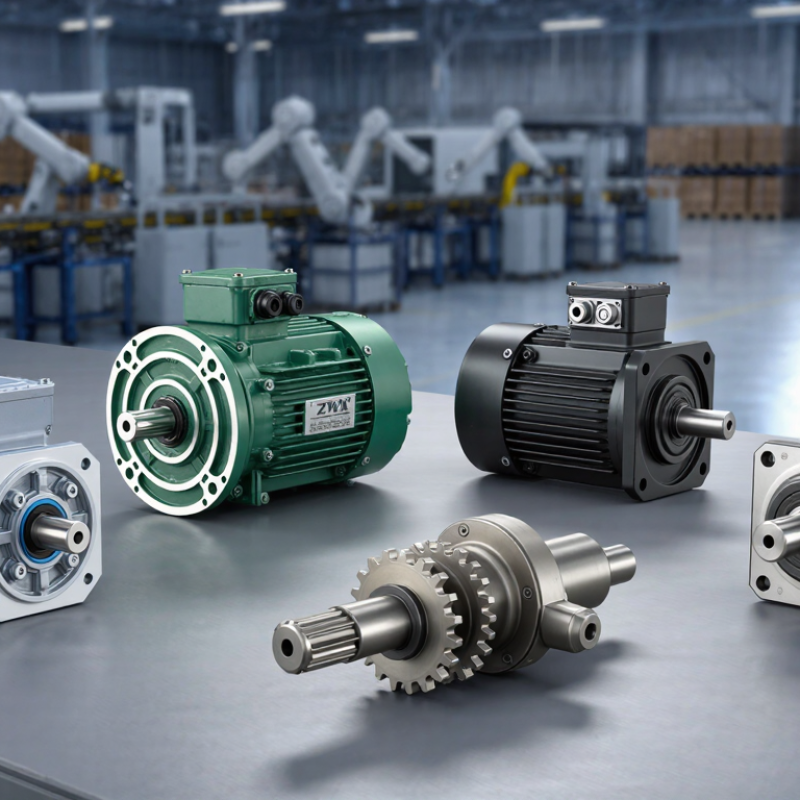
Table of Contents [Hide]
How ZWX Gear Motors Are Classified by Gear Design
ZWX gear motors are commonly classified by the gears that transfer torque inside the housing. Spur gear motors use straight teeth on parallel shafts. They are straightforward to inspect and can deliver efficient power in compact assemblies. Their trade-off is audible gear noise, especially at higher speeds.
Helical gear motors use angled teeth that engage gradually. This usually makes operation smoother and quieter than with spur gears, though axial forces need suitable bearing support. Worm gear motors pair a screw-shaped worm with a toothed wheel, often turning a drive through a right angle. They can provide substantial reduction in a small space. Heat and efficiency deserve attention during continuous operation. Quiet, but not silent.
Planetary gear motors place several small planet gears around a central sun gear. Their balanced load sharing allows high torque in a compact package, useful in robotics and positioning equipment. Bevel gear motors change the direction of rotation between intersecting shafts, often at a right angle. The best design depends on speed, load, noise limits, and available space. Those labels help, but actual performance also depends on materials, lubrication, and build quality; I would not choose from gear type alone.