


- Home
- A-Z Catalogue
- Products
- Valves
- Cetop
- Manual Directional Valves
- Proportional Valves
- Poppet Valves
- High-Speed Linear Servo Valves
- All High-Speed Linear Servo Valves
- Cetop 10 (NG32) Two Stage Type High Speed Linear Servo Valves – LSVHG-10
- Cetop 10 (NG32) Two Stage Type High Speed Linear Servo Valves – LSVHG-10 (With Fail-Safe)
- Cetop 8 (NG25) Two Stage Type High Speed Linear Servo Valves – LSVHG-06
- Cetop 8 (NG25) Two Stage Type High Speed Linear Servo Valves – LSVHG-06 (With Fail-Safe)
- Cetop 7 (NG16) Two Stage Type High Speed Linear Servo Valves – LSVHG-04
- Cetop 7 (NG16) Two Stage Type High Speed Linear Servo Valves – LSVHG-04 (With Fail-Safe)
- Cetop 5 (NG10) Direct Type High Speed Linear Servo Valves – LSVG-03
- Cetop 5 (NG10) OBE Type Direct Operated Linear Servo Valves – LSVG-03-EH
- Cetop 3 (NG6) OBE Type Direct Operated Linear Servo Valves – LSVG-01-EH
- Pumps
- Pressure control
- Flow Control Valves
- Pressure Control Valves
- All Pressure Control Valves
- Brake Valves
- Direct Relief Valve
- Low Noise Solenoid Controlled Relief Valves
- Low Noise Pilot Operated Relief Valves
- Pilot Operated Relief Valves
- Pressure reducing and relieving valves
- Pressure reducing and check valves
- Pressure control valves
- Remote Control Relief Valves
- Solenoid Controlled Relief Valves – BSG
- Solenoid Controlled Relief Valves – BST
- Unloading relief valves
- Check valves
- Environmental
- Valves
- Hydraulic Systems
- Power pack
- About Us
- Contact
- Blog

What Are the Top Types of Electronic Pouring Sealants?
Electronic assemblies often face moisture, vibration, dust, and temperature changes. Electronic Pouring Sealants protect circuit boards and components by filling gaps and creating a stable barrier. The right formulation depends on the device, its operating environment, and repair requirements. A sealant suitable for a sensor may not work well in a power module.
Several material families appear in practical designs. Epoxy compounds provide strong adhesion and rigid protection, especially where mechanical stability matters. Silicone compounds remain flexible across temperature changes and can reduce stress around delicate parts. Polyurethane options balance flexibility and toughness, though moisture control during processing deserves attention. Some products also offer thermal conductivity or UV curing for specialized production needs. Details matter.
This guide compares these main types by performance, processing, and typical applications. It also considers viscosity, cure time, heat transfer, electrical insulation, and compatibility with plastics or metals. Check technical data sheets, then test shortlisted materials on representative assemblies. Small batches can reveal trapped air, poor wetting, or unexpected component stress before full production. No single chemistry suits every application. That is easy to overlook. Selection should reflect measured conditions, not broad product claims. Component geometry, dispensing equipment, and operating temperatures can all change the result. When failure would be costly, a qualified materials engineer can help confirm suitability.
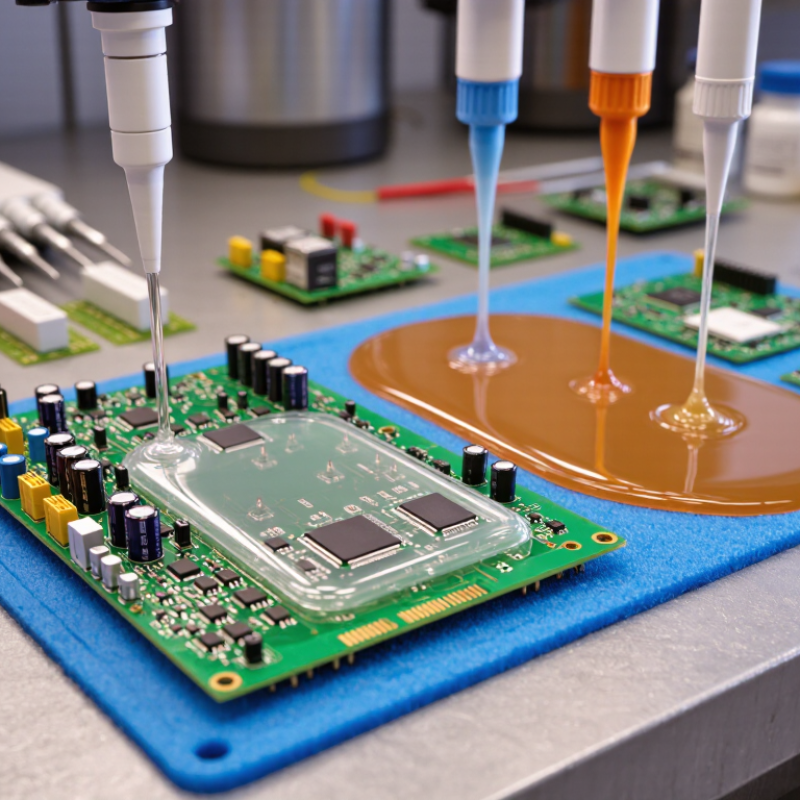
Table of Contents [Hide]
How Electronic Potting Sealants Protect Components
Electronic potting sealants protect components by surrounding them with a solid or flexible barrier. The cured material helps limit moisture, dust, vibration, and accidental contact with conductive debris. Inside a compact sensor, it can fill the narrow space between a circuit board and its enclosure. Small gaps matter. A poorly filled corner may still become a path for moisture.
The right chemistry depends on the component and its operating conditions. Epoxy often offers firm support, while silicone can accommodate movement and temperature changes. Polyurethane may provide a balance of flexibility and protection. None is automatically best. A rigid fill can stress solder joints when materials expand at different rates, and excess heat during curing may harm sensitive parts. NASA’s ASTM E595 screening criteria use limits of 1.0% total mass loss and 0.10% collected volatile condensable material for spacecraft materials. These figures are useful when low-outgassing performance matters, but they are not universal requirements for commercial electronics. Test the complete assembly, not just a resin sample. Check cure depth, adhesion, thermal cycling, and repair needs; a sealant that protects well may also make later rework difficult.





