


- Home
- A-Z Catalogue
- Products
- Valves
- Cetop
- Manual Directional Valves
- Proportional Valves
- Poppet Valves
- High-Speed Linear Servo Valves
- All High-Speed Linear Servo Valves
- Cetop 10 (NG32) Two Stage Type High Speed Linear Servo Valves – LSVHG-10
- Cetop 10 (NG32) Two Stage Type High Speed Linear Servo Valves – LSVHG-10 (With Fail-Safe)
- Cetop 8 (NG25) Two Stage Type High Speed Linear Servo Valves – LSVHG-06
- Cetop 8 (NG25) Two Stage Type High Speed Linear Servo Valves – LSVHG-06 (With Fail-Safe)
- Cetop 7 (NG16) Two Stage Type High Speed Linear Servo Valves – LSVHG-04
- Cetop 7 (NG16) Two Stage Type High Speed Linear Servo Valves – LSVHG-04 (With Fail-Safe)
- Cetop 5 (NG10) Direct Type High Speed Linear Servo Valves – LSVG-03
- Cetop 5 (NG10) OBE Type Direct Operated Linear Servo Valves – LSVG-03-EH
- Cetop 3 (NG6) OBE Type Direct Operated Linear Servo Valves – LSVG-01-EH
- Pumps
- Pressure control
- Flow Control Valves
- Pressure Control Valves
- All Pressure Control Valves
- Brake Valves
- Direct Relief Valve
- Low Noise Solenoid Controlled Relief Valves
- Low Noise Pilot Operated Relief Valves
- Pilot Operated Relief Valves
- Pressure reducing and relieving valves
- Pressure reducing and check valves
- Pressure control valves
- Remote Control Relief Valves
- Solenoid Controlled Relief Valves – BSG
- Solenoid Controlled Relief Valves – BST
- Unloading relief valves
- Check valves
- Environmental
- Valves
- Hydraulic Systems
- Power pack
- About Us
- Contact
- Blog

What Are the Top Toothbrush Mold Types for Buyers in 2026?
Choosing a toothbrush mold in 2026 means balancing output, product design, and manufacturing cost. Buyers may compare single-cavity and multi-cavity molds, family molds, and hot-runner or cold-runner systems. Each option suits different production needs. A small factory testing a new handle shape may value lower upfront costs, while a high-volume producer may prioritize shorter cycles and consistent parts. Small details matter.
The right choice depends on more than cavity count. Consider the toothbrush’s handle geometry, material, surface finish, expected order volume, and available molding equipment. Ask suppliers about steel grade, mold-life estimates, cooling layout, maintenance access, and quality checks. Request sample parts where possible. A smooth handle can still hide uneven wall thickness or warping, so inspect fit and finish closely. Real production conditions can differ from a polished sample.
This guide reviews common toothbrush mold types and explains the trade-offs buyers should weigh before requesting quotes. It also highlights questions that help compare suppliers on practical evidence, not promises alone. No mold is ideal for every project. Even a detailed specification may need revision after the first trial; that is worth acknowledging early. With clear requirements and a careful review process, buyers can narrow their options and make a more informed decision for 2026.
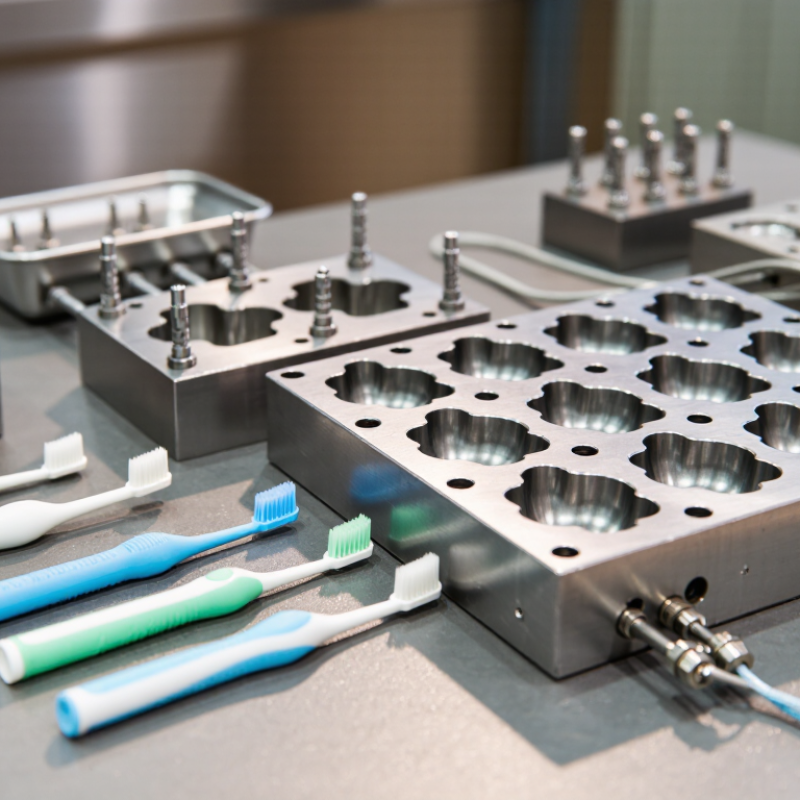
Table of Contents [Hide]
What Is a Toothbrush Mold and How Does It Work?
A toothbrush mold is a precision tool that shapes the plastic handle and head. It contains two main sections: a cavity and a core. Together, they form the toothbrush’s outer shape. In injection molding, plastic pellets are heated until molten, then pushed into the closed mold under pressure. Cooling channels help the plastic set. Ejector pins release the finished part. Small details matter: a raised grip pattern or thin neck can affect filling, cooling, and strength.
Many toothbrush handles use multi-cavity molds, which make several parts in one production cycle. The number of cavities depends on the design, machine capacity, and required output. Brush bristles are usually added through a separate tufting process, not formed by the handle mold. That distinction is easy to miss. Grand View Research estimated the global toothbrush market at about USD 7.28 billion in 2023; this is a product-market figure, not a mold-market estimate.
For buyers, mold quality shows up in consistent dimensions, clean edges, and stable production. ISO 20126:2022 sets requirements and test methods for manual toothbrushes, offering useful context for evaluating finished products. It does not prescribe one mold design. A smooth cavity surface can improve appearance, but it cannot fix poor material flow or an uneven cooling layout. Even experienced teams may need trial runs. Real parts can reveal issues that drawings miss.





