


- Home
- A-Z Catalogue
- Products
- Valves
- Cetop
- Manual Directional Valves
- Proportional Valves
- Poppet Valves
- High-Speed Linear Servo Valves
- All High-Speed Linear Servo Valves
- Cetop 10 (NG32) Two Stage Type High Speed Linear Servo Valves – LSVHG-10
- Cetop 10 (NG32) Two Stage Type High Speed Linear Servo Valves – LSVHG-10 (With Fail-Safe)
- Cetop 8 (NG25) Two Stage Type High Speed Linear Servo Valves – LSVHG-06
- Cetop 8 (NG25) Two Stage Type High Speed Linear Servo Valves – LSVHG-06 (With Fail-Safe)
- Cetop 7 (NG16) Two Stage Type High Speed Linear Servo Valves – LSVHG-04
- Cetop 7 (NG16) Two Stage Type High Speed Linear Servo Valves – LSVHG-04 (With Fail-Safe)
- Cetop 5 (NG10) Direct Type High Speed Linear Servo Valves – LSVG-03
- Cetop 5 (NG10) OBE Type Direct Operated Linear Servo Valves – LSVG-03-EH
- Cetop 3 (NG6) OBE Type Direct Operated Linear Servo Valves – LSVG-01-EH
- Pumps
- Pressure control
- Flow Control Valves
- Pressure Control Valves
- All Pressure Control Valves
- Brake Valves
- Direct Relief Valve
- Low Noise Solenoid Controlled Relief Valves
- Low Noise Pilot Operated Relief Valves
- Pilot Operated Relief Valves
- Pressure reducing and relieving valves
- Pressure reducing and check valves
- Pressure control valves
- Remote Control Relief Valves
- Solenoid Controlled Relief Valves – BSG
- Solenoid Controlled Relief Valves – BST
- Unloading relief valves
- Check valves
- Environmental
- Valves
- Hydraulic Systems
- Power pack
- About Us
- Contact
- Blog

China Top Toasted Garlic Suppliers for Global Buyers?
China has become a central sourcing base for global buyers seeking consistent Toasted Garlic. FAOSTAT production data shows China contributes roughly three-quarters of worldwide garlic output in recent years. This scale supports broad raw-material access, competitive processing capacity, and varied export formats.
However, volume alone does not guarantee dependable supply. USDA Foreign Agricultural Service trade data highlights China’s strong role in global agricultural exports, while industry reports from Grand View Research and Mordor Intelligence identify growing demand for processed garlic, convenience ingredients, and longer-shelf-life seasonings. Buyers should examine roasting control, moisture levels, particle size, packaging barriers, microbiological testing, and lot traceability. A golden, crisp granule should not become soft inside the carton.
Food writer and science communicator Harold McGee explains, “Garlic’s characteristic flavor comes from sulfur compounds.” That chemistry matters during roasting. Excessive heat can create bitterness, dark edges, and a flat aroma. Controlled roasting can produce deeper sweetness and a more rounded savory note.
The best Chinese suppliers usually demonstrate more than factory scale. They provide clear specifications, retained samples, audit records, and responsive communication. Some claims still require careful checking. “Natural” does not always mean minimally processed. “Premium” needs measurable proof.
This guide introduces China’s leading Toasted Garlic suppliers for global buyers. It focuses on practical sourcing evidence, product consistency, documentation, and realistic quality expectations. Experiences can differ between batches, seasons, and facilities. That uncertainty deserves attention.
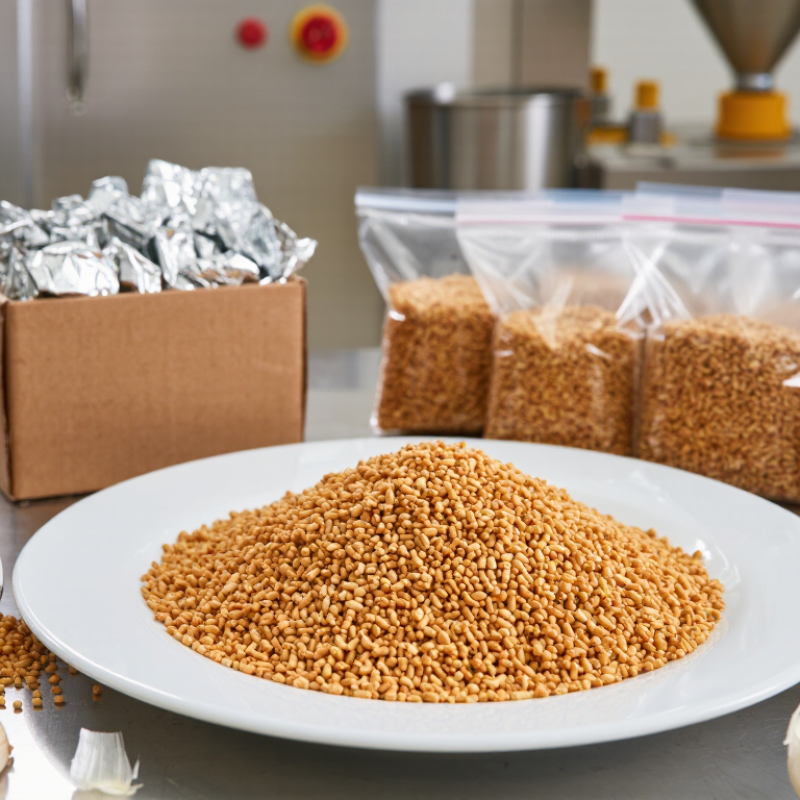
Table of Contents [Hide]
What Toasted Garlic Is and Why Global Buyers Choose China
Toasted garlic is fresh garlic that has been gently heated until its moisture decreases and its flavor becomes deeper. The result is crisp, golden, and slightly sweet, with a roasted aroma. It is commonly used in noodles, sauces, soups, seasonings, and snack coatings. Unlike raw garlic, toasted garlic offers a softer bite and a more rounded taste. It smells warm.
Global buyers often choose China because its garlic processing supply chain is extensive and adaptable. Growing regions provide steady raw material, while established facilities support peeling, slicing, toasting, screening, and packing. Experienced suppliers can adjust particle size, toast level, moisture, and packaging for different applications. This flexibility helps food manufacturers manage both recipe consistency and production costs. In practical sourcing, these details matter more than a low quotation.
Reliable purchasing still requires careful verification. Buyers should review processing records, food safety systems, allergen controls, moisture testing, and batch samples before placing larger orders. Traceability from farm or storage site to finished product is equally important. Not every batch performs identically. Garlic age, variety, storage conditions, and heating time can change color and aroma. I would also compare samples after several weeks, because crispness may weaken during storage. China can offer strong value, but dependable results come from clear specifications, honest communication, and repeated quality checks.





