


- Home
- A-Z Catalogue
- Products
- Valves
- Cetop
- Manual Directional Valves
- Proportional Valves
- Poppet Valves
- High-Speed Linear Servo Valves
- All High-Speed Linear Servo Valves
- Cetop 10 (NG32) Two Stage Type High Speed Linear Servo Valves – LSVHG-10
- Cetop 10 (NG32) Two Stage Type High Speed Linear Servo Valves – LSVHG-10 (With Fail-Safe)
- Cetop 8 (NG25) Two Stage Type High Speed Linear Servo Valves – LSVHG-06
- Cetop 8 (NG25) Two Stage Type High Speed Linear Servo Valves – LSVHG-06 (With Fail-Safe)
- Cetop 7 (NG16) Two Stage Type High Speed Linear Servo Valves – LSVHG-04
- Cetop 7 (NG16) Two Stage Type High Speed Linear Servo Valves – LSVHG-04 (With Fail-Safe)
- Cetop 5 (NG10) Direct Type High Speed Linear Servo Valves – LSVG-03
- Cetop 5 (NG10) OBE Type Direct Operated Linear Servo Valves – LSVG-03-EH
- Cetop 3 (NG6) OBE Type Direct Operated Linear Servo Valves – LSVG-01-EH
- Pumps
- Pressure control
- Flow Control Valves
- Pressure Control Valves
- All Pressure Control Valves
- Brake Valves
- Direct Relief Valve
- Low Noise Solenoid Controlled Relief Valves
- Low Noise Pilot Operated Relief Valves
- Pilot Operated Relief Valves
- Pressure reducing and relieving valves
- Pressure reducing and check valves
- Pressure control valves
- Remote Control Relief Valves
- Solenoid Controlled Relief Valves – BSG
- Solenoid Controlled Relief Valves – BST
- Unloading relief valves
- Check valves
- Environmental
- Valves
- Hydraulic Systems
- Power pack
- About Us
- Contact
- Blog

7 Best Threaded Linear Shaft Suppliers Worldwide?
Choosing among the 7 Best Threaded Linear Shaft Suppliers Worldwide requires more than comparing catalog prices. A Threaded Linear Shaft must tolerate load, rotation, contamination, and repeated positioning without excessive backlash. In real workshops, a poorly matched shaft can create vibration, uneven travel, and premature nut wear. Small dimensional errors become visible when a carriage moves only a few millimeters.
Industry reports support this demand. MarketsandMarkets’ Linear Motion Market analysis identifies factory automation, robotics, and material-handling equipment as major growth drivers. Grand View Research also links industrial automation expansion with rising demand for precision motion components. These reports indicate a healthy market, but they do not prove that every supplier offers equal quality. That distinction matters.
Alexander Slocum, an MIT authority in precision engineering, states, “The machine tool is a system.” His principle applies directly here. Shaft material, thread profile, straightness, surface finish, lubrication, and nut design must work together. A supplier with impressive tolerances may still disappoint if packaging or technical support is weak. That is often overlooked.
This guide examines global suppliers through practical criteria: manufacturing consistency, material traceability, custom sizing, delivery capability, and application support. It considers stainless steel and hardened steel options, including shafts used in dusty production lines and compact laboratory equipment. No ranking is perfect. Buyer requirements differ. Still, a careful comparison can reduce costly trial and error.
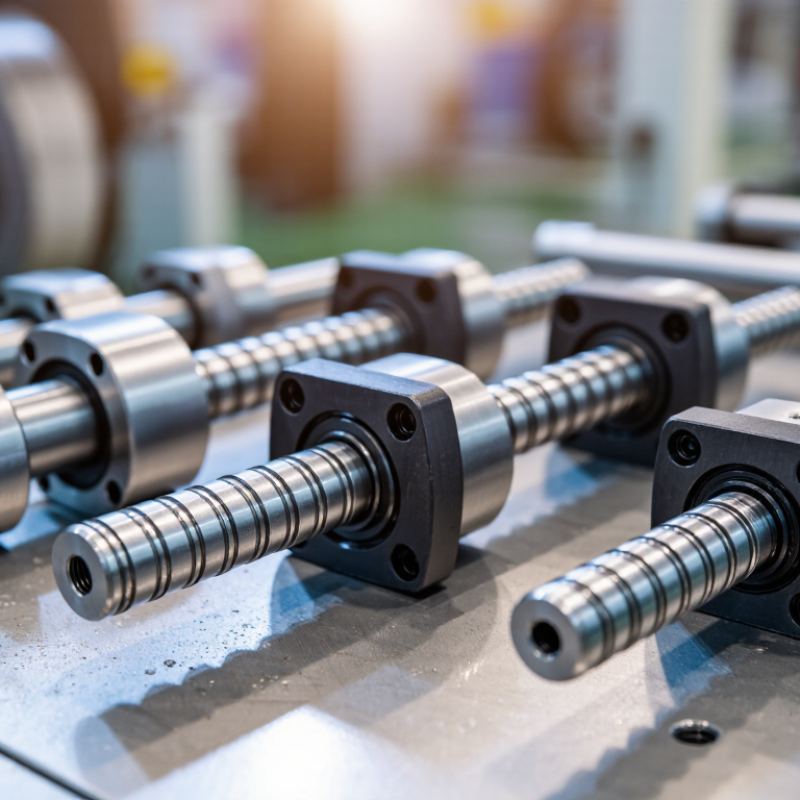
Table of Contents [Hide]
What Are Threaded Linear Shafts and How Do They Work?
Threaded linear shafts combine a precision shaft with external threads, allowing controlled linear movement. Unlike smooth shafts, they can transmit motion while guiding a load. A matching nut travels along the threaded surface when the shaft rotates. The connected platform then moves forward or backward.
The mechanism is simple. Alignment is not.
For example, a motor turns the shaft through a coupling. The nut cannot rotate freely, so it advances along the thread. Thread pitch determines travel distance per revolution. A fine pitch improves positioning, while a coarse pitch can move loads faster. Lubrication, preload, and surface hardness also affect service life.
In practical equipment, I check shaft straightness before installation. Even a slight bend can create vibration, noise, and uneven wear. I also inspect thread form, diameter tolerance, and end machining. These details matter when comparing worldwide suppliers. A polished surface alone does not prove accuracy.
One overlooked issue is contamination. Dust can enter the nut and damage the contact surfaces. Protective covers and suitable seals often prevent premature failure. Heat can matter too. Continuous rotation may expand the shaft and change positioning accuracy. I once treated thermal growth as negligible; that assumption needed correction.
Reliable suppliers should provide material certificates, dimensional reports, load data, and clear inspection standards. Sample testing remains wise, especially for custom lengths or unusual thread profiles. A drawing may look correct, yet the assembled shaft can reveal stiffness or alignment problems. That is why engineering review should include the actual operating speed, load direction, duty cycle, and installation environment.





