


- Home
- A-Z Catalogue
- Products
- Valves
- Cetop
- Manual Directional Valves
- Proportional Valves
- Poppet Valves
- High-Speed Linear Servo Valves
- All High-Speed Linear Servo Valves
- Cetop 10 (NG32) Two Stage Type High Speed Linear Servo Valves – LSVHG-10
- Cetop 10 (NG32) Two Stage Type High Speed Linear Servo Valves – LSVHG-10 (With Fail-Safe)
- Cetop 8 (NG25) Two Stage Type High Speed Linear Servo Valves – LSVHG-06
- Cetop 8 (NG25) Two Stage Type High Speed Linear Servo Valves – LSVHG-06 (With Fail-Safe)
- Cetop 7 (NG16) Two Stage Type High Speed Linear Servo Valves – LSVHG-04
- Cetop 7 (NG16) Two Stage Type High Speed Linear Servo Valves – LSVHG-04 (With Fail-Safe)
- Cetop 5 (NG10) Direct Type High Speed Linear Servo Valves – LSVG-03
- Cetop 5 (NG10) OBE Type Direct Operated Linear Servo Valves – LSVG-03-EH
- Cetop 3 (NG6) OBE Type Direct Operated Linear Servo Valves – LSVG-01-EH
- Pumps
- Pressure control
- Flow Control Valves
- Pressure Control Valves
- All Pressure Control Valves
- Brake Valves
- Direct Relief Valve
- Low Noise Solenoid Controlled Relief Valves
- Low Noise Pilot Operated Relief Valves
- Pilot Operated Relief Valves
- Pressure reducing and relieving valves
- Pressure reducing and check valves
- Pressure control valves
- Remote Control Relief Valves
- Solenoid Controlled Relief Valves – BSG
- Solenoid Controlled Relief Valves – BST
- Unloading relief valves
- Check valves
- Environmental
- Valves
- Hydraulic Systems
- Power pack
- About Us
- Contact
- Blog

Top Steel Wire Rod Manufacturers Worldwide?
Choosing the top Steel Wire Rod Manufacturers worldwide requires more than comparing production volumes. Buyers must examine quality consistency, delivery performance, technical support, and regional certifications. A reliable Steel Wire Rod Manufacturer should provide stable chemistry, accurate coil dimensions, and traceable mill-test certificates. These details matter when rod becomes tire cord, welding wire, fasteners, or high-strength cable.
The market operates within a much larger steel ecosystem. The World Steel Association reported approximately 1.88 billion tonnes of global crude steel production in 2024. China remained the largest producer, contributing more than half of worldwide output. However, crude steel capacity does not automatically prove wire rod expertise. The OECD’s latest steel-market analysis also highlights persistent overcapacity concerns and uneven demand recovery. That makes supplier evaluation more complicated. Bigger is not always better.
Practical evidence should guide the ranking. Industry buyers can compare product ranges, drawing performance, surface quality, low-carbon grades, and shipment records. CRU market assessments are useful for reviewing regional pricing and capacity trends. World Steel Association statistics provide essential production context. Yet published figures have limits. Company disclosures may differ in scope, and some data remain difficult to verify. A thoughtful comparison should admit that weakness.
A strong manufacturer leaves evidence behind. Think of clean coils, readable heat numbers, and packaging that survives a long sea voyage. Factory audits, laboratory testing, and customer references add confidence. The following overview assesses leading producers through these measurable signals, while recognizing that rankings can change with technology, trade flows, and demand.
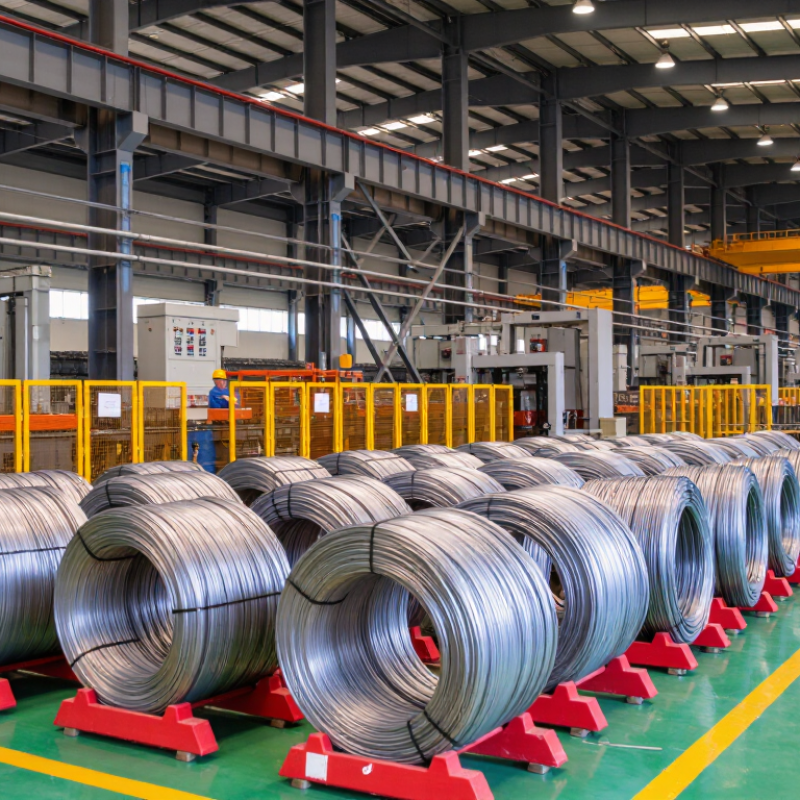
Table of Contents [Hide]
Steel Wire Rod: Definition, Grades, and Global Applications
Top Steel Wire Rod Manufacturers Worldwide?
Steel wire rod is a hot-rolled, semi-finished steel product supplied in coils. Its circular section commonly ranges from about 5.5 to 16 millimeters. Manufacturers produce it from continuously cast billets, then control rolling temperature, cooling rate, and surface quality. These steps affect drawing performance.
Grades differ by chemistry and intended use. Low-carbon rod supports nails, mesh, basic fasteners, and general-purpose wire. Medium- and high-carbon grades suit springs, tire cord, prestressed concrete wire, and demanding mechanical products. Alloy and stainless grades provide improved strength, corrosion resistance, or heat performance. They cost more.
Quality begins with more than a test certificate. Buyers should review carbon variation, sulfur, phosphorus, tensile strength, decarburization, scale condition, and coil consistency. Recognized standards may include ASTM, EN, or JIS requirements, but local specifications still matter. A neat product sheet is not proof of stable production. Independent testing and sample drawing trials remain useful. In practice, even experienced engineers can underestimate packaging, transport moisture, or inconsistent coil weights. Those details can interrupt a high-speed drawing line. Global manufacturers are often judged by traceability, process control, delivery reliability, and technical support. Yet the best choice depends on the final application, not reputation alone.





