


- Home
- A-Z Catalogue
- Products
- Valves
- Cetop
- Manual Directional Valves
- Proportional Valves
- Poppet Valves
- High-Speed Linear Servo Valves
- All High-Speed Linear Servo Valves
- Cetop 10 (NG32) Two Stage Type High Speed Linear Servo Valves – LSVHG-10
- Cetop 10 (NG32) Two Stage Type High Speed Linear Servo Valves – LSVHG-10 (With Fail-Safe)
- Cetop 8 (NG25) Two Stage Type High Speed Linear Servo Valves – LSVHG-06
- Cetop 8 (NG25) Two Stage Type High Speed Linear Servo Valves – LSVHG-06 (With Fail-Safe)
- Cetop 7 (NG16) Two Stage Type High Speed Linear Servo Valves – LSVHG-04
- Cetop 7 (NG16) Two Stage Type High Speed Linear Servo Valves – LSVHG-04 (With Fail-Safe)
- Cetop 5 (NG10) Direct Type High Speed Linear Servo Valves – LSVG-03
- Cetop 5 (NG10) OBE Type Direct Operated Linear Servo Valves – LSVG-03-EH
- Cetop 3 (NG6) OBE Type Direct Operated Linear Servo Valves – LSVG-01-EH
- Pumps
- Pressure control
- Flow Control Valves
- Pressure Control Valves
- All Pressure Control Valves
- Brake Valves
- Direct Relief Valve
- Low Noise Solenoid Controlled Relief Valves
- Low Noise Pilot Operated Relief Valves
- Pilot Operated Relief Valves
- Pressure reducing and relieving valves
- Pressure reducing and check valves
- Pressure control valves
- Remote Control Relief Valves
- Solenoid Controlled Relief Valves – BSG
- Solenoid Controlled Relief Valves – BST
- Unloading relief valves
- Check valves
- Environmental
- Valves
- Hydraulic Systems
- Power pack
- About Us
- Contact
- Blog

2026 Top Seawater Desalination Membrane Types?
As water stress intensifies, the 2026 desalination market is moving beyond one-size-fits-all solutions. This article examines the leading Seawater Desalination Membrane types shaping new plant designs. Reverse osmosis remains the commercial benchmark. Its thin-film composite layers can produce fresh water under high pressure. However, performance depends on more than salt rejection. Operators must also manage fouling, boron passage, pressure loss, cleaning frequency, and membrane replacement.
Professor Menachem Elimelech, a widely recognized desalination researcher, offers a useful warning: “Desalination is not a silver bullet.” That sentence deserves attention. A membrane may reject dissolved salts effectively, yet still perform poorly when algae, suspended solids, or oil reach the feed channel. A real intake line is rarely as clean as a laboratory sample. Small design choices matter. Pretreatment quality, energy recovery, brine handling, and local electricity sources can change the environmental result.
The 2026 discussion will therefore compare several membrane pathways. These include advanced reverse osmosis, nanocomposite membranes, forward osmosis, membrane distillation, and hybrid systems. Each type presents a different balance of energy demand, durability, selectivity, and scale-up readiness. Reverse osmosis leads today, while emerging membranes attract attention through lower pressure potential or improved fouling resistance. Still, laboratory results can look better than full-scale operation. That gap remains difficult. This overview uses engineering evidence, operating experience, and current industry direction to identify which Seawater Desalination Membrane technologies appear practical, promising, or not yet ready for broad deployment.
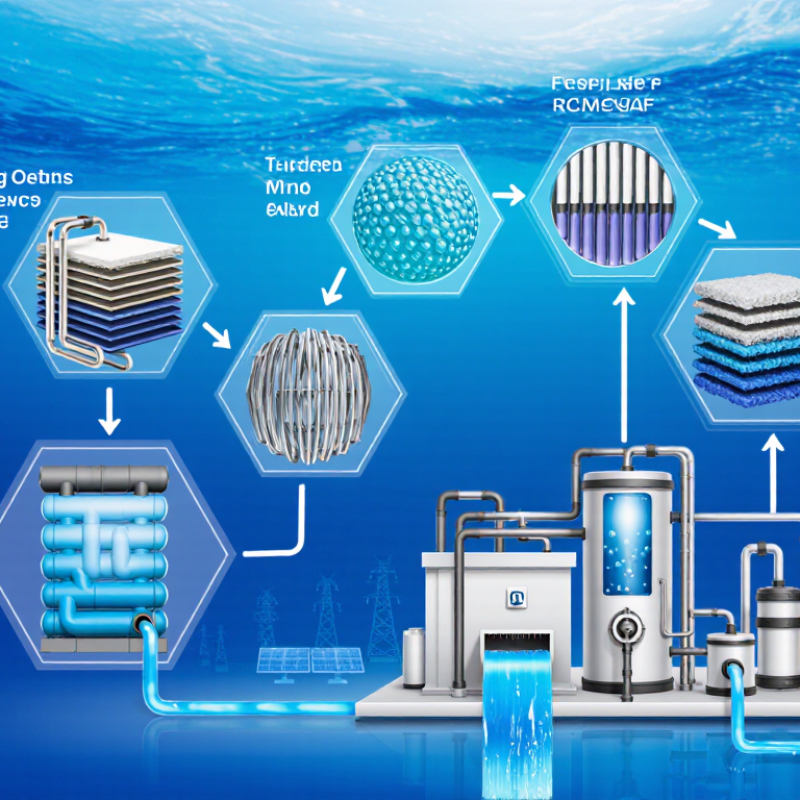
Table of Contents [Hide]
What Seawater Desalination Membranes Are and How They Work
Seawater desalination membranes act as selective barriers. They allow water molecules to pass while slowing dissolved salts, minerals, and many contaminants. A typical seawater feed contains about 35,000 milligrams of salt per liter. That is a demanding environment.
Reverse osmosis remains the leading membrane type for large desalination plants in 2026. High-pressure pumps push seawater against a dense membrane surface, often at 55–70 bar. Water crosses through microscopic free volume inside the membrane. Most salts stay behind in the concentrated brine stream. The purified flow is called permeate. Membrane fouling still causes trouble. Algae, oil, and fine particles can block the surface, so careful pretreatment matters.
Ultrafiltration and microfiltration usually protect the main process rather than remove dissolved salt. Their larger pores can capture suspended solids, bacteria, and colloidal particles before reverse osmosis. Nanofiltration uses a tighter structure and can reduce hardness, sulfate, and some organic compounds at lower pressure. It may support seawater treatment, but it rarely replaces reverse osmosis for full salt removal. Forward osmosis is also being studied. It draws water through a membrane using a concentrated solution, but recovering that solution adds complexity. Membrane selection is not purely technical. Feed quality, cleaning frequency, energy use, and local discharge limits can change the better choice. No membrane performs perfectly. Even small design assumptions deserve testing.