


- Home
- A-Z Catalogue
- Products
- Valves
- Cetop
- Manual Directional Valves
- Proportional Valves
- Poppet Valves
- High-Speed Linear Servo Valves
- All High-Speed Linear Servo Valves
- Cetop 10 (NG32) Two Stage Type High Speed Linear Servo Valves – LSVHG-10
- Cetop 10 (NG32) Two Stage Type High Speed Linear Servo Valves – LSVHG-10 (With Fail-Safe)
- Cetop 8 (NG25) Two Stage Type High Speed Linear Servo Valves – LSVHG-06
- Cetop 8 (NG25) Two Stage Type High Speed Linear Servo Valves – LSVHG-06 (With Fail-Safe)
- Cetop 7 (NG16) Two Stage Type High Speed Linear Servo Valves – LSVHG-04
- Cetop 7 (NG16) Two Stage Type High Speed Linear Servo Valves – LSVHG-04 (With Fail-Safe)
- Cetop 5 (NG10) Direct Type High Speed Linear Servo Valves – LSVG-03
- Cetop 5 (NG10) OBE Type Direct Operated Linear Servo Valves – LSVG-03-EH
- Cetop 3 (NG6) OBE Type Direct Operated Linear Servo Valves – LSVG-01-EH
- Pumps
- Pressure control
- Flow Control Valves
- Pressure Control Valves
- All Pressure Control Valves
- Brake Valves
- Direct Relief Valve
- Low Noise Solenoid Controlled Relief Valves
- Low Noise Pilot Operated Relief Valves
- Pilot Operated Relief Valves
- Pressure reducing and relieving valves
- Pressure reducing and check valves
- Pressure control valves
- Remote Control Relief Valves
- Solenoid Controlled Relief Valves – BSG
- Solenoid Controlled Relief Valves – BST
- Unloading relief valves
- Check valves
- Environmental
- Valves
- Hydraulic Systems
- Power pack
- About Us
- Contact
- Blog

Top POY Spinning Line Manufacturers for Global Buyers
Selecting among the top POY Spinning Line manufacturers requires more than comparing machine prices. Global buyers must examine engineering depth, production stability, and after-sales support. A polished brochure is not enough.
A dependable POY Spinning Line should maintain stable spinning speed, yarn denier, and winding tension across long production runs. Buyers should inspect the extruder, metering pumps, spinnerets, godets, interlacing units, and automatic winders. Small temperature changes can affect yarn quality. Visible details matter. Look for clean control cabinets, accessible service points, and clear alarm records.
Georg Stausberg, former CEO of Oerlikon Manmade Fibers, has stated, “Technology only creates value when it performs reliably in the customer’s plant.” This principle guides the manufacturers discussed in this article. Their real strength appears in factory trials, energy consumption, commissioning support, and spare-parts response. A supplier may offer impressive output figures, yet unstable operation can create waste, downtime, and customer complaints.
Experience matters.
The best manufacturers usually provide process design, operator training, remote diagnostics, and practical maintenance documentation. They also adapt equipment to local power conditions, climate, labor skills, and product requirements. However, no ranking is perfect. A supplier that performs well for fine-denier polyester may not suit high-speed industrial yarn production. Buyers should request reference visits, verified test data, and a detailed total-cost analysis before signing a contract. This introduction compares leading options with a practical and cautious perspective, because equipment decisions should survive real factory conditions, not only sales presentations.
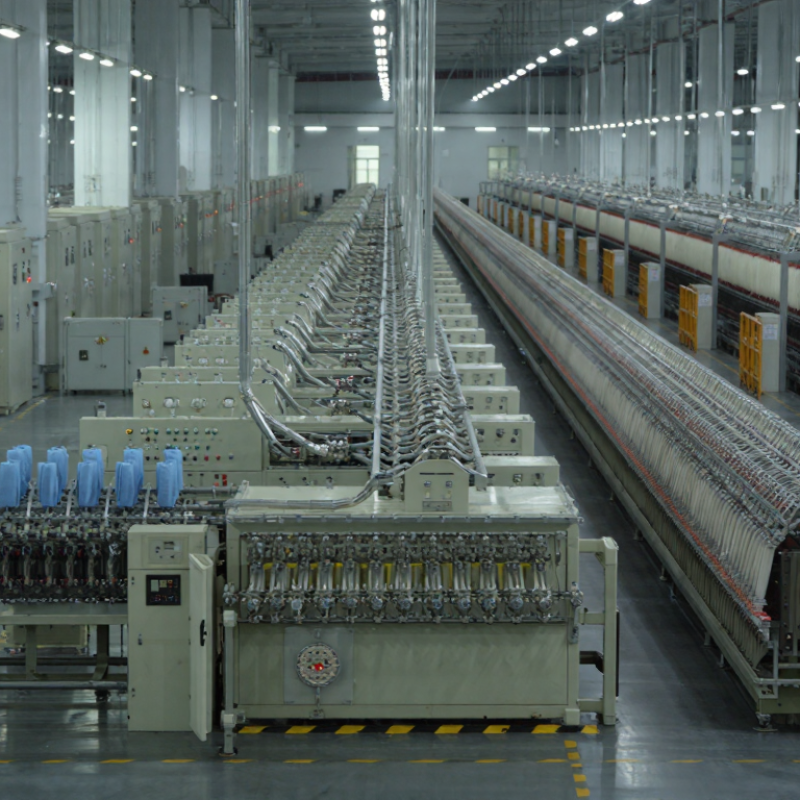
Table of Contents [Hide]
POY Spinning Lines: Definition, Process, and Core Functions
POY spinning lines manufacture partially oriented yarn, usually from polyester chips. The yarn is not fully drawn, so it retains controlled stretch for later texturing or fabric production. A complete line includes chip drying, extrusion, melt filtration, spinning, cooling, and winding. Each section affects yarn uniformity.
The process begins when dried chips enter an extruder. Heat turns them into a stable polymer melt. A metering pump sends the melt through a spinneret with many fine holes. Air cools the fresh filaments below the spinning beam. Godets then control speed and tension. Finally, a precision winder forms packages for transport or downstream processing.
Core functions include accurate temperature control, continuous pressure monitoring, stable quenching, and tension management. Automatic alarms can detect broken filaments, diameter changes, or winding defects. For global buyers, experienced manufacturers should provide output data, energy estimates, maintenance access, and operator training. These details matter on the factory floor. A line may look advanced, yet poor filtration can create frequent breaks. That is an easy mistake to overlook. I would also question promised capacity without testing conditions, because polymer quality, ambient humidity, and operator skill influence results. No specification replaces a practical trial.





