


- Home
- A-Z Catalogue
- Products
- Valves
- Cetop
- Manual Directional Valves
- Proportional Valves
- Poppet Valves
- High-Speed Linear Servo Valves
- All High-Speed Linear Servo Valves
- Cetop 10 (NG32) Two Stage Type High Speed Linear Servo Valves – LSVHG-10
- Cetop 10 (NG32) Two Stage Type High Speed Linear Servo Valves – LSVHG-10 (With Fail-Safe)
- Cetop 8 (NG25) Two Stage Type High Speed Linear Servo Valves – LSVHG-06
- Cetop 8 (NG25) Two Stage Type High Speed Linear Servo Valves – LSVHG-06 (With Fail-Safe)
- Cetop 7 (NG16) Two Stage Type High Speed Linear Servo Valves – LSVHG-04
- Cetop 7 (NG16) Two Stage Type High Speed Linear Servo Valves – LSVHG-04 (With Fail-Safe)
- Cetop 5 (NG10) Direct Type High Speed Linear Servo Valves – LSVG-03
- Cetop 5 (NG10) OBE Type Direct Operated Linear Servo Valves – LSVG-03-EH
- Cetop 3 (NG6) OBE Type Direct Operated Linear Servo Valves – LSVG-01-EH
- Pumps
- Pressure control
- Flow Control Valves
- Pressure Control Valves
- All Pressure Control Valves
- Brake Valves
- Direct Relief Valve
- Low Noise Solenoid Controlled Relief Valves
- Low Noise Pilot Operated Relief Valves
- Pilot Operated Relief Valves
- Pressure reducing and relieving valves
- Pressure reducing and check valves
- Pressure control valves
- Remote Control Relief Valves
- Solenoid Controlled Relief Valves – BSG
- Solenoid Controlled Relief Valves – BST
- Unloading relief valves
- Check valves
- Environmental
- Valves
- Hydraulic Systems
- Power pack
- About Us
- Contact
- Blog

Top Machine Spindle Manufacturers and Suppliers?
Choosing the right Machine Spindle manufacturer can shape a factory’s accuracy, uptime, and long-term maintenance costs. The decision deserves more than a polished catalog or a low purchase price. A spindle running at 24,000 revolutions per minute faces heat, vibration, tool imbalance, and demanding duty cycles every day.
Dr. Scott Smith, a respected machining-dynamics researcher, has described the spindle as “the heart of the machine tool.” That comparison is practical. A healthy spindle produces a clean surface, stable cutting, and predictable tool life. A poorly matched unit may create chatter marks, excessive noise, or unplanned downtime within months.
This guide examines leading Machine Spindle manufacturers and suppliers across different applications. It considers high-speed machining, heavy-duty milling, grinding, turning, and automated production. Important comparison points include power range, maximum speed, bearing design, cooling method, taper standard, encoder options, repair support, and spare-part availability. Local service matters.
Very much.
A supplier may offer impressive specifications but weak technical support. Another may cost more while providing faster diagnostics and documented balancing services. That difference becomes visible beside a production line at 2 a.m.
The market is not perfectly simple. Published accuracy figures may use different testing conditions, making direct comparisons difficult. Buyers should request test methods, thermal-growth data, warranty terms, and references from similar machines. This article aims to support that process with practical judgment, not exaggerated promises. The best choice depends on material, tooling, duty cycle, machine structure, and the manufacturer’s ability to support the spindle after installation.
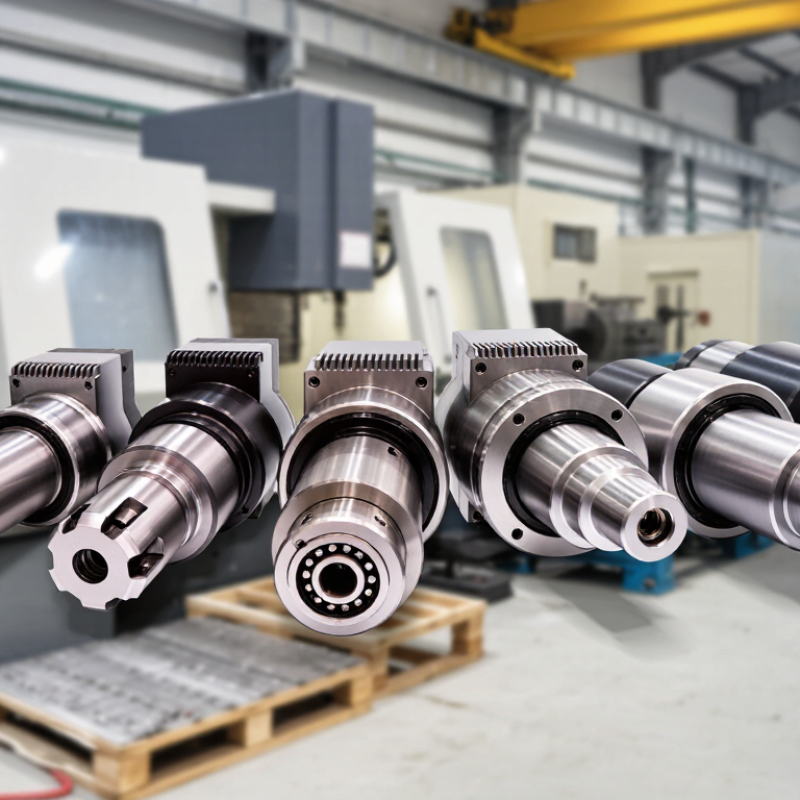
Table of Contents [Hide]
What Is a Machine Spindle and Why Does It Matter?
A machine spindle is the rotating unit that holds and drives a cutting tool. It transfers motor power through bearings, a shaft, and a tool interface. During milling, the spindle controls speed, torque, stiffness, and runout. These factors shape surface finish, dimensional accuracy, tool life, and cycle time.
It is the rotating heart. Speed alone misleads. A 24,000-rpm spindle may suit aluminum, but a lower-speed, high-torque unit can perform better in steel. Shop-floor checks should include vibration, bearing temperature, drawbar force, and runout at the tool nose. A small runout error can create visible marks on a precision bore. Thermal growth also changes accuracy after extended operation. ISO 230-3 addresses thermal effects in machine tools, while ISO 230-2 supports positioning-accuracy evaluation.
Demand for reliable spindle systems is growing with CNC adoption. Fortune Business Insights valued the global CNC machine market at about 83.99 billion dollars in 2023. Its 2024 report projects the market to reach approximately 128.86 billion dollars by 2032. This growth increases pressure on suppliers to provide documented test results, service plans, and compatible control systems. Buyers should compare duty cycles, cooling methods, torque curves, and replacement lead times. The cheapest spindle can become expensive when downtime, balancing, and repeat repairs are included. Specifications still need skepticism. A catalog rating may reflect ideal conditions, not continuous cutting.