


- Home
- A-Z Catalogue
- Products
- Valves
- Cetop
- Manual Directional Valves
- Proportional Valves
- Poppet Valves
- High-Speed Linear Servo Valves
- All High-Speed Linear Servo Valves
- Cetop 10 (NG32) Two Stage Type High Speed Linear Servo Valves – LSVHG-10
- Cetop 10 (NG32) Two Stage Type High Speed Linear Servo Valves – LSVHG-10 (With Fail-Safe)
- Cetop 8 (NG25) Two Stage Type High Speed Linear Servo Valves – LSVHG-06
- Cetop 8 (NG25) Two Stage Type High Speed Linear Servo Valves – LSVHG-06 (With Fail-Safe)
- Cetop 7 (NG16) Two Stage Type High Speed Linear Servo Valves – LSVHG-04
- Cetop 7 (NG16) Two Stage Type High Speed Linear Servo Valves – LSVHG-04 (With Fail-Safe)
- Cetop 5 (NG10) Direct Type High Speed Linear Servo Valves – LSVG-03
- Cetop 5 (NG10) OBE Type Direct Operated Linear Servo Valves – LSVG-03-EH
- Cetop 3 (NG6) OBE Type Direct Operated Linear Servo Valves – LSVG-01-EH
- Pumps
- Pressure control
- Flow Control Valves
- Pressure Control Valves
- All Pressure Control Valves
- Brake Valves
- Direct Relief Valve
- Low Noise Solenoid Controlled Relief Valves
- Low Noise Pilot Operated Relief Valves
- Pilot Operated Relief Valves
- Pressure reducing and relieving valves
- Pressure reducing and check valves
- Pressure control valves
- Remote Control Relief Valves
- Solenoid Controlled Relief Valves – BSG
- Solenoid Controlled Relief Valves – BST
- Unloading relief valves
- Check valves
- Environmental
- Valves
- Hydraulic Systems
- Power pack
- About Us
- Contact
- Blog

Top 10 Hydraulic Pumps Buyers Should Know About?
Hydraulic Pumps are vital components in various sectors, including manufacturing, construction, and agriculture. According to a recent report by Market Research Future, the global hydraulic pumps market is projected to reach USD 49.9 billion by 2025. This growth reflects increasing demand for these essential machines. One expert, Dr. Emily Carter, noted, "Understanding hydraulic pumps is crucial for optimizing efficiency in industrial applications."
These machines transform mechanical energy into hydraulic energy, allowing powerful operations in countless applications. However, many buyers struggle with choosing the right type. There are many types of hydraulic pumps, each suited for specific tasks. The complexity of these choices can be overwhelming.
Moreover, the industry faces challenges such as fluctuating raw material prices and advancements in technology. Buyers must remain informed to make sound decisions. As Dr. Carter emphasizes, continuous learning about hydraulic pumps is vital to maintain an edge in this competitive market. The right decision can lead to significant operational efficiency, but neglecting to understand the options may hinder performance.
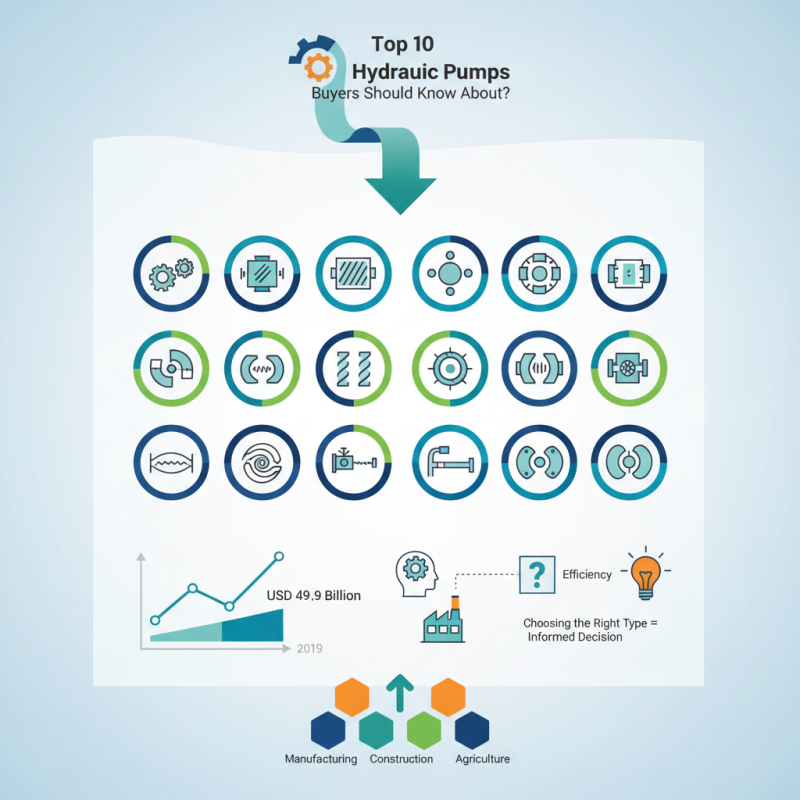
Table of Contents [Hide]
Top 10 Types of Hydraulic Pumps Evaluated by Performance Metrics
When considering hydraulic pumps, performance metrics are crucial. Various types cater to different applications. Gear pumps are among the most common choices. They are known for their efficiency and compact design. These pumps work well in high pressure situations but may face issues with suction.
Piston pumps are another popular option. They offer high pressure and flow rates, ideal for heavy machinery. However, they can be complex and require regular maintenance. Another noteworthy type is the vane pump. It has a simple structure and provides a smooth flow. Yet, its performance can decline over time, especially under varying load conditions.
Diaphragm pumps excel in handling corrosive fluids. Their design prevents contamination of the hydraulic fluid. Unfortunately, they may not perform well in high viscosity applications.
Understanding these metrics helps buyers choose the right pump. Each type has strengths and weaknesses. Careful consideration of these factors ensures lasting performance.