


- Home
- A-Z Catalogue
- Products
- Valves
- Cetop
- Manual Directional Valves
- Proportional Valves
- Poppet Valves
- High-Speed Linear Servo Valves
- All High-Speed Linear Servo Valves
- Cetop 10 (NG32) Two Stage Type High Speed Linear Servo Valves – LSVHG-10
- Cetop 10 (NG32) Two Stage Type High Speed Linear Servo Valves – LSVHG-10 (With Fail-Safe)
- Cetop 8 (NG25) Two Stage Type High Speed Linear Servo Valves – LSVHG-06
- Cetop 8 (NG25) Two Stage Type High Speed Linear Servo Valves – LSVHG-06 (With Fail-Safe)
- Cetop 7 (NG16) Two Stage Type High Speed Linear Servo Valves – LSVHG-04
- Cetop 7 (NG16) Two Stage Type High Speed Linear Servo Valves – LSVHG-04 (With Fail-Safe)
- Cetop 5 (NG10) Direct Type High Speed Linear Servo Valves – LSVG-03
- Cetop 5 (NG10) OBE Type Direct Operated Linear Servo Valves – LSVG-03-EH
- Cetop 3 (NG6) OBE Type Direct Operated Linear Servo Valves – LSVG-01-EH
- Pumps
- Pressure control
- Flow Control Valves
- Pressure Control Valves
- All Pressure Control Valves
- Brake Valves
- Direct Relief Valve
- Low Noise Solenoid Controlled Relief Valves
- Low Noise Pilot Operated Relief Valves
- Pilot Operated Relief Valves
- Pressure reducing and relieving valves
- Pressure reducing and check valves
- Pressure control valves
- Remote Control Relief Valves
- Solenoid Controlled Relief Valves – BSG
- Solenoid Controlled Relief Valves – BST
- Unloading relief valves
- Check valves
- Environmental
- Valves
- Hydraulic Systems
- Power pack
- About Us
- Contact
- Blog

China Best Harbor Crane Manufacturers and Suppliers
Harbor Cranes are vital to the steady movement of cargo through busy ports. A container may weigh dozens of tonnes, yet operators expect each lift to be controlled and repeatable. Along the quay, wind, salt spray, tight vessel schedules, and constant shifts in cargo demand test every machine. Small design choices matter. Boom reach, lifting capacity, trolley speed, and corrosion protection affect daily performance.
UNCTAD’s Review of Maritime Transport 2024 reports that maritime trade grew by 2.4% in 2023. The World Bank’s Container Port Performance Index 2023 assessed 405 container ports, highlighting how port efficiency depends on coordinated operations. These figures do not measure crane quality directly, but they show the demanding environment suppliers must serve. UNCTAD Secretary-General Rebeca Grynspan has described maritime transport as “the backbone of international trade and the global economy.” Her point applies on the quay, where dependable equipment helps keep cargo moving.
Choosing among China’s harbor crane manufacturers and suppliers calls for more than comparing quoted prices. Buyers should examine rated capacity, working radius, duty classification, control systems, maintenance access, spare-parts support, and documented testing. Ask how the crane performs in the conditions your terminal actually faces. A polished specification sheet cannot answer everything. Installation records and service references deserve close attention, too. This guide introduces leading suppliers and practical questions for evaluating them. One caution remains: published claims can be difficult to compare, so verify the details before deciding.
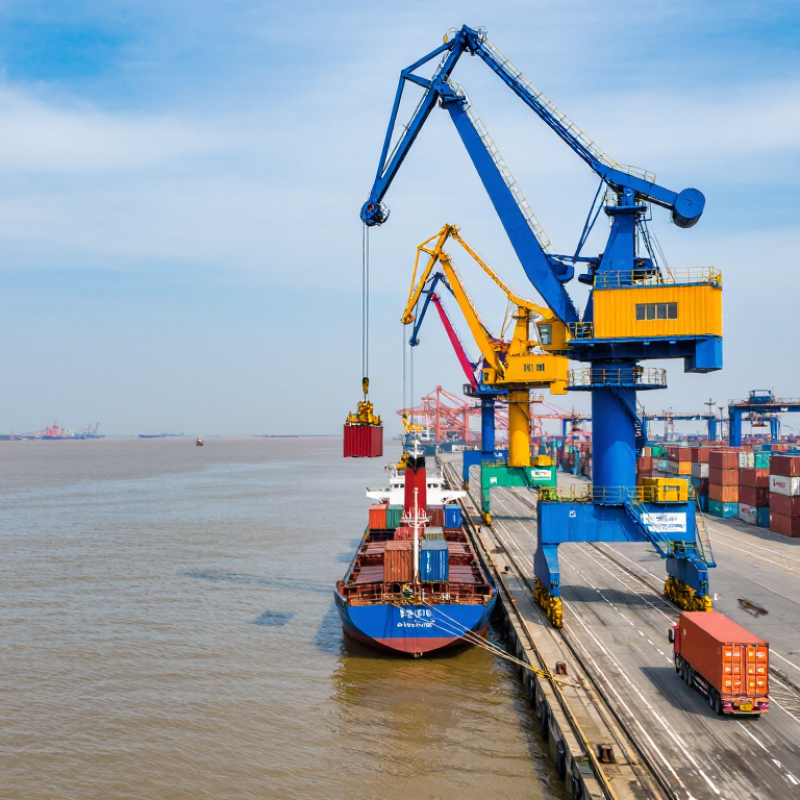
Table of Contents [Hide]
What Harbor Cranes Are and the Work They Perform
A harbor crane is a shore-based lifting machine used to move cargo between ships and the port. Ship-to-shore cranes reach across a vessel’s side, while mobile harbor cranes can serve different berths. Depending on their design, cranes handle containers, breakbulk cargo, or bulk materials. A container crane’s spreader locks onto a box; operators lift it clear, then lower it onto a truck or transfer vehicle. They do heavy work. The movements must still be controlled, especially when wind, vessel motion, or crowded quays complicate a lift.
The scale is substantial. UNCTAD’s Review of Maritime Transport 2024 reports that global maritime trade reached 12.3 billion tonnes in 2023, up 2.4% from 2022. That volume depends on coordinated port operations, not cranes alone. The World Bank’s Container Port Performance Index 2023 assessed 405 ports, using vessel time in port as a key performance measure. Crane speed can influence that time, but berth planning, labor, yard capacity, and equipment downtime matter too. A crane may look impressive from the quay; its useful work is measured in safe, steady transfers. And no single performance figure tells the whole story.





