


- Home
- A-Z Catalogue
- Products
- Valves
- Cetop
- Manual Directional Valves
- Proportional Valves
- Poppet Valves
- High-Speed Linear Servo Valves
- All High-Speed Linear Servo Valves
- Cetop 10 (NG32) Two Stage Type High Speed Linear Servo Valves – LSVHG-10
- Cetop 10 (NG32) Two Stage Type High Speed Linear Servo Valves – LSVHG-10 (With Fail-Safe)
- Cetop 8 (NG25) Two Stage Type High Speed Linear Servo Valves – LSVHG-06
- Cetop 8 (NG25) Two Stage Type High Speed Linear Servo Valves – LSVHG-06 (With Fail-Safe)
- Cetop 7 (NG16) Two Stage Type High Speed Linear Servo Valves – LSVHG-04
- Cetop 7 (NG16) Two Stage Type High Speed Linear Servo Valves – LSVHG-04 (With Fail-Safe)
- Cetop 5 (NG10) Direct Type High Speed Linear Servo Valves – LSVG-03
- Cetop 5 (NG10) OBE Type Direct Operated Linear Servo Valves – LSVG-03-EH
- Cetop 3 (NG6) OBE Type Direct Operated Linear Servo Valves – LSVG-01-EH
- Pumps
- Pressure control
- Flow Control Valves
- Pressure Control Valves
- All Pressure Control Valves
- Brake Valves
- Direct Relief Valve
- Low Noise Solenoid Controlled Relief Valves
- Low Noise Pilot Operated Relief Valves
- Pilot Operated Relief Valves
- Pressure reducing and relieving valves
- Pressure reducing and check valves
- Pressure control valves
- Remote Control Relief Valves
- Solenoid Controlled Relief Valves – BSG
- Solenoid Controlled Relief Valves – BST
- Unloading relief valves
- Check valves
- Environmental
- Valves
- Hydraulic Systems
- Power pack
- About Us
- Contact
- Blog

What Are the Top Deck Boards for Outdoor Use?
Choosing Deck Boards for outdoor use means balancing durability, comfort, maintenance, and cost—not simply picking the most attractive sample. Sun, rain, freeze-thaw cycles, and damp shade can affect boards differently. A surface that feels cool and smooth in a showroom may become hot, slippery, or demanding to maintain on a real patio. Small details matter: drainage beneath the boards, spacing between them, and how often the deck will be cleaned.
Industry data offers useful context, but it cannot name one best material for every home. Zonda’s 2024 Cost vs. Value report estimated national average cost recoup at resale of 82.9% for a wood deck addition and 68.2% for a composite deck addition. These figures describe estimated project costs and resale value, not product lifespan or performance in every climate. Treat them as a benchmark, not a promise. That matters. This guide compares common options, including pressure-treated wood, cedar, tropical hardwood, and composite boards, with attention to upkeep, weather exposure, installation needs, and likely long-term value. No board is perfect. Even durable materials can disappoint when poorly installed or mismatched to local conditions. The practical choice is the one that suits your climate, budget, and willingness to maintain it.
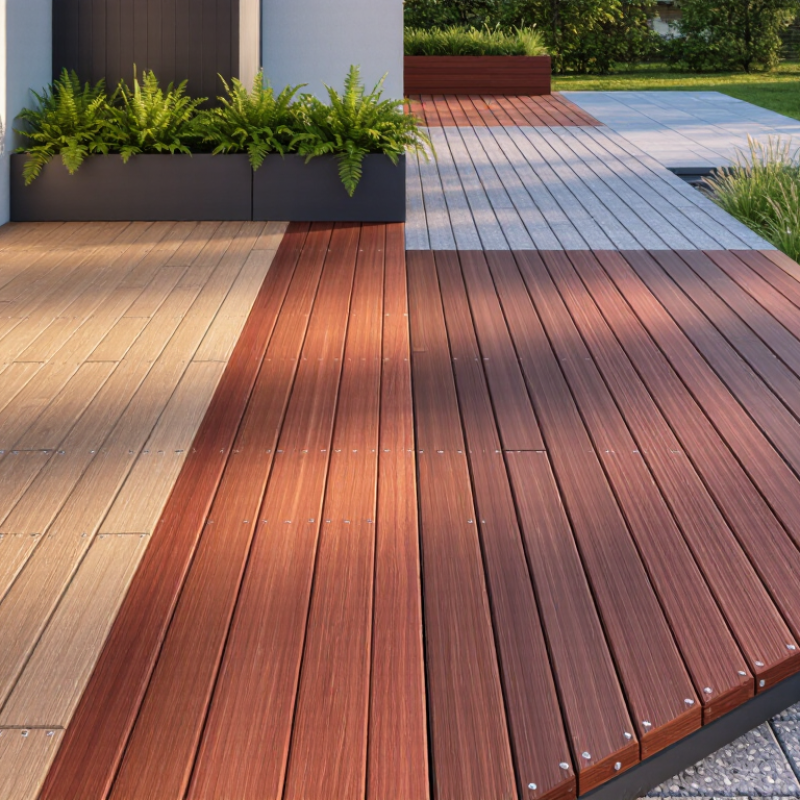
Table of Contents [Hide]
What Makes a Deck Board Suitable for Outdoor Use?
What Are the Top Deck Boards for Outdoor Use?
What Makes a Deck Board Suitable for Outdoor Use?
A suitable outdoor deck board must withstand moisture, sunlight, temperature changes, and regular foot traffic. It should resist swelling, splintering, and surface wear under local conditions. On a damp morning, grip matters. Water should drain rather than collect in grooves or between boards.
That detail is easy to overlook when choosing from a dry showroom sample. A board’s color and texture can also change after months of sun exposure, so check care instructions and expected fading before deciding.
Different materials handle these stresses in different ways. Treated timber can be practical, but it may need periodic cleaning and protective treatment. Naturally durable wood can weather attractively, though its color may shift and boards can vary. Composite boards often need less surface treatment, but some become hot in direct sun and still require cleaning.
No option is maintenance-free, despite how tidy a sample looks indoors. Look for a surface suited to wet feet, compatible fasteners, and clear guidance on spacing and ventilation. Installation matters too: trapped moisture beneath a deck can shorten the life of even a durable board. Consider your climate, shade, drainage, and willingness to maintain the surface before choosing.





