


- Home
- A-Z Catalogue
- Products
- Valves
- Cetop
- Manual Directional Valves
- Proportional Valves
- Poppet Valves
- High-Speed Linear Servo Valves
- All High-Speed Linear Servo Valves
- Cetop 10 (NG32) Two Stage Type High Speed Linear Servo Valves – LSVHG-10
- Cetop 10 (NG32) Two Stage Type High Speed Linear Servo Valves – LSVHG-10 (With Fail-Safe)
- Cetop 8 (NG25) Two Stage Type High Speed Linear Servo Valves – LSVHG-06
- Cetop 8 (NG25) Two Stage Type High Speed Linear Servo Valves – LSVHG-06 (With Fail-Safe)
- Cetop 7 (NG16) Two Stage Type High Speed Linear Servo Valves – LSVHG-04
- Cetop 7 (NG16) Two Stage Type High Speed Linear Servo Valves – LSVHG-04 (With Fail-Safe)
- Cetop 5 (NG10) Direct Type High Speed Linear Servo Valves – LSVG-03
- Cetop 5 (NG10) OBE Type Direct Operated Linear Servo Valves – LSVG-03-EH
- Cetop 3 (NG6) OBE Type Direct Operated Linear Servo Valves – LSVG-01-EH
- Pumps
- Pressure control
- Flow Control Valves
- Pressure Control Valves
- All Pressure Control Valves
- Brake Valves
- Direct Relief Valve
- Low Noise Solenoid Controlled Relief Valves
- Low Noise Pilot Operated Relief Valves
- Pilot Operated Relief Valves
- Pressure reducing and relieving valves
- Pressure reducing and check valves
- Pressure control valves
- Remote Control Relief Valves
- Solenoid Controlled Relief Valves – BSG
- Solenoid Controlled Relief Valves – BST
- Unloading relief valves
- Check valves
- Environmental
- Valves
- Hydraulic Systems
- Power pack
- About Us
- Contact
- Blog

Top 10 Agricultural Forklift Types Buyers Should Know?
Choosing the right Agricultural Forklift is no longer a simple capacity decision. Farms now move pallets, bulk bags, crates, fertilizer, and feed across uneven ground. Each load creates different stability, traction, and maintenance demands. A machine that performs well inside a warehouse may struggle beside a muddy grain store.
The Food and Agriculture Organization’s State of Food and Agriculture reports show how strongly food systems depend on efficient, resilient supply chains. Meanwhile, the Industrial Truck Association reports that forklift safety and operator training remain central industry concerns. These findings matter on farms, where dust, slopes, rain, and irregular surfaces can expose equipment weaknesses quickly. The right Agricultural Forklift should match terrain, load shape, lifting height, fuel access, and seasonal workload. Small details matter. Tire tread matters.
Brett Wood, a recognized material-handling safety specialist and former Toyota Material Handling executive, has often emphasized, “Safety is not a destination; it is a journey.” That principle belongs in every purchasing discussion. Still, buyers sometimes focus too heavily on purchase price. That can be a costly blind spot. Fuel use, service access, attachment compatibility, operator visibility, and downtime may decide the real return. This guide examines ten Agricultural Forklift types, from rough-terrain models to compact electric units, helping buyers compare practical strengths and limitations. No single machine fits every farm. Even experienced buyers can misjudge changing conditions.
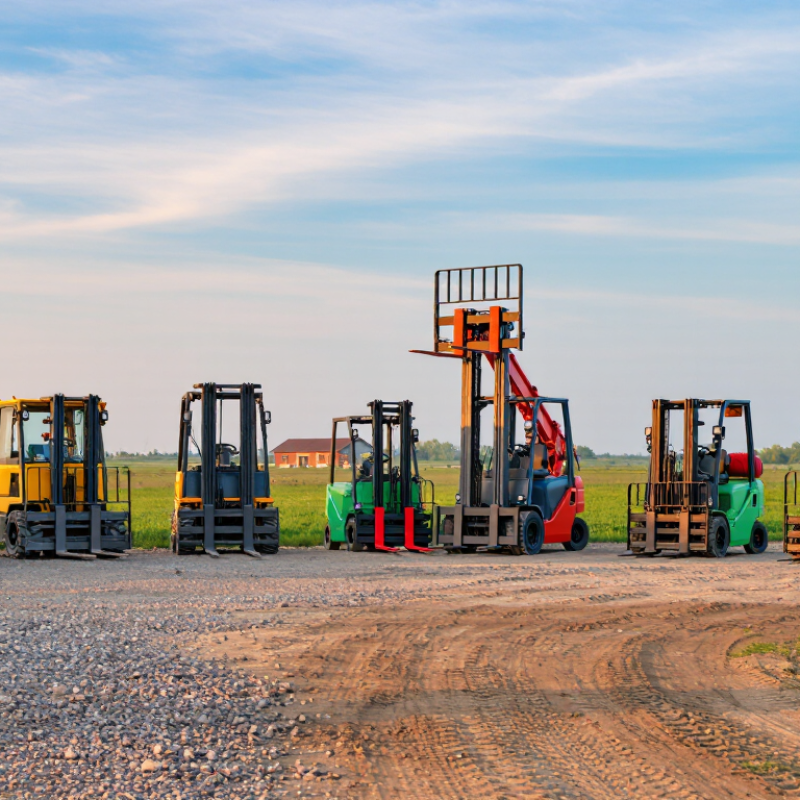
Table of Contents [Hide]
Forklift Classification: OSHA Classes I–V, Power Sources, and Farm Uses
Agricultural forklifts are easier to select when buyers connect OSHA classes with real farm conditions. Class I covers electric motor rider trucks, suited to quiet indoor sheds and battery charging areas. Class II includes narrow-aisle electric trucks for storage rooms. Class III covers powered pallet trucks and stackers. Class IV uses internal-combustion engines with cushion tires, while Class V uses pneumatic tires for rougher outdoor surfaces. These five classes form the foundation, not the whole decision.
A practical top-ten list includes electric counterbalance, narrow-aisle, pallet, walkie stacker, cushion-tire, pneumatic-tire, rough-terrain, telehandler, side-loader, and attachment-ready forklifts. Power choices matter. Electricity reduces indoor emissions, propane offers quick refueling, and diesel supports demanding outdoor cycles.
OSHA reports about 85 powered-industrial-truck fatalities and 34,900 serious injuries annually in the United States. That figure makes operator training, visibility, load stability, and seat-belt use farm priorities, not optional extras.
Picture a muddy yard, a 1,000-kilogram feed pallet, and a trailer ramp with uneven steel. A pneumatic-tire truck may perform better than a compact warehouse model. For hay bales, a telehandler can provide reach, but its load chart changes with boom angle and attachment choice. USDA farm equipment data shows that farms vary greatly in scale and operating conditions, so one universal forklift rarely works well. Buyers should measure aisle width, surface strength, lift height, daily hours, and attachment weight before purchasing. I would still challenge one common assumption: the largest machine is not always the safest or most productive choice.





