


- Home
- A-Z Catalogue
- Products
- Valves
- Cetop
- Manual Directional Valves
- Proportional Valves
- Poppet Valves
- High-Speed Linear Servo Valves
- All High-Speed Linear Servo Valves
- Cetop 10 (NG32) Two Stage Type High Speed Linear Servo Valves – LSVHG-10
- Cetop 10 (NG32) Two Stage Type High Speed Linear Servo Valves – LSVHG-10 (With Fail-Safe)
- Cetop 8 (NG25) Two Stage Type High Speed Linear Servo Valves – LSVHG-06
- Cetop 8 (NG25) Two Stage Type High Speed Linear Servo Valves – LSVHG-06 (With Fail-Safe)
- Cetop 7 (NG16) Two Stage Type High Speed Linear Servo Valves – LSVHG-04
- Cetop 7 (NG16) Two Stage Type High Speed Linear Servo Valves – LSVHG-04 (With Fail-Safe)
- Cetop 5 (NG10) Direct Type High Speed Linear Servo Valves – LSVG-03
- Cetop 5 (NG10) OBE Type Direct Operated Linear Servo Valves – LSVG-03-EH
- Cetop 3 (NG6) OBE Type Direct Operated Linear Servo Valves – LSVG-01-EH
- Pumps
- Pressure control
- Flow Control Valves
- Pressure Control Valves
- All Pressure Control Valves
- Brake Valves
- Direct Relief Valve
- Low Noise Solenoid Controlled Relief Valves
- Low Noise Pilot Operated Relief Valves
- Pilot Operated Relief Valves
- Pressure reducing and relieving valves
- Pressure reducing and check valves
- Pressure control valves
- Remote Control Relief Valves
- Solenoid Controlled Relief Valves – BSG
- Solenoid Controlled Relief Valves – BST
- Unloading relief valves
- Check valves
- Environmental
- Valves
- Hydraulic Systems
- Power pack
- About Us
- Contact
- Blog

What Are the Top 10 Types of Stainless Steel Meat Hooks?
Stainless Steel Meat Hooks may look simple, but their shape affects how securely meat hangs, turns, and drains. This guide introduces ten common types, from familiar S-hooks and J-hooks to gambrel, double-prong, and spreader designs. Each serves a different task. A compact hook may suit smaller cuts, while a wider design can provide more balance for larger pieces. The right choice depends on the load, available hanging space, and how the hook will be cleaned and stored.
Small details matter. Wire thickness, weld quality, surface finish, and stated load capacity are worth checking before purchase. Stainless steel grades also differ in corrosion resistance, so product specifications should be clear rather than assumed from a shiny appearance. In practical use, smooth edges and easy-to-clean joints can make a noticeable difference around meat and moisture. Fit comes first. There is no universal best hook, and even a careful comparison cannot fully predict how a design will feel in a cold, wet hand. The overview below explains what each type is generally suited for and what to inspect, helping readers compare options with greater confidence. Always follow the maker’s load guidance and maintain hooks according to their instructions.
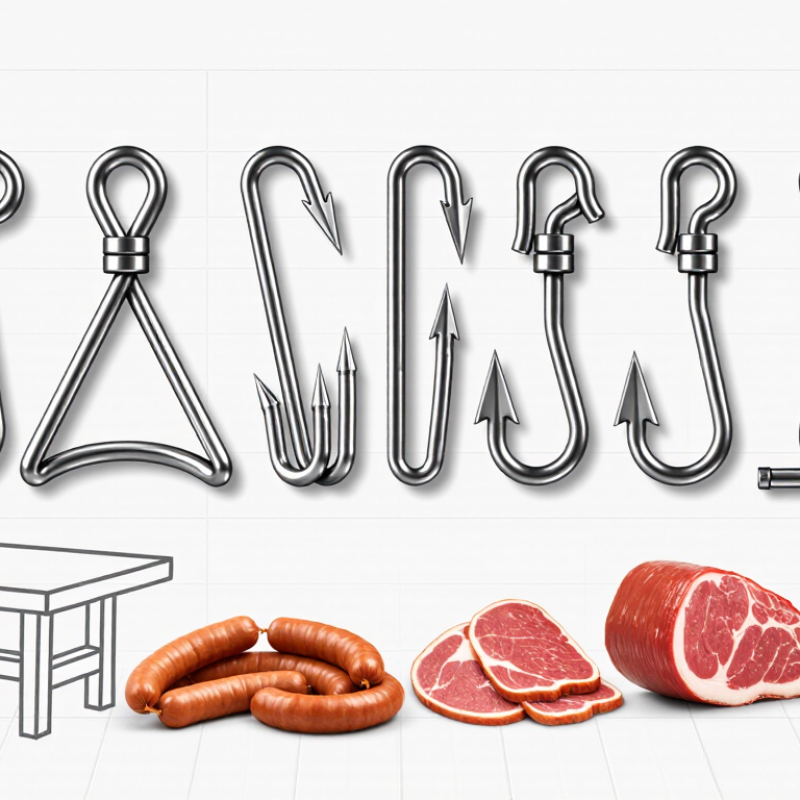
Table of Contents [Hide]
How Stainless Steel Meat Hooks Are Classified by Shape and Function
What Are the Top 10 Types of Stainless Steel Meat Hooks?
How Stainless Steel Meat Hooks Are Classified by Shape and Function
Meat hooks are easier to compare by their shape and intended task than by name alone. Common designs include straight single-point hooks, curved single-point hooks, double-point hooks, S-hooks, J-hooks, gambrel hooks, spreader hooks, swivel hooks, ring hooks, and hand hooks. The categories overlap. A gambrel, for example, often uses two points to support a cut across a wider area.
Shape affects how a hook engages the load. A curved point can help hold meat securely, while a straight point offers a simple entry angle. S- and J-shaped hooks are often used for hanging or transferring items between supports. Gambrel and spreader designs keep two contact points apart; this can improve balance when the load suits the hook’s width. Swivel models allow rotation, while ring-style forms provide a closed hanging point. Small differences matter.
Function matters just as much. Hand hooks are designed for manual handling, while rail hooks hang from compatible overhead systems. Check the hook’s rated capacity, point finish, and dimensions before use; stainless steel alone does not indicate strength. Inspect it for bending, cracks, or a loose swivel. A close visual check helps. I would not assume two hooks with similar shapes perform alike, since gauge, weld quality, and intended load can vary.





