


- Home
- A-Z Catalogue
- Products
- Valves
- Cetop
- Manual Directional Valves
- Proportional Valves
- Poppet Valves
- High-Speed Linear Servo Valves
- All High-Speed Linear Servo Valves
- Cetop 10 (NG32) Two Stage Type High Speed Linear Servo Valves – LSVHG-10
- Cetop 10 (NG32) Two Stage Type High Speed Linear Servo Valves – LSVHG-10 (With Fail-Safe)
- Cetop 8 (NG25) Two Stage Type High Speed Linear Servo Valves – LSVHG-06
- Cetop 8 (NG25) Two Stage Type High Speed Linear Servo Valves – LSVHG-06 (With Fail-Safe)
- Cetop 7 (NG16) Two Stage Type High Speed Linear Servo Valves – LSVHG-04
- Cetop 7 (NG16) Two Stage Type High Speed Linear Servo Valves – LSVHG-04 (With Fail-Safe)
- Cetop 5 (NG10) Direct Type High Speed Linear Servo Valves – LSVG-03
- Cetop 5 (NG10) OBE Type Direct Operated Linear Servo Valves – LSVG-03-EH
- Cetop 3 (NG6) OBE Type Direct Operated Linear Servo Valves – LSVG-01-EH
- Pumps
- Pressure control
- Flow Control Valves
- Pressure Control Valves
- All Pressure Control Valves
- Brake Valves
- Direct Relief Valve
- Low Noise Solenoid Controlled Relief Valves
- Low Noise Pilot Operated Relief Valves
- Pilot Operated Relief Valves
- Pressure reducing and relieving valves
- Pressure reducing and check valves
- Pressure control valves
- Remote Control Relief Valves
- Solenoid Controlled Relief Valves – BSG
- Solenoid Controlled Relief Valves – BST
- Unloading relief valves
- Check valves
- Environmental
- Valves
- Hydraulic Systems
- Power pack
- About Us
- Contact
- Blog

Top 10 L CNG Refueling Station Manufacturers
Choosing a reliable L-CNG/CNG Refueling Station manufacturer means looking beyond the equipment brochure. A station must manage high-pressure gas, cryogenic liquid, controls, and safety systems in one compact footprint. Operators also care about uptime, maintenance access, and how quickly the system can respond to demand. Small details matter. A difficult-to-reach valve can turn routine service into avoidable downtime.
NGV Global’s published industry statistics place the worldwide natural-gas vehicle fleet above 30 million, with tens of thousands of refueling stations serving it. These figures combine different markets and station types; they should not be read as an L-CNG-only count. Still, they show the scale of the infrastructure behind gas mobility. The International Energy Agency’s work on energy efficiency also offers a useful lens. IEA Executive Director Fatih Birol has stated, “Energy efficiency is the first fuel.” For station buyers, that principle points toward practical questions: how much energy does compression and cooling consume, and how consistently can the station deliver fuel?
This Top 10 overview compares manufacturers by technology scope, project experience, service capability, and transparency about performance. No ranking can replace site-specific engineering. A supplier’s record in one climate may not transfer neatly to another. That deserves a closer look. We also distinguish verified specifications from marketing claims, because published data can be uneven across manufacturers.
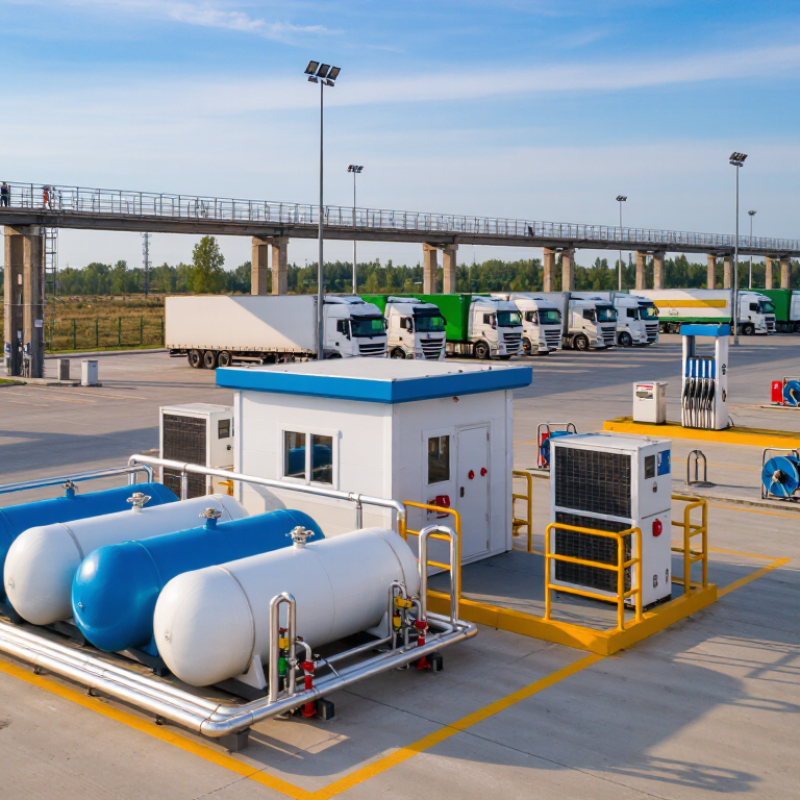
Table of Contents [Hide]
Understanding L-CNG Refueling Stations and Their Role
L-CNG refueling stations store natural gas as a cryogenic liquid, then convert it into compressed gas for vehicle tanks. This approach can serve fleets that need CNG but lack a nearby pipeline with enough pressure. A typical station includes insulated storage tanks, pumps, vaporizers, pressure controls, and dispensers. The equipment works as a connected system, not as isolated parts.
At the station, a high-pressure pump moves liquid LNG through a vaporizer, where heat turns it into gas. The gas is then regulated and dispensed at the pressure required by the vehicle. Operators monitor tank temperature, pressure, flow, and leak detection systems. Small changes matter. A poorly matched pump or vaporizer can slow fueling, especially during busy hours or extreme weather. Routine inspections help identify worn seals, frost buildup, or unusual pressure readings before they disrupt service.
L-CNG stations can offer compact supply infrastructure for truck depots and other high-use sites. Their performance depends on reliable LNG deliveries, careful maintenance, and trained personnel. The process is efficient in principle, but real sites face practical limits: storage capacity, refueling queues, and changing demand. Planning often gets one detail wrong. It is easy to focus on equipment ratings and overlook how drivers actually use the station.
Top 10 L CNG Refueling Station Manufacturers - Understanding L-CNG Refueling Stations and Their Role
Capability-based guide to the main systems and engineering areas to assess when comparing L-CNG station manufacturers. It is not a company ranking.
| No. | Manufacturer Capability Area | Role in an L-CNG Station | Key Evaluation Points |
|---|---|---|---|
| 1 | LNG storage and cryogenic tank integration | Stores liquefied natural gas at cryogenic temperatures before it is pumped and converted into compressed natural gas. | Check usable capacity, design pressure, insulation performance, instrumentation, applicable pressure-vessel requirements, and provisions for safe filling and venting. |
| 2 | LNG unloading and transfer systems | Moves LNG from a delivery vehicle into the station’s storage tank through insulated transfer lines and dedicated connections. | Review transfer-line insulation, compatible couplings, operating procedures, emergency isolation, and protection against unintended liquid release. |
| 3 | Cryogenic LNG pumps | Raises the pressure of LNG in liquid form. Pressurizing the liquid before vaporization is a defining process step in an L-CNG station. | Compare rated flow and discharge pressure with the station duty, turndown range, materials suitability, maintenance access, and operating data for the proposed service. |
| 4 | High-pressure vaporizers | Warm the pressurized LNG and convert it into gas for downstream conditioning, storage, or dispensing. | Assess rated thermal capacity, outlet-temperature control, ambient operating limits, icing management where applicable, and safeguards for abnormal operating conditions. |
| 5 | Gas conditioning and pressure control | Helps deliver gas at the pressure and condition required by the station’s storage and dispensing design. | Verify the specified operating envelope, pressure-regulation arrangement, filtration or conditioning needs, instrumentation, and compatibility with the intended vehicle-fueling protocol. |
| 6 | High-pressure gas storage | Provides a buffer of compressed gas that can support vehicle fills and manage differences between production rate and demand. | Check storage capacity and pressure stages against the station’s stated throughput and dispensing design; confirm vessel certification, inspection access, and pressure-relief provisions. |
| 7 | CNG dispensers and filling controls | Measures and delivers compressed natural gas to vehicles through the dispensing equipment and its control system. | Confirm connector and protocol compatibility for the target vehicle fleet, metering requirements, hose and breakaway arrangements, user interface, and intended fill-rate performance. |
| 8 | Boil-off gas and vent management | Addresses gas generated as LNG receives heat or changes conditions during storage and operation. | Ask for the project-specific boil-off strategy, operating scenarios, monitoring, and safe handling or recovery arrangements; requirements depend on the station design and local codes. |
| 9 | Controls, monitoring, and integration | Coordinates equipment operation and presents operating status, alarms, and process information to station personnel. | Review control-system scope, alarm and shutdown logic, instrument list, data access, communications interfaces, and documentation for commissioning and maintenance. |
| 10 | Safety engineering and lifecycle support | Integrates risk controls into the station layout and equipment package and supports safe operation over the facility’s service life. | Evaluate hazard studies, gas detection and emergency shutdown provisions, training, spare-parts support, maintenance documentation, commissioning assistance, and compliance with applicable local regulations. |





