


- Home
- A-Z Catalogue
- Products
- Valves
- Cetop
- Manual Directional Valves
- Proportional Valves
- Poppet Valves
- High-Speed Linear Servo Valves
- All High-Speed Linear Servo Valves
- Cetop 10 (NG32) Two Stage Type High Speed Linear Servo Valves – LSVHG-10
- Cetop 10 (NG32) Two Stage Type High Speed Linear Servo Valves – LSVHG-10 (With Fail-Safe)
- Cetop 8 (NG25) Two Stage Type High Speed Linear Servo Valves – LSVHG-06
- Cetop 8 (NG25) Two Stage Type High Speed Linear Servo Valves – LSVHG-06 (With Fail-Safe)
- Cetop 7 (NG16) Two Stage Type High Speed Linear Servo Valves – LSVHG-04
- Cetop 7 (NG16) Two Stage Type High Speed Linear Servo Valves – LSVHG-04 (With Fail-Safe)
- Cetop 5 (NG10) Direct Type High Speed Linear Servo Valves – LSVG-03
- Cetop 5 (NG10) OBE Type Direct Operated Linear Servo Valves – LSVG-03-EH
- Cetop 3 (NG6) OBE Type Direct Operated Linear Servo Valves – LSVG-01-EH
- Pumps
- Pressure control
- Flow Control Valves
- Pressure Control Valves
- All Pressure Control Valves
- Brake Valves
- Direct Relief Valve
- Low Noise Solenoid Controlled Relief Valves
- Low Noise Pilot Operated Relief Valves
- Pilot Operated Relief Valves
- Pressure reducing and relieving valves
- Pressure reducing and check valves
- Pressure control valves
- Remote Control Relief Valves
- Solenoid Controlled Relief Valves – BSG
- Solenoid Controlled Relief Valves – BST
- Unloading relief valves
- Check valves
- Environmental
- Valves
- Hydraulic Systems
- Power pack
- About Us
- Contact
- Blog

What Are the Top 10 CNC Cutting Machine Types?
Choosing the right CNC Cutting Machine can shape a workshop’s speed, accuracy, and long-term operating costs. However, one machine rarely solves every production problem. Material thickness, edge quality, working area, maintenance skill, and available power all influence the decision. A small fabrication shop may value a compact plasma system, while an aerospace supplier may require a high-precision waterjet or laser cutter. The best choice depends on real production conditions, not impressive catalog claims.
This guide examines ten widely used CNC cutting machine types, including plasma, laser, waterjet, oxy-fuel, router, knife, ultrasonic, wire EDM, tube, and multi-axis systems. Each type has a practical strength. Lasers create clean profiles on suitable metals, while waterjets cut heat-sensitive materials without a heat-affected zone. Routers handle wood, plastics, and composites efficiently. Wire EDM offers exceptional precision but usually works more slowly. Details matter. Operators should compare cutting speed, kerf width, consumable costs, software compatibility, and service support. Manufacturer specifications provide a starting point, but test cuts reveal more. A machine that performs well in a showroom may struggle with dusty floors, uneven material, or changing workloads.
There is no perfect ranking. Some recommendations can become outdated as technology improves. Even experienced buyers make mistakes when they overlook training or maintenance access. Reliable selection requires verified specifications, supplier references, and careful sample testing. The following overview aims to provide a practical, balanced foundation for comparing each CNC Cutting Machine type.
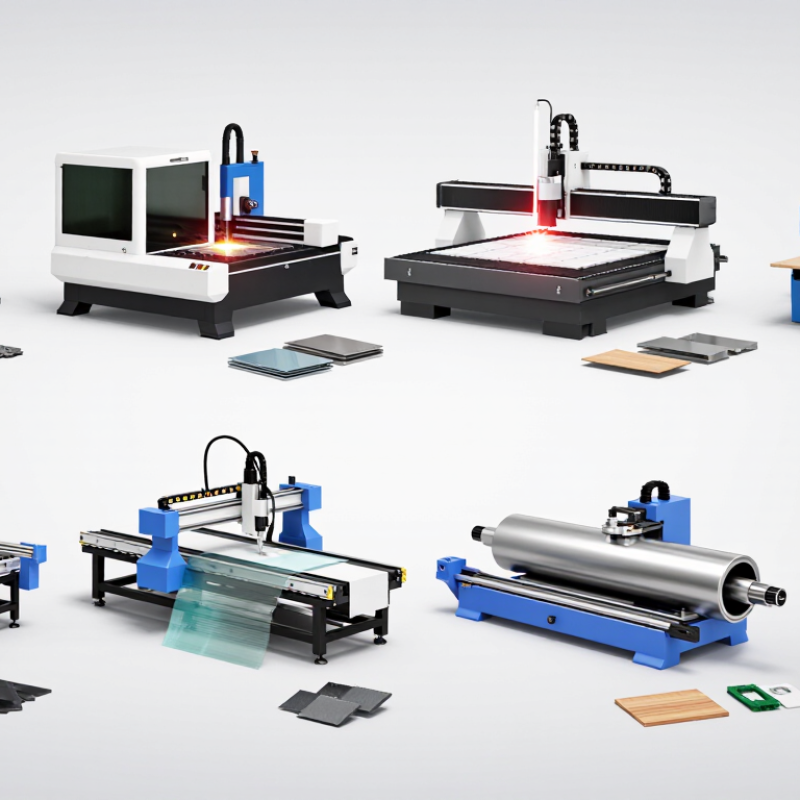
Table of Contents [Hide]
What Is a CNC Cutting Machine and How Does It Work?
A CNC cutting machine is a computer-controlled system that removes or separates material along programmed paths. CNC means computer numerical control. The machine reads coded instructions, moves its cutting head, and produces repeated shapes with consistent accuracy. Common types include CNC routers, laser cutters, plasma cutters, waterjet machines, oxy-fuel cutters, knife cutters, ultrasonic cutters, wire EDM machines, milling cutters, and abrasive saws.
The process usually begins with a CAD drawing. CAM software converts that design into toolpaths and G-code. The operator then selects cutting speed, feed rate, depth, and tool settings. After securing the sheet, the machine follows coordinates across several axes. A laser melts material, while a router uses a rotating bit. A waterjet cuts with high-pressure water and abrasive particles. Each method behaves differently.
Material thickness matters. So does heat. A plasma cut may leave a rougher edge, while a waterjet can protect heat-sensitive materials. In daily production, checking the first piece is essential. Small errors in focus, clamping, or tool wear can affect every later part. The first cut is rarely perfect. That is a useful warning, not a failure. Operators should inspect dimensions, edge quality, and burrs before continuing. Dust extraction, guarding, emergency stops, and correct personal protection also remain necessary, even when the machine appears fully automated.