


- Home
- A-Z Catalogue
- Products
- Valves
- Cetop
- Manual Directional Valves
- Proportional Valves
- Poppet Valves
- High-Speed Linear Servo Valves
- All High-Speed Linear Servo Valves
- Cetop 10 (NG32) Two Stage Type High Speed Linear Servo Valves – LSVHG-10
- Cetop 10 (NG32) Two Stage Type High Speed Linear Servo Valves – LSVHG-10 (With Fail-Safe)
- Cetop 8 (NG25) Two Stage Type High Speed Linear Servo Valves – LSVHG-06
- Cetop 8 (NG25) Two Stage Type High Speed Linear Servo Valves – LSVHG-06 (With Fail-Safe)
- Cetop 7 (NG16) Two Stage Type High Speed Linear Servo Valves – LSVHG-04
- Cetop 7 (NG16) Two Stage Type High Speed Linear Servo Valves – LSVHG-04 (With Fail-Safe)
- Cetop 5 (NG10) Direct Type High Speed Linear Servo Valves – LSVG-03
- Cetop 5 (NG10) OBE Type Direct Operated Linear Servo Valves – LSVG-03-EH
- Cetop 3 (NG6) OBE Type Direct Operated Linear Servo Valves – LSVG-01-EH
- Pumps
- Pressure control
- Flow Control Valves
- Pressure Control Valves
- All Pressure Control Valves
- Brake Valves
- Direct Relief Valve
- Low Noise Solenoid Controlled Relief Valves
- Low Noise Pilot Operated Relief Valves
- Pilot Operated Relief Valves
- Pressure reducing and relieving valves
- Pressure reducing and check valves
- Pressure control valves
- Remote Control Relief Valves
- Solenoid Controlled Relief Valves – BSG
- Solenoid Controlled Relief Valves – BST
- Unloading relief valves
- Check valves
- Environmental
- Valves
- Hydraulic Systems
- Power pack
- About Us
- Contact
- Blog

7 Tips for Choosing the Best Strut Channel Machine?
Choosing the right Strut Channel Machine is more than comparing prices or browsing attractive photographs. The machine must match your channel dimensions, material thickness, production volume, and required tolerances. A 41 x 41 millimeter channel may look simple, yet its bends, holes, and finished length demand precise coordination. Small errors can create fitting problems during installation.
Industry consultant Michael Chen offers a practical reminder: “A reliable roll-forming line should serve the channel design, not force the design to follow the machine.” That idea deserves careful attention. Buyers should examine roll tooling, punching accuracy, decoiler capacity, line speed, changeover time, and after-sales support. Floor space and electrical requirements also matter. An impressive machine can become an expensive obstacle if your workshop cannot operate it efficiently.
This guide presents seven useful tips for selecting a Strut Channel Machine with fewer assumptions. It considers real production details, including galvanized steel scratches, inconsistent hole spacing, noisy cutting stations, and difficult maintenance access. These details are not glamorous. They affect rejected products and operator confidence.
There is no perfect choice.
A faster line may not be better for short runs. A cheaper machine may demand more adjustments. Even experienced buyers can overlook tooling storage or future product changes. You may need to question the original specification before signing an order. Careful comparison, sample testing, and a direct discussion with the manufacturer can reveal weaknesses early. The goal is not simply to purchase equipment. It is to build a stable, repeatable, and commercially sensible production process.
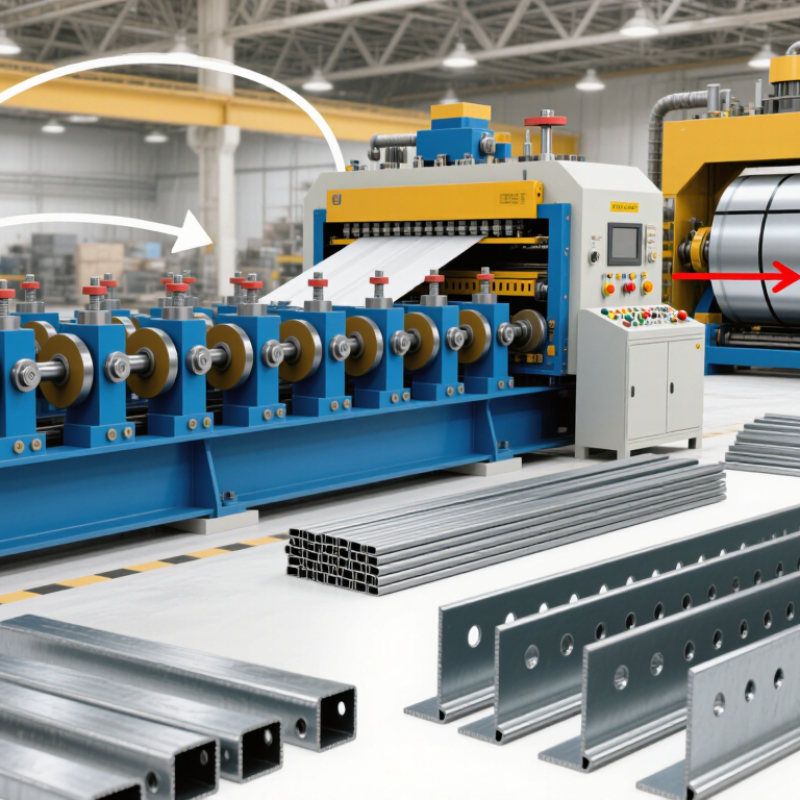
Table of Contents [Hide]
Define Channel Profiles, Steel Grades, and Gauge Before Comparing Machines
Define Channel Profiles, Steel Grades, and Gauge Before Comparing Machines
Choosing the best strut channel machine starts with the finished channel, not the machine catalog. Define the profile first: 41 x 41 mm, 41 x 21 mm, or a custom section. Record flange shape, hole pattern, slot length, pitch, and corner radius. A small radius change can affect roll tooling, springback, and final fit.
Steel grade comes next.
AISI S100 covers structural steel design principles, but it does not replace material certification. Confirm yield strength, coating, and surface condition with mill certificates. The World Steel Association reported approximately 1.89 billion tonnes of crude steel production in 2023, showing the scale of steel supply, but volume does not guarantee consistent forming behavior. Gauge needs equal attention. Measure actual thickness, not only the nominal label. Galvanized coating and tolerance can alter the result.
Then match the machine to these inputs.
Compare forming stations, drive capacity, entry guidance, cutoff accuracy, and quick-change tooling. Ask for trial production using your real coil. I have seen buyers compare speed while ignoring profile recovery after cutting. That assumption is risky. A machine producing 30 meters per minute is not efficient if the channel twists or misses dimensional tolerances. Request sample measurements, repeatability data, and maintenance records. Leave room for doubt; future steel grades may behave differently.