


- Home
- A-Z Catalogue
- Products
- Valves
- Cetop
- Manual Directional Valves
- Proportional Valves
- Poppet Valves
- High-Speed Linear Servo Valves
- All High-Speed Linear Servo Valves
- Cetop 10 (NG32) Two Stage Type High Speed Linear Servo Valves – LSVHG-10
- Cetop 10 (NG32) Two Stage Type High Speed Linear Servo Valves – LSVHG-10 (With Fail-Safe)
- Cetop 8 (NG25) Two Stage Type High Speed Linear Servo Valves – LSVHG-06
- Cetop 8 (NG25) Two Stage Type High Speed Linear Servo Valves – LSVHG-06 (With Fail-Safe)
- Cetop 7 (NG16) Two Stage Type High Speed Linear Servo Valves – LSVHG-04
- Cetop 7 (NG16) Two Stage Type High Speed Linear Servo Valves – LSVHG-04 (With Fail-Safe)
- Cetop 5 (NG10) Direct Type High Speed Linear Servo Valves – LSVG-03
- Cetop 5 (NG10) OBE Type Direct Operated Linear Servo Valves – LSVG-03-EH
- Cetop 3 (NG6) OBE Type Direct Operated Linear Servo Valves – LSVG-01-EH
- Pumps
- Pressure control
- Flow Control Valves
- Pressure Control Valves
- All Pressure Control Valves
- Brake Valves
- Direct Relief Valve
- Low Noise Solenoid Controlled Relief Valves
- Low Noise Pilot Operated Relief Valves
- Pilot Operated Relief Valves
- Pressure reducing and relieving valves
- Pressure reducing and check valves
- Pressure control valves
- Remote Control Relief Valves
- Solenoid Controlled Relief Valves – BSG
- Solenoid Controlled Relief Valves – BST
- Unloading relief valves
- Check valves
- Environmental
- Valves
- Hydraulic Systems
- Power pack
- About Us
- Contact
- Blog

7 Tips for Buying UPVC Door Hinges
A uPVC door can look solid and still sag at the lock edge. The hinges carry the panel’s weight, guide its movement, and help maintain an even seal. Small differences matter. A hinge that is too weak may loosen; poor adjustment can leave a visible gap near the frame. Replacing the wrong type can also mean extra drilling and a door that never closes smoothly.
The U.S. Department of Energy’s Buildings Energy Data Book provides useful context on energy use in buildings, while National Fenestration Rating Council guidance evaluates whole-window performance. Neither source ranks individual hinges, and that distinction matters. A hinge alone cannot guarantee an airtight door. Still, stable alignment helps the door meet its frame as designed. When comparing Upvc Door Hinges, check the door’s weight, hinge dimensions, adjustment range, material, and fixing pattern. Look for clear manufacturer specifications, not just confident product claims. A shiny finish is not proof of long service life. And real conditions can be messy: a slightly twisted frame may affect performance as much as the hinge itself. These seven tips focus on practical checks buyers can make before ordering, so the new hardware fits the door, not merely the product photo.
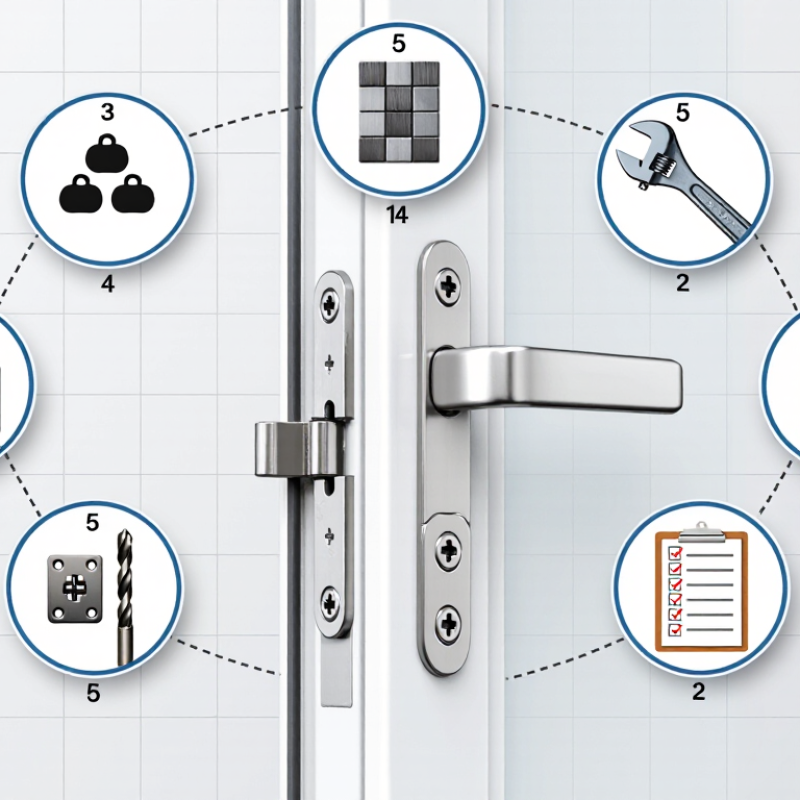
Table of Contents [Hide]
Identify the Hinge Type That Matches Your UPVC Door
Before buying, identify how the existing hinge sits on the door. Flag hinges are common on UPVC doors and are visible when the door is open. Butt hinges may sit differently, while rebated hinges suit doors with a stepped edge. These types are not automatically interchangeable. Check the door edge, frame, and hinge shape rather than relying on appearance alone.
Take clear photos of each hinge, including its screw positions and adjustment points. Measure the fixing centres and note the hinge’s height, width, and stack height. Check whether the door opens left or right, too. A small mismatch can leave the door rubbing the frame or prevent the cover caps from fitting. A close match matters.
The technical standard BS EN 1935:2002 classifies single-axis hinges by performance, including endurance; its top endurance grade covers 200,000 test cycles. Treat that as a useful comparison, not a guarantee that any hinge will suit your door. Door weight, hinge spacing, and the UPVC profile also affect suitability. I would recheck the existing hinge model and measurements before ordering—photos can hide a few millimetres. If the type remains unclear, ask a qualified door installer to identify it from the door and frame.





