


- Home
- A-Z Catalogue
- Products
- Valves
- Cetop
- Manual Directional Valves
- Proportional Valves
- Poppet Valves
- High-Speed Linear Servo Valves
- All High-Speed Linear Servo Valves
- Cetop 10 (NG32) Two Stage Type High Speed Linear Servo Valves – LSVHG-10
- Cetop 10 (NG32) Two Stage Type High Speed Linear Servo Valves – LSVHG-10 (With Fail-Safe)
- Cetop 8 (NG25) Two Stage Type High Speed Linear Servo Valves – LSVHG-06
- Cetop 8 (NG25) Two Stage Type High Speed Linear Servo Valves – LSVHG-06 (With Fail-Safe)
- Cetop 7 (NG16) Two Stage Type High Speed Linear Servo Valves – LSVHG-04
- Cetop 7 (NG16) Two Stage Type High Speed Linear Servo Valves – LSVHG-04 (With Fail-Safe)
- Cetop 5 (NG10) Direct Type High Speed Linear Servo Valves – LSVG-03
- Cetop 5 (NG10) OBE Type Direct Operated Linear Servo Valves – LSVG-03-EH
- Cetop 3 (NG6) OBE Type Direct Operated Linear Servo Valves – LSVG-01-EH
- Pumps
- Pressure control
- Flow Control Valves
- Pressure Control Valves
- All Pressure Control Valves
- Brake Valves
- Direct Relief Valve
- Low Noise Solenoid Controlled Relief Valves
- Low Noise Pilot Operated Relief Valves
- Pilot Operated Relief Valves
- Pressure reducing and relieving valves
- Pressure reducing and check valves
- Pressure control valves
- Remote Control Relief Valves
- Solenoid Controlled Relief Valves – BSG
- Solenoid Controlled Relief Valves – BST
- Unloading relief valves
- Check valves
- Environmental
- Valves
- Hydraulic Systems
- Power pack
- About Us
- Contact
- Blog

What Is a Street Outdoor Light and Which Type Is Best?
A Street Outdoor Light is a purpose-built fixture that illuminates roads, sidewalks, crossings, and public spaces after dark. It is more than a lamp on a pole. Its optics direct light toward walking and driving surfaces, while its mounting height and spacing shape visibility along the street. Small details matter: a poorly aimed fixture can leave a crosswalk dim or send unwanted glare into nearby windows.
The choice is not simply “brightest wins.” The Illuminating Engineering Society’s RP-8 guidance emphasizes visibility, consistent light distribution, and glare control in roadway design. The U.S. Department of Energy has reported that LED street-lighting upgrades can reduce energy use by 50% or more, depending on the existing equipment and project design. Useful potential. Not a guarantee. Results vary with fixture selection, dimming controls, operating hours, and maintenance.
For many streets, LED fixtures are a practical starting point because they offer efficient light output and flexible controls. Yet the best option depends on the setting: a residential lane, busy intersection, and pedestrian plaza need different beam patterns and light levels. A decorative post-top fixture may suit a plaza, while a cutoff roadway luminaire may better control spill on a traffic corridor. There is no universal winner. Even a well-designed plan can miss the mark if real street conditions are overlooked. This guide explains the main Street Outdoor Light types and how to compare them by visibility, efficiency, durability, and application.
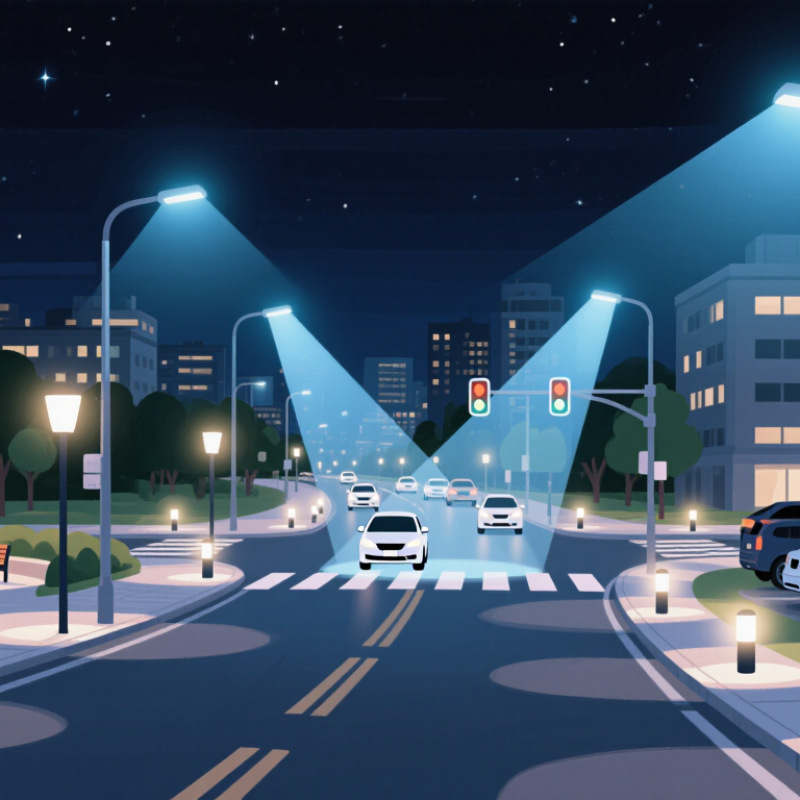
Table of Contents [Hide]
What Defines a Street Outdoor Light? ANSI/IES RP-8-22 Roadway Scope
A street outdoor light is not defined by its pole alone. Under ANSI/IES RP-8-22, roadway lighting is considered as part of a designed environment that supports visibility for drivers, pedestrians, and other road users. The practice addresses roadway and parking-facility lighting, with guidance shaped by conditions such as road layout, traffic, and surrounding activity. Context matters.
That means a suitable street light must do more than make the pavement look bright. Its light distribution, mounting height, spacing, and output affect how evenly people can see the road, crossings, and nearby objects. A bright patch beneath a pole can still leave dark gaps between fixtures. Glare can also make details harder to distinguish, especially on a wet street. Small design choices matter.
RP-8-22 provides professional recommendations, not a single fixture specification for every street. Designers assess the location and select lighting to meet its visual needs while considering energy use and maintenance. A quiet residential road and a busy intersection do not call for identical layouts. I would be cautious about choosing by lumen output alone; it is easy to overlook uniformity and pedestrian visibility. The standard helps structure that judgment, though real sites can be imperfect and may need review after installation.





