


- Home
- A-Z Catalogue
- Products
- Valves
- Cetop
- Manual Directional Valves
- Proportional Valves
- Poppet Valves
- High-Speed Linear Servo Valves
- All High-Speed Linear Servo Valves
- Cetop 10 (NG32) Two Stage Type High Speed Linear Servo Valves – LSVHG-10
- Cetop 10 (NG32) Two Stage Type High Speed Linear Servo Valves – LSVHG-10 (With Fail-Safe)
- Cetop 8 (NG25) Two Stage Type High Speed Linear Servo Valves – LSVHG-06
- Cetop 8 (NG25) Two Stage Type High Speed Linear Servo Valves – LSVHG-06 (With Fail-Safe)
- Cetop 7 (NG16) Two Stage Type High Speed Linear Servo Valves – LSVHG-04
- Cetop 7 (NG16) Two Stage Type High Speed Linear Servo Valves – LSVHG-04 (With Fail-Safe)
- Cetop 5 (NG10) Direct Type High Speed Linear Servo Valves – LSVG-03
- Cetop 5 (NG10) OBE Type Direct Operated Linear Servo Valves – LSVG-03-EH
- Cetop 3 (NG6) OBE Type Direct Operated Linear Servo Valves – LSVG-01-EH
- Pumps
- Pressure control
- Flow Control Valves
- Pressure Control Valves
- All Pressure Control Valves
- Brake Valves
- Direct Relief Valve
- Low Noise Solenoid Controlled Relief Valves
- Low Noise Pilot Operated Relief Valves
- Pilot Operated Relief Valves
- Pressure reducing and relieving valves
- Pressure reducing and check valves
- Pressure control valves
- Remote Control Relief Valves
- Solenoid Controlled Relief Valves – BSG
- Solenoid Controlled Relief Valves – BST
- Unloading relief valves
- Check valves
- Environmental
- Valves
- Hydraulic Systems
- Power pack
- About Us
- Contact
- Blog

Why Choose Steel Slotted Shelving for Global Sourcing?
Why Choose Steel Slotted Shelving for Global Sourcing?
Global sourcing demands more than a low unit price. It requires dependable materials, repeatable production, and practical shipping decisions. Steel Slotted shelving offers a proven storage structure for warehouses, workshops, archives, and retail backrooms. Its upright posts and adjustable beams allow buyers to change shelf heights as inventory changes. That flexibility can reduce redesign costs over time.
In sourcing projects, small details often decide performance. Buyers should review steel thickness, load ratings, coating quality, shelf dimensions, and assembly methods. A sample inspection can reveal uneven slots, weak welds, or scratched finishes before a larger order begins. Supplier experience also matters. Reliable manufacturers provide clear drawings, inspection records, packaging details, and consistent communication across time zones. These signals support better purchasing decisions.
Shipping conditions deserve attention too. Knock-down components can use container space efficiently, but poorly protected edges may arrive damaged. Strong cartons, corner guards, and moisture-resistant wrapping are practical safeguards. Nothing is perfect. A shelf may meet its rated capacity yet perform poorly on an uneven floor or with careless loading. This is where professional judgment matters. Buyers should compare test results with real warehouse conditions, not rely on attractive photos alone. Steel Slotted shelving is not automatically the best choice for every project. However, when specifications, supplier verification, and field requirements align, it can provide a durable and adaptable foundation for international procurement.
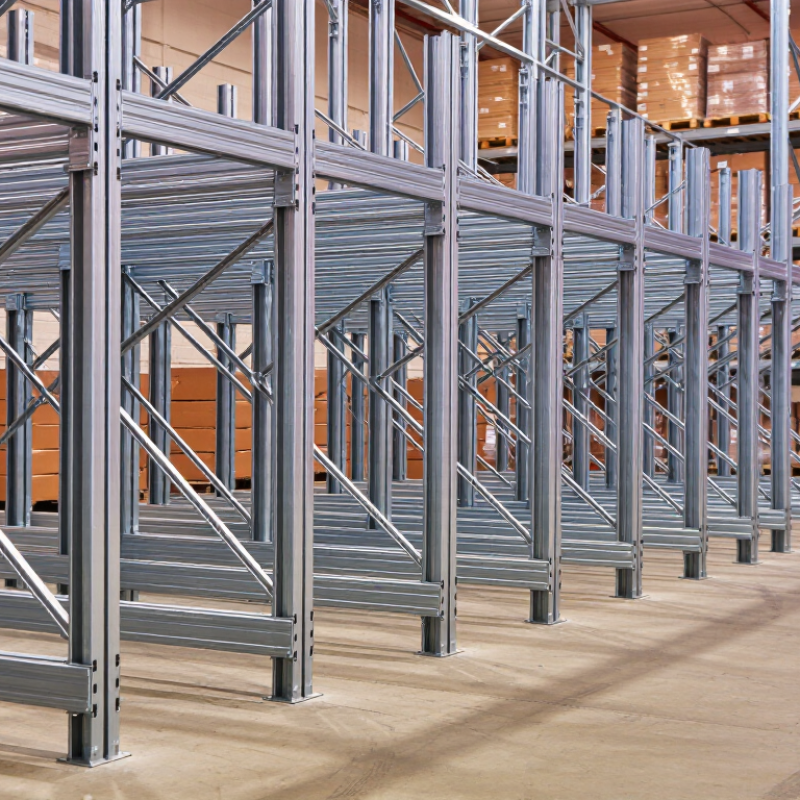
Table of Contents [Hide]
Steel Slotted Shelving: Definition and Core Design Features
Steel slotted shelving is a modular storage system made from steel uprights, horizontal panels, and connecting braces. Its vertical frames contain repeated slots, allowing shelves to move up or down without welding. This simple structure supports cartons, tools, spare parts, and packaged components in many warehouse environments.
The core design is easy to recognize. Uprights carry the vertical load, while beams or shelf panels distribute weight across the bay. Bolted or clipped joints make assembly practical during warehouse changes. Adjustable spacing helps buyers store both shallow trays and taller cartons. Steel construction also resists daily impact better than many lightweight alternatives. However, capacity depends on shelf length, steel thickness, connection quality, and load placement. Appearance alone is not enough.
A reliable sourcing review should check dimensions, surface treatment, packaging, and test documentation. Powder coating can reduce surface corrosion, but it cannot repair poor storage conditions. Inspect slot alignment and frame straightness before installation. Small errors matter. I have seen shelving appear robust, yet flex when loads were placed unevenly. This is a useful reminder: rated capacity must be verified under defined conditions. Global buyers should also confirm measurement units, assembly instructions, replacement-part availability, and local safety requirements. Design flexibility is valuable, but excessive adjustability may create confusion without clear labeling.
Why Choose Steel Slotted Shelving for Global Sourcing? - Steel Slotted Shelving: Definition and Core Design Features
| Data Dimension | Typical Specification or Fact | Why It Matters for Global Sourcing | Recommended Verification Point |
|---|---|---|---|
| Definition | A modular storage system made from steel uprights, horizontal shelves, and connecting components. The uprights contain regularly spaced slots or perforations for shelf adjustment. | The basic structure is easy to understand, compare, manufacture, pack, and assemble across different supply markets. | Confirm whether the design uses bolts, clips, brackets, or a combination of fastening methods. |
| Common Overall Dimensions | Typical configurations range from approximately 900–2,400 mm in height, 600–1,200 mm in width, and 300–600 mm in depth. | Standardized dimensions can simplify warehouse planning, container loading, replacement, and future expansion. | Request a dimensional drawing showing the external size, usable shelf size, and upright clearance. |
| Shelf Adjustment | Shelf levels are commonly adjustable through regularly spaced slots, often using increments of about 25–50 mm. | Adjustability supports mixed inventory sizes and reduces the need to purchase different rack types for every application. | Check the slot pitch, adjustment range, and whether tools are required for repositioning. |
| Steel Material | Cold-formed or rolled carbon steel is commonly used. Sheet thickness frequently falls within approximately 0.8–1.5 mm, depending on the component and rated load. | Material selection affects strength, weight, corrosion resistance, freight cost, and long-term service life. | Obtain the material grade, component thickness, and test documentation rather than relying only on nominal product names. |
| Shelf Load Capacity | Light- to medium-duty shelves commonly support about 50–300 kg per level when the load is evenly distributed. Higher ratings require specific structural designs. | A clearly defined load rating helps prevent overloading, product damage, and safety problems in different operating locations. | Verify whether the rating is per shelf or per bay, and whether it applies to evenly distributed or point-loaded cargo. |
| Load Deflection | Shelf performance is commonly evaluated by measuring vertical deflection under load. The acceptable limit depends on the design specification and intended use. | Two shelves with the same stated capacity may perform differently if their stiffness and deflection control are not equivalent. | Ask for the test load, span, loading method, and measured deflection value. |
| Surface Finish | Common finishes include powder coating, painted steel, and zinc-plated or galvanized components. Powder coating is widely used for indoor storage applications. | The finish influences corrosion resistance, appearance, cleaning requirements, and suitability for humid environments. | Specify coating type, coating thickness, color reference, pretreatment, and corrosion-testing requirements where applicable. |
| Assembly Method | Systems may be assembled with bolts and nuts, slot-in connectors, shelf clips, or mixed fastening systems. Many designs can be assembled without welding at the installation site. | Knock-down assembly can reduce shipping volume and make installation easier in overseas warehouses. | Confirm the included hardware, required tools, assembly time, and availability of illustrated instructions. |
| Modularity | Shelves, dividers, panels, drawers, and additional bays can often be added or repositioned, provided that the components use compatible dimensions and slots. | Modular components can support changing inventory profiles and reduce the cost of replacing an entire storage system. | Confirm interchangeability between batches and request a component compatibility list. |
| Packaging Efficiency | Knock-down steel shelving is commonly shipped in bundled or flat-packed form, which reduces shipping volume compared with fully assembled units. | Compact packing can improve container utilization and lower handling and international freight costs. | Request carton dimensions, gross weight, packing quantity, pallet requirements, and packaging-drop-test details. |
| Safety and Stability | Tall or heavily loaded units may require leveling feet, wall anchoring, bay linking, back bracing, or other anti-tip measures. | Stability requirements can vary according to height, floor condition, seismic risk, and local workplace rules. | Confirm the maximum recommended height-to-depth ratio and the required anchoring or bracing method. |
| Quality Control Records | Useful records include dimensional inspection reports, coating checks, weld or connection inspections where applicable, and load-performance test results. | Documented inspection criteria make it easier to compare suppliers and maintain consistent quality across repeat orders. | Agree on approved samples, inspection tolerances, sampling levels, and corrective-action procedures before production. |
| Best-Fit Applications | Suitable for warehouses, workshops, archives, retail back rooms, maintenance stores, and general inventory areas when the selected capacity and stability features match the application. | The broad application range supports standardized sourcing for multiple facilities and inventory categories. | Match the shelving specification to item weight, dimensions, handling frequency, environmental conditions, and local safety requirements. |
Note: The specifications above are typical industry ranges for general steel slotted shelving. Actual capacity, dimensions, materials, and safety requirements vary by design and must be confirmed through the supplier’s technical drawings and test documentation.





