


- Home
- A-Z Catalogue
- Products
- Valves
- Cetop
- Manual Directional Valves
- Proportional Valves
- Poppet Valves
- High-Speed Linear Servo Valves
- All High-Speed Linear Servo Valves
- Cetop 10 (NG32) Two Stage Type High Speed Linear Servo Valves – LSVHG-10
- Cetop 10 (NG32) Two Stage Type High Speed Linear Servo Valves – LSVHG-10 (With Fail-Safe)
- Cetop 8 (NG25) Two Stage Type High Speed Linear Servo Valves – LSVHG-06
- Cetop 8 (NG25) Two Stage Type High Speed Linear Servo Valves – LSVHG-06 (With Fail-Safe)
- Cetop 7 (NG16) Two Stage Type High Speed Linear Servo Valves – LSVHG-04
- Cetop 7 (NG16) Two Stage Type High Speed Linear Servo Valves – LSVHG-04 (With Fail-Safe)
- Cetop 5 (NG10) Direct Type High Speed Linear Servo Valves – LSVG-03
- Cetop 5 (NG10) OBE Type Direct Operated Linear Servo Valves – LSVG-03-EH
- Cetop 3 (NG6) OBE Type Direct Operated Linear Servo Valves – LSVG-01-EH
- Pumps
- Pressure control
- Flow Control Valves
- Pressure Control Valves
- All Pressure Control Valves
- Brake Valves
- Direct Relief Valve
- Low Noise Solenoid Controlled Relief Valves
- Low Noise Pilot Operated Relief Valves
- Pilot Operated Relief Valves
- Pressure reducing and relieving valves
- Pressure reducing and check valves
- Pressure control valves
- Remote Control Relief Valves
- Solenoid Controlled Relief Valves – BSG
- Solenoid Controlled Relief Valves – BST
- Unloading relief valves
- Check valves
- Environmental
- Valves
- Hydraulic Systems
- Power pack
- About Us
- Contact
- Blog

What Is a Solar Energy Light Pole and How Does It Work?
A solar energy light pole is a standalone outdoor lighting system that combines a photovoltaic panel, battery, LED fixture, controller, and supporting pole. During daylight, the panel converts sunlight into electricity and stores it in the battery. After sunset, the controller powers the LED light, often using programmed dimming or motion detection. No trenching is normally required.
The technology reflects a wider shift toward distributed solar power. The International Energy Agency’s Renewables 2023 report expects solar photovoltaic and wind power to provide about 95% of global renewable capacity growth through 2028. IRENA’s Renewable Capacity Statistics 2024 also recorded roughly 1,419 gigawatts of global solar capacity at the end of 2023. These figures do not directly measure solar street lighting, but they show why solar components are becoming more accessible and familiar.
Real performance depends on more than panel wattage. A coastal pole may face salt corrosion, while a shaded pathway may receive limited winter charging. Battery chemistry, autonomy days, LED optics, pole height, and local weather records all matter. Professional designers should review illuminance targets, glare control, wind loading, and relevant IEC or local lighting requirements. Photometric testing is valuable because a bright lamp can still leave dark gaps.
The system is not maintenance-free. Batteries age. Panels collect dust. Controllers can fail quietly. A careful specification should include realistic nighttime runtime and replacement access, not only attractive energy-saving claims. The IEA and IRENA provide strong market evidence, yet site-specific engineering remains essential. That distinction is easy to miss.
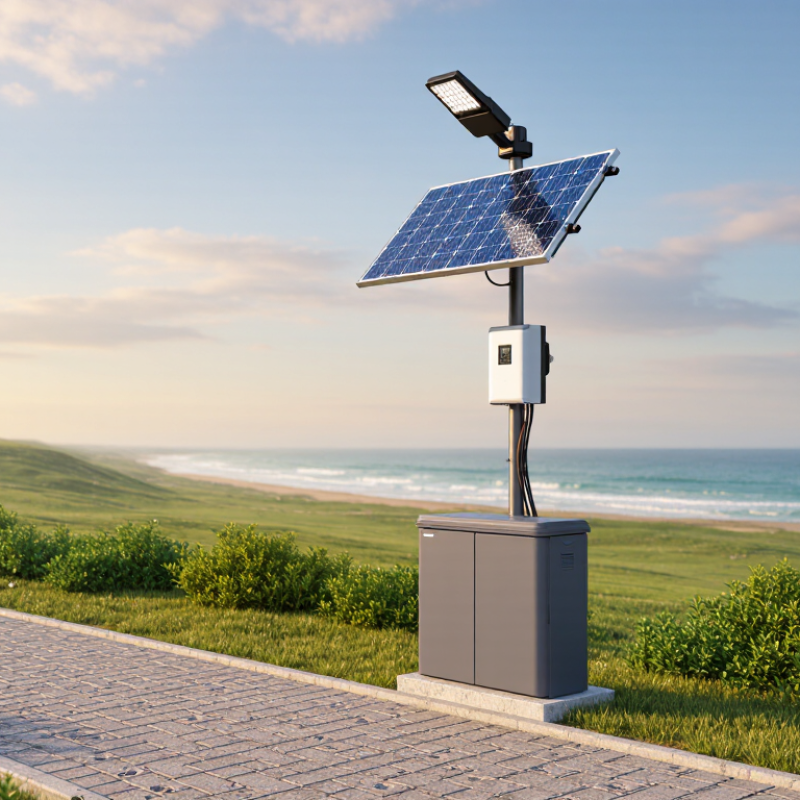
Table of Contents [Hide]
Definition and Main Components of a Solar Energy Light Pole
What Is a Solar Energy Light Pole and How Does It Work?
A solar energy light pole is an independent outdoor lighting system powered by sunlight. Its main components include a photovoltaic panel, charge controller, rechargeable battery, LED luminaire, pole, wiring, and protective enclosure. During daylight, the panel converts sunlight into electricity. The controller regulates charging and helps protect the battery from overcharging or deep discharge. After sunset, stored energy powers the LED fixture, often through a timer or motion sensor.
The International Renewable Energy Agency reported 1,419 GW of global solar photovoltaic capacity at the end of 2023. That scale reflects solar’s growing technical maturity, although a light pole still depends heavily on local conditions. The U.S. Department of Energy notes that LED lighting uses at least 75% less energy and can last up to 25 times longer than incandescent lighting. This makes LEDs suitable for limited battery capacity.
The battery is the system’s quiet risk. Poor sizing can leave a pathway dark after several cloudy nights. Engineers therefore consider solar radiation, winter temperatures, lighting hours, battery chemistry, and required autonomy. A practical design may use a dusk-to-dawn setting, reduced midnight brightness, and motion-based boosting. These details improve endurance, but they also add control complexity. Dust, shade, loose connections, and snow can reduce real-world output. Field inspections still matter. A specification sheet cannot fully predict every installation site.





