


- Home
- A-Z Catalogue
- Products
- Valves
- Cetop
- Manual Directional Valves
- Proportional Valves
- Poppet Valves
- High-Speed Linear Servo Valves
- All High-Speed Linear Servo Valves
- Cetop 10 (NG32) Two Stage Type High Speed Linear Servo Valves – LSVHG-10
- Cetop 10 (NG32) Two Stage Type High Speed Linear Servo Valves – LSVHG-10 (With Fail-Safe)
- Cetop 8 (NG25) Two Stage Type High Speed Linear Servo Valves – LSVHG-06
- Cetop 8 (NG25) Two Stage Type High Speed Linear Servo Valves – LSVHG-06 (With Fail-Safe)
- Cetop 7 (NG16) Two Stage Type High Speed Linear Servo Valves – LSVHG-04
- Cetop 7 (NG16) Two Stage Type High Speed Linear Servo Valves – LSVHG-04 (With Fail-Safe)
- Cetop 5 (NG10) Direct Type High Speed Linear Servo Valves – LSVG-03
- Cetop 5 (NG10) OBE Type Direct Operated Linear Servo Valves – LSVG-03-EH
- Cetop 3 (NG6) OBE Type Direct Operated Linear Servo Valves – LSVG-01-EH
- Pumps
- Pressure control
- Flow Control Valves
- Pressure Control Valves
- All Pressure Control Valves
- Brake Valves
- Direct Relief Valve
- Low Noise Solenoid Controlled Relief Valves
- Low Noise Pilot Operated Relief Valves
- Pilot Operated Relief Valves
- Pressure reducing and relieving valves
- Pressure reducing and check valves
- Pressure control valves
- Remote Control Relief Valves
- Solenoid Controlled Relief Valves – BSG
- Solenoid Controlled Relief Valves – BST
- Unloading relief valves
- Check valves
- Environmental
- Valves
- Hydraulic Systems
- Power pack
- About Us
- Contact
- Blog

10 Smart Street Light Buying Tips for Global Buyers
A Smart Street Light can do more than illuminate a road. It can dim when streets are quiet, report faults remotely, and help cities manage energy use. But a connected fixture is only valuable when it fits local roads, maintenance capacity, and network conditions. Small details matter: lens shape, pole spacing, salt air, dust, and the reach of a service crew.
The International Energy Agency reports that lighting uses about 15% of global electricity and produces roughly 5% of global greenhouse gas emissions. Those figures make efficiency worth serious attention, but they do not guarantee savings from any particular product. Mark Rea, former director of the Lighting Research Center, has described light as “a drug”—a reminder that lighting affects people, not only power bills. Buyers should assess visibility and glare alongside wattage. A bright specification sheet is not a lighting plan.
This guide outlines ten practical checks for global buyers: photometric evidence, controls, interoperability, environmental ratings, component life, warranties, cybersecurity, certifications, lifecycle cost, and supplier support. Ask for test reports, not just catalog claims. Request clear details on dimming protocols, replacement parts, and software updates. Pilot the system on representative streets before scaling up. That takes time. It may also expose awkward gaps in the specification. Better to find them early. A careful purchase balances measurable performance with the less tidy realities of installation and upkeep.
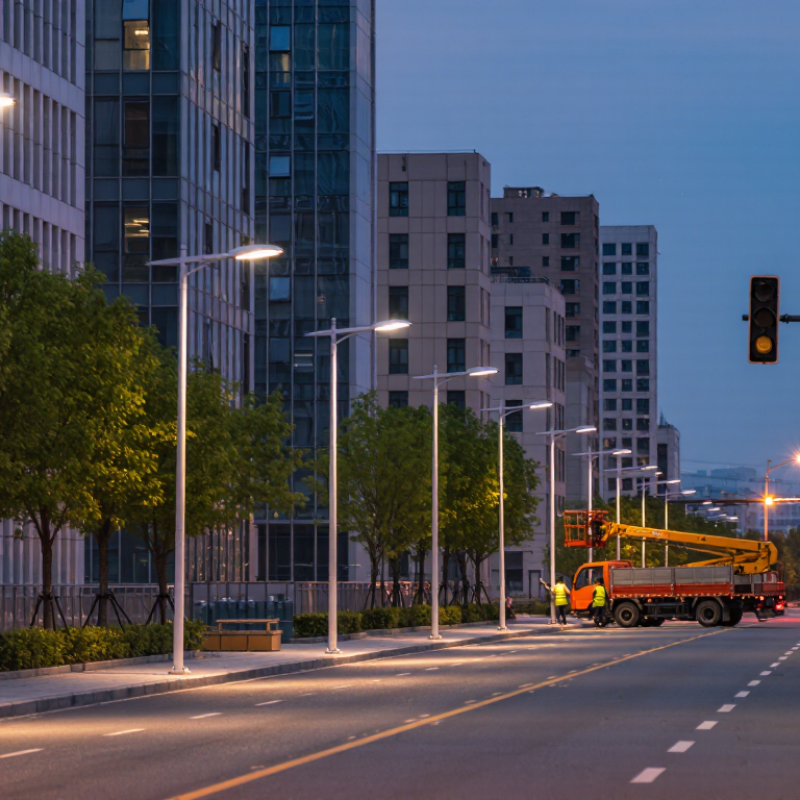
Table of Contents [Hide]
Assessing Project Needs and Local Street Lighting Requirements
Before requesting quotations, define what each road and public space needs. A residential lane, a market street, and a highway junction require different light levels and distribution. Walk the site after dark, noting pole spacing, tree cover, crossings, dark patches, and nearby homes. Measure at night. A simple map with pole locations and photographs can reveal gaps that daytime surveys miss.
Check local authority specifications for illuminance, uniformity, glare, color temperature, and permitted dimming schedules. Requirements may differ between road classes, and a neighboring city’s design is not reliable evidence. Ask the responsible municipal department or a qualified lighting engineer to confirm the applicable standard. Then assess local conditions: coastal salt, dust, heavy rain, extreme heat, or unstable power can affect equipment choices and maintenance intervals. Consider whether crews can safely reach each pole and whether replacement parts are readily available. Practical details matter.
Match controls to local capacity. Networked dimming may reduce energy use, but only if staff can manage the system and communications remain dependable. Check electricity tariffs, operating hours, and existing wiring before estimating savings. Plans can miss seasonal foliage or temporary road changes. That happens. Leave room for a site review and adjust quantities before purchase.





