


- Home
- A-Z Catalogue
- Products
- Valves
- Cetop
- Manual Directional Valves
- Proportional Valves
- Poppet Valves
- High-Speed Linear Servo Valves
- All High-Speed Linear Servo Valves
- Cetop 10 (NG32) Two Stage Type High Speed Linear Servo Valves – LSVHG-10
- Cetop 10 (NG32) Two Stage Type High Speed Linear Servo Valves – LSVHG-10 (With Fail-Safe)
- Cetop 8 (NG25) Two Stage Type High Speed Linear Servo Valves – LSVHG-06
- Cetop 8 (NG25) Two Stage Type High Speed Linear Servo Valves – LSVHG-06 (With Fail-Safe)
- Cetop 7 (NG16) Two Stage Type High Speed Linear Servo Valves – LSVHG-04
- Cetop 7 (NG16) Two Stage Type High Speed Linear Servo Valves – LSVHG-04 (With Fail-Safe)
- Cetop 5 (NG10) Direct Type High Speed Linear Servo Valves – LSVG-03
- Cetop 5 (NG10) OBE Type Direct Operated Linear Servo Valves – LSVG-03-EH
- Cetop 3 (NG6) OBE Type Direct Operated Linear Servo Valves – LSVG-01-EH
- Pumps
- Pressure control
- Flow Control Valves
- Pressure Control Valves
- All Pressure Control Valves
- Brake Valves
- Direct Relief Valve
- Low Noise Solenoid Controlled Relief Valves
- Low Noise Pilot Operated Relief Valves
- Pilot Operated Relief Valves
- Pressure reducing and relieving valves
- Pressure reducing and check valves
- Pressure control valves
- Remote Control Relief Valves
- Solenoid Controlled Relief Valves – BSG
- Solenoid Controlled Relief Valves – BST
- Unloading relief valves
- Check valves
- Environmental
- Valves
- Hydraulic Systems
- Power pack
- About Us
- Contact
- Blog

What Is Sintered Stone and Why Is It So Popular?
sintered stone has moved from a specialist architectural product into kitchens, bathrooms, hotels, and outdoor living spaces. It is manufactured from carefully selected minerals, compressed under intense pressure, and treated at very high temperatures. This process creates a dense, non-porous surface with a stone-like appearance. The result feels solid beneath the hand, yet it can reproduce delicate marble veins, concrete textures, or warm wood patterns.
Designer Daniel Germani, a long-time collaborator in the sintered-stone sector, has described Dekton as “a blank canvas for design.” That idea explains much of its appeal. Designers can specify large slabs, slim profiles, and coordinated indoor-outdoor surfaces. A kitchen island may carry the same pattern onto a terrace wall. Daily stains usually remain on the surface rather than sinking into it. Cleaning often needs only water and a neutral product.
But popularity should not become marketing shorthand for perfection. Sintered stone is highly resistant to heat, scratches, ultraviolet light, and moisture. It can still chip at exposed edges, especially after poor cutting or careless installation. Heavy slabs also require accurate measurement, trained fabricators, and suitable support. A beautiful surface can fail when the substrate moves.
Environmental claims also deserve closer attention. Long service life can reduce replacement frequency, but manufacturing and transportation still consume energy. The material is impressive, not magical. Understanding its strengths, limitations, finish, thickness, and installation requirements helps homeowners choose it for the right reason: dependable performance with a refined visual character.
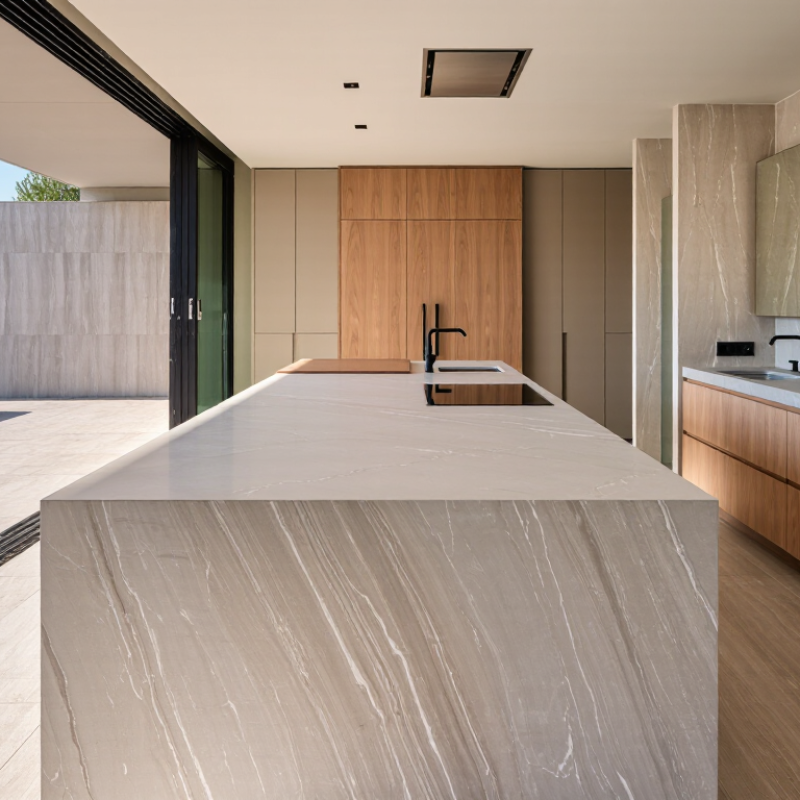
Table of Contents [Hide]
What Is Sintered Stone?
Sintered stone is an engineered mineral surface made from selected minerals, pigments, and natural stone-like particles. Manufacturers compress these materials under intense pressure, then fire them at very high temperatures. The European Commission’s 2020 Ceramic Manufacturing BREF places common ceramic firing temperatures around 1,000–1,250°C. This process creates a dense, non-porous slab with consistent color and pattern. Unlike many resin-based surfaces, sintered stone typically contains no polymer binder. It is not natural stone, either. The name can be confusing.
Its popularity comes from practical performance. Many products resist stains, moisture, ultraviolet exposure, and everyday abrasion. They can suit kitchen counters, bathroom walls, floors, and outdoor furniture. The ISO 13006 standard evaluates ceramic products through properties such as water absorption, but sintered stone is not automatically identical across manufacturers. Always check the technical sheet. Grand View Research estimated the global ceramic tiles market at about USD 227 billion in 2023, showing the scale of demand for durable mineral surfaces. That figure does not measure sintered stone alone. Still, it reflects a wider movement toward hard, low-maintenance finishes. The material is tough, but not indestructible. A sharp impact on an unsupported corner may still cause chipping.
Tips: Request water-absorption, slip-resistance, stain-resistance, and thermal-shock test results. Ask whether the slab follows ISO or ASTM testing methods. Inspect the edge detail before installation. Large slabs need accurate support, careful transport, and trained fabrication. Surface samples can also mislead; lighting may change how patterns appear.