


- Home
- A-Z Catalogue
- Products
- Valves
- Cetop
- Manual Directional Valves
- Proportional Valves
- Poppet Valves
- High-Speed Linear Servo Valves
- All High-Speed Linear Servo Valves
- Cetop 10 (NG32) Two Stage Type High Speed Linear Servo Valves – LSVHG-10
- Cetop 10 (NG32) Two Stage Type High Speed Linear Servo Valves – LSVHG-10 (With Fail-Safe)
- Cetop 8 (NG25) Two Stage Type High Speed Linear Servo Valves – LSVHG-06
- Cetop 8 (NG25) Two Stage Type High Speed Linear Servo Valves – LSVHG-06 (With Fail-Safe)
- Cetop 7 (NG16) Two Stage Type High Speed Linear Servo Valves – LSVHG-04
- Cetop 7 (NG16) Two Stage Type High Speed Linear Servo Valves – LSVHG-04 (With Fail-Safe)
- Cetop 5 (NG10) Direct Type High Speed Linear Servo Valves – LSVG-03
- Cetop 5 (NG10) OBE Type Direct Operated Linear Servo Valves – LSVG-03-EH
- Cetop 3 (NG6) OBE Type Direct Operated Linear Servo Valves – LSVG-01-EH
- Pumps
- Pressure control
- Flow Control Valves
- Pressure Control Valves
- All Pressure Control Valves
- Brake Valves
- Direct Relief Valve
- Low Noise Solenoid Controlled Relief Valves
- Low Noise Pilot Operated Relief Valves
- Pilot Operated Relief Valves
- Pressure reducing and relieving valves
- Pressure reducing and check valves
- Pressure control valves
- Remote Control Relief Valves
- Solenoid Controlled Relief Valves – BSG
- Solenoid Controlled Relief Valves – BST
- Unloading relief valves
- Check valves
- Environmental
- Valves
- Hydraulic Systems
- Power pack
- About Us
- Contact
- Blog

Why Choose a Single Line Single Hose LNG Dispenser?
A Single-Line and Single-Hose LNG Dispenser can be a practical choice for sites with steady, predictable fueling demand. Its straightforward layout gives operators one dispensing point to monitor, maintain, and explain to drivers. In a compact station, fewer hoses can also make the fueling area easier to organize. The benefit is clear. But simplicity alone does not guarantee better performance.
LNG is stored at cryogenic temperatures, so the dispenser must be designed for compatible materials, secure connections, accurate metering, and controlled operation. Operators should assess expected vehicle volume, fueling time, storage capacity, and maintenance access before selecting a configuration. A single hose may suit a fleet with consistent vehicle requirements, yet it can limit flexibility when several vehicles need service at once. Small details matter: hose reach, connector handling, clear operating instructions, and accessible emergency shutoffs all affect daily use. These are not decorative features.
This guide considers where a single-line, single-hose design fits, what trade-offs deserve attention, and which technical questions buyers should raise with qualified suppliers. Product specifications and site conditions vary, so claims about efficiency or cost should be checked against real operating data. There is room for doubt. A well-matched dispenser can support reliable service, but the right choice depends on the station—not just the equipment.
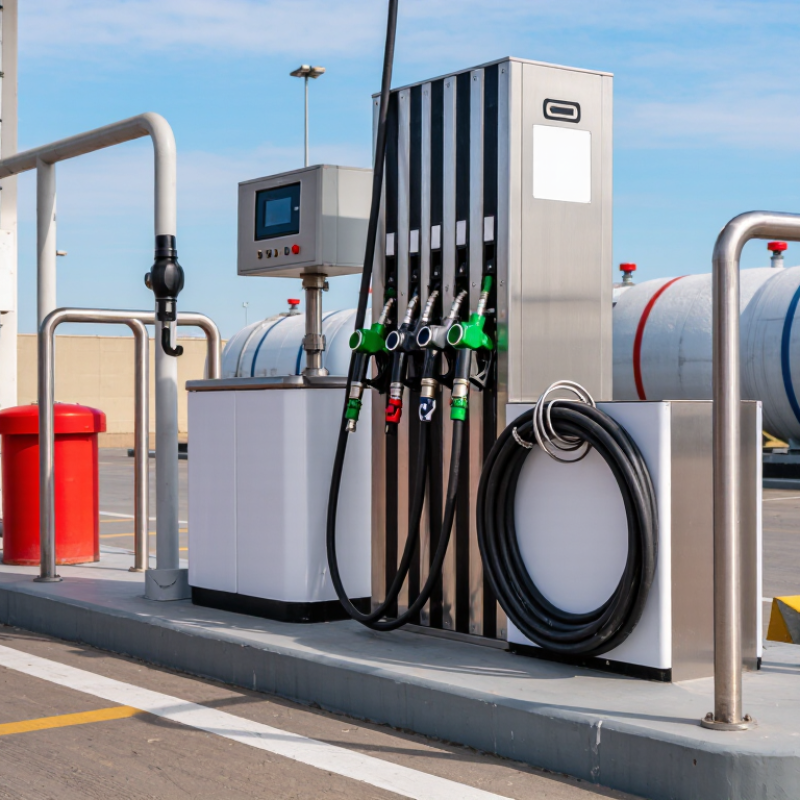
Table of Contents [Hide]
What Is a Single-Line, Single-Hose LNG Dispenser?
A single-line, single-hose LNG dispenser delivers liquefied natural gas through one supply path and one fueling hose. The hose is insulated to limit heat transfer, and its coupling is designed for cryogenic service. During fueling, an operator connects the nozzle to the vehicle’s receptacle, checks the connection, and starts the dispensing sequence.
One hose, one connection.
The exact arrangement of valves, meters, and return paths varies by equipment design, so “single-line” should not be taken to mean every dispenser works identically.
This layout can make the fueling area easier to navigate, with fewer hoses to position around a vehicle. It can also simplify routine tasks such as inspecting the hose and keeping the nozzle stored correctly.
Still, simplicity is not the same as risk-free operation. LNG is extremely cold, and a damaged seal or poorly connected coupler can create a serious hazard. Operators need clear procedures, suitable protective equipment, and regular checks of the hose, fittings, and safety controls.
A single-hose unit serves one vehicle connection at a time; that may suit a modest fueling site, but it can limit throughput when several vehicles arrive together. The best choice depends on actual demand, vehicle compatibility, and the dispenser’s documented operating limits.





