


- Home
- A-Z Catalogue
- Products
- Valves
- Cetop
- Manual Directional Valves
- Proportional Valves
- Poppet Valves
- High-Speed Linear Servo Valves
- All High-Speed Linear Servo Valves
- Cetop 10 (NG32) Two Stage Type High Speed Linear Servo Valves – LSVHG-10
- Cetop 10 (NG32) Two Stage Type High Speed Linear Servo Valves – LSVHG-10 (With Fail-Safe)
- Cetop 8 (NG25) Two Stage Type High Speed Linear Servo Valves – LSVHG-06
- Cetop 8 (NG25) Two Stage Type High Speed Linear Servo Valves – LSVHG-06 (With Fail-Safe)
- Cetop 7 (NG16) Two Stage Type High Speed Linear Servo Valves – LSVHG-04
- Cetop 7 (NG16) Two Stage Type High Speed Linear Servo Valves – LSVHG-04 (With Fail-Safe)
- Cetop 5 (NG10) Direct Type High Speed Linear Servo Valves – LSVG-03
- Cetop 5 (NG10) OBE Type Direct Operated Linear Servo Valves – LSVG-03-EH
- Cetop 3 (NG6) OBE Type Direct Operated Linear Servo Valves – LSVG-01-EH
- Pumps
- Pressure control
- Flow Control Valves
- Pressure Control Valves
- All Pressure Control Valves
- Brake Valves
- Direct Relief Valve
- Low Noise Solenoid Controlled Relief Valves
- Low Noise Pilot Operated Relief Valves
- Pilot Operated Relief Valves
- Pressure reducing and relieving valves
- Pressure reducing and check valves
- Pressure control valves
- Remote Control Relief Valves
- Solenoid Controlled Relief Valves – BSG
- Solenoid Controlled Relief Valves – BST
- Unloading relief valves
- Check valves
- Environmental
- Valves
- Hydraulic Systems
- Power pack
- About Us
- Contact
- Blog

What Is PUR Block Foam and What Is It Used For?
PUR Block Foam is a versatile polyurethane material produced in large buns or blocks, then cut into practical shapes. It is formed when polyols react with isocyanates, creating a cellular structure with controlled softness, density, and resilience. Most flexible grades contain interconnected cells, allowing air to move through the foam. This structure explains its familiar springy feel.
Industry research shows why this material remains commercially important. Grand View Research identifies flexible polyurethane foam as a major segment within the global polyurethane foam market, supported by furniture, bedding, automotive, and interior applications. The American Chemistry Council also describes polyurethane as a key material family used in comfort, insulation, and transportation products. However, market figures differ between reports because some include rigid foam, coatings, adhesives, or finished products. The numbers are useful, but not perfectly comparable.
In manufacturing, block foam may be sliced into mattress layers, sofa cushions, carpet underlay, acoustic panels, filters, and protective packaging. A warehouse worker might see the process clearly: a large foam bun enters a cutting line, while thin sheets leave with consistent thickness. Density and hardness must match the final use. Otherwise, a cushion may collapse early, or an acoustic panel may perform poorly.
Performance depends on formulation, cell structure, aging, humidity, temperature, and cutting accuracy. There is no universal grade. ASTM testing, supplier certificates, and application trials should guide selection. This practical caution matters because attractive specifications can hide weak long-term performance. PUR Block Foam is highly adaptable, but responsible buyers should verify test conditions, fire performance, emissions, and durability before approving it for production.
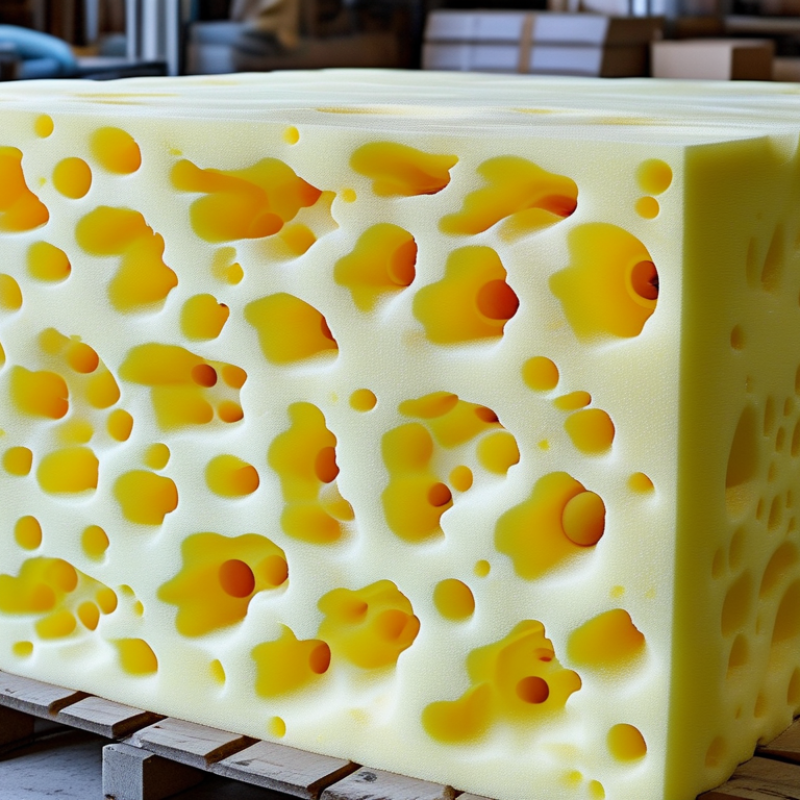
Table of Contents [Hide]
Definition and Basic Structure of PUR Block Foam
What Is PUR Block Foam and What Is It Used For?
PUR block foam is polyurethane foam manufactured as a large, continuous block. PUR means polyurethane, a polymer formed by reacting polyols with isocyanates. During production, a controlled chemical reaction releases gas and expands the material. This creates millions of small cells throughout the block.
Most flexible PUR block foam has an open-cell structure. Each cell connects with nearby cells, allowing air to move through the foam when it is compressed. The soft, springy feel comes from these elastic cell walls.
A typical block may show a fine texture at the cut surface, although the structure is rarely perfectly uniform. Density, hardness, cell size, and resilience can change from the center to the edges.
The block is usually cut into sheets, rolls, cushions, pads, or shaped components. Its uses include seating, mattresses, acoustic panels, packaging inserts, filters, and protective padding.
Different applications require different grades. A seat cushion needs recovery after repeated pressure, while an acoustic panel depends more on airflow and surface area.
Simple visual inspection helps, but it cannot confirm performance. Testing is still needed for compression, durability, and fire behavior.
Even experienced users can misjudge foam by touch alone.
Temperature, moisture, and cutting quality also influence its service life.