


- Home
- A-Z Catalogue
- Products
- Valves
- Cetop
- Manual Directional Valves
- Proportional Valves
- Poppet Valves
- High-Speed Linear Servo Valves
- All High-Speed Linear Servo Valves
- Cetop 10 (NG32) Two Stage Type High Speed Linear Servo Valves – LSVHG-10
- Cetop 10 (NG32) Two Stage Type High Speed Linear Servo Valves – LSVHG-10 (With Fail-Safe)
- Cetop 8 (NG25) Two Stage Type High Speed Linear Servo Valves – LSVHG-06
- Cetop 8 (NG25) Two Stage Type High Speed Linear Servo Valves – LSVHG-06 (With Fail-Safe)
- Cetop 7 (NG16) Two Stage Type High Speed Linear Servo Valves – LSVHG-04
- Cetop 7 (NG16) Two Stage Type High Speed Linear Servo Valves – LSVHG-04 (With Fail-Safe)
- Cetop 5 (NG10) Direct Type High Speed Linear Servo Valves – LSVG-03
- Cetop 5 (NG10) OBE Type Direct Operated Linear Servo Valves – LSVG-03-EH
- Cetop 3 (NG6) OBE Type Direct Operated Linear Servo Valves – LSVG-01-EH
- Pumps
- Pressure control
- Flow Control Valves
- Pressure Control Valves
- All Pressure Control Valves
- Brake Valves
- Direct Relief Valve
- Low Noise Solenoid Controlled Relief Valves
- Low Noise Pilot Operated Relief Valves
- Pilot Operated Relief Valves
- Pressure reducing and relieving valves
- Pressure reducing and check valves
- Pressure control valves
- Remote Control Relief Valves
- Solenoid Controlled Relief Valves – BSG
- Solenoid Controlled Relief Valves – BST
- Unloading relief valves
- Check valves
- Environmental
- Valves
- Hydraulic Systems
- Power pack
- About Us
- Contact
- Blog

What Are Mechanical Parts and Their Types?
Mechanical Parts are the working elements that make machines move, connect, support, seal, or transfer force. A steel shaft carries torque through a gearbox. A bearing reduces friction around that shaft. A gear changes speed and direction, while a fastener holds two housings together under repeated vibration.
Henry Ford’s practical principle, “Nothing is particularly hard if you divide it into small jobs,” offers a useful way to understand these components. Each part has a defined function, but its performance depends on the surrounding assembly. A gear may appear simple. Its tooth profile, material hardness, lubrication, and alignment determine whether it runs smoothly or fails early.
This guide examines common types of Mechanical Parts, including structural components, power-transmission elements, fastening parts, seals, springs, and fluid-control components. It also considers the materials, tolerances, loads, and manufacturing methods behind them. These details matter. A small clearance can prevent overheating. A poor surface finish can damage a seal.
Real machines are rarely so tidy.
One component may fit several categories. A coupling joins shafts, yet it also transmits motion and absorbs misalignment. Classification can therefore vary between textbooks, manufacturers, and engineering teams. That uncertainty deserves attention, not concealment.
Reliable identification requires more than appearance. Engineers and technicians compare drawings, dimensions, material specifications, operating conditions, and inspection results. Standards such as ISO and ASME can support consistent decisions, but they do not replace professional judgment. By connecting theory with workshop realities, this article builds a clearer foundation for selecting, maintaining, and evaluating Mechanical Parts.
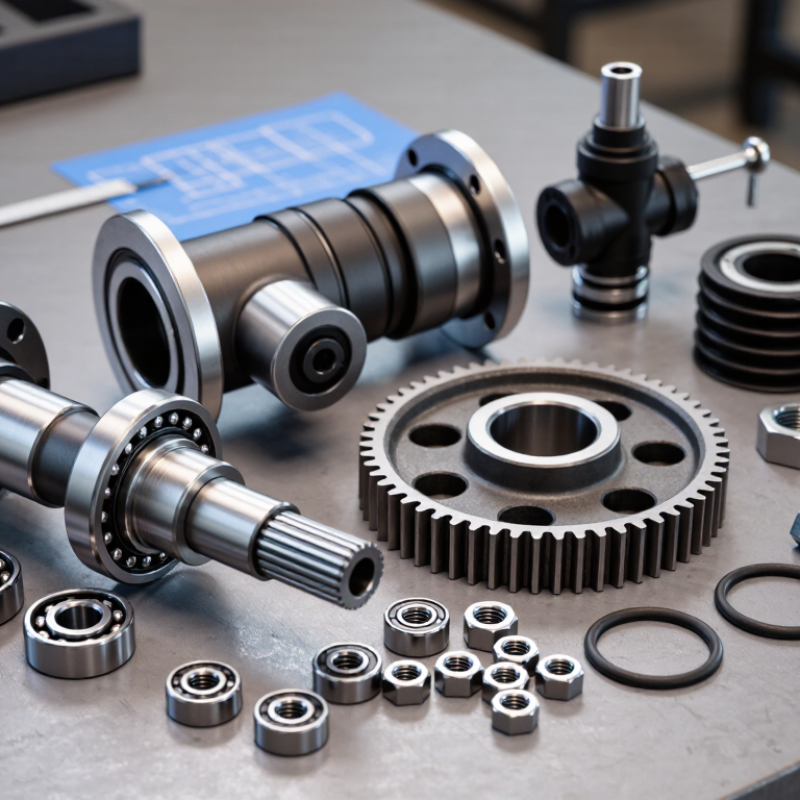
Table of Contents [Hide]
Defining Mechanical Parts Through ISO 286 Dimensional Tolerances
What Are Mechanical Parts and Their Types?
Mechanical parts include shafts, gears, bearings, fasteners, housings, and precision pins. Each part transfers motion, supports loads, or controls alignment. In practical machining, a part is not defined by shape alone. Its function also depends on measurable size limits.
ISO 286-1 and ISO 286-2 provide a global system for dimensional tolerances and fits. The system uses tolerance grades from IT01 through IT18. Smaller numbers indicate tighter control. For a nominal diameter between 30 and 50 mm, ISO 286-2 assigns approximately 25 micrometres to IT7. That is thinner than a human hair. A hole-basis fit commonly uses H for the hole, while the shaft receives a selected deviation. Clearance, transition, or interference then depends on both tolerance zones.
A quality engineer should verify these values with calibrated gauges and current drawings. Measurement uncertainty matters. A reported 25-micrometre tolerance is not automatically reliable. ISO 14253-1 requires decision rules when measurement results approach specification limits. That detail is often overlooked. So are temperature effects, burrs, coating thickness, and tool wear. The International Trade Centre’s 2023 machinery trade data also shows the global scale of mechanical equipment exchange, where consistent fit supports interchangeability across suppliers. Yet ISO 286 cannot solve every problem. Surface roughness, material expansion, and assembly force still need separate engineering controls.