


- Home
- A-Z Catalogue
- Products
- Valves
- Cetop
- Manual Directional Valves
- Proportional Valves
- Poppet Valves
- High-Speed Linear Servo Valves
- All High-Speed Linear Servo Valves
- Cetop 10 (NG32) Two Stage Type High Speed Linear Servo Valves – LSVHG-10
- Cetop 10 (NG32) Two Stage Type High Speed Linear Servo Valves – LSVHG-10 (With Fail-Safe)
- Cetop 8 (NG25) Two Stage Type High Speed Linear Servo Valves – LSVHG-06
- Cetop 8 (NG25) Two Stage Type High Speed Linear Servo Valves – LSVHG-06 (With Fail-Safe)
- Cetop 7 (NG16) Two Stage Type High Speed Linear Servo Valves – LSVHG-04
- Cetop 7 (NG16) Two Stage Type High Speed Linear Servo Valves – LSVHG-04 (With Fail-Safe)
- Cetop 5 (NG10) Direct Type High Speed Linear Servo Valves – LSVG-03
- Cetop 5 (NG10) OBE Type Direct Operated Linear Servo Valves – LSVG-03-EH
- Cetop 3 (NG6) OBE Type Direct Operated Linear Servo Valves – LSVG-01-EH
- Pumps
- Pressure control
- Flow Control Valves
- Pressure Control Valves
- All Pressure Control Valves
- Brake Valves
- Direct Relief Valve
- Low Noise Solenoid Controlled Relief Valves
- Low Noise Pilot Operated Relief Valves
- Pilot Operated Relief Valves
- Pressure reducing and relieving valves
- Pressure reducing and check valves
- Pressure control valves
- Remote Control Relief Valves
- Solenoid Controlled Relief Valves – BSG
- Solenoid Controlled Relief Valves – BST
- Unloading relief valves
- Check valves
- Environmental
- Valves
- Hydraulic Systems
- Power pack
- About Us
- Contact
- Blog

Top MCB Assembly Robot Manufacturers for Global Buyers
The global push toward smarter electrical manufacturing is reshaping how miniature circuit breakers are produced. The International Federation of Robotics reported 541,302 new industrial robots installed worldwide in 2023. Asia accounted for most installations, with China remaining the largest market. These figures show strong automation demand, but they do not guarantee reliable MCB production.
A capable Mcb Assembly Robot must do more than place components quickly. It should manage spring loading, contact installation, screw fastening, electrical testing, and final inspection with repeatable accuracy. Buyers should examine cycle time, torque control, vision performance, changeover design, and production traceability. Small errors matter. A poorly seated terminal can create costly rejects or safety concerns.
Standards matter too. IEC 60898-1 guides requirements for household and similar circuit breakers, while ISO 10218 supports industrial robot safety practices. Reputable manufacturers explain how their systems support these requirements. They also provide validation records, spare-parts planning, operator training, and responsive technical service.
This guide evaluates leading MCB assembly robot manufacturers for global buyers. It considers engineering capability, integration experience, quality systems, and after-sales support. Factory demonstrations can be useful. Yet demonstrations may hide difficult realities, such as mixed product models, unstable component feeding, or lengthy maintenance.
Look beyond speed.
The best supplier is not always the cheapest or most automated. A practical assessment should compare verified production results, total ownership costs, safety documentation, and local support. Industry reports offer valuable context, but each factory still requires careful technical review. That step is often underestimated.
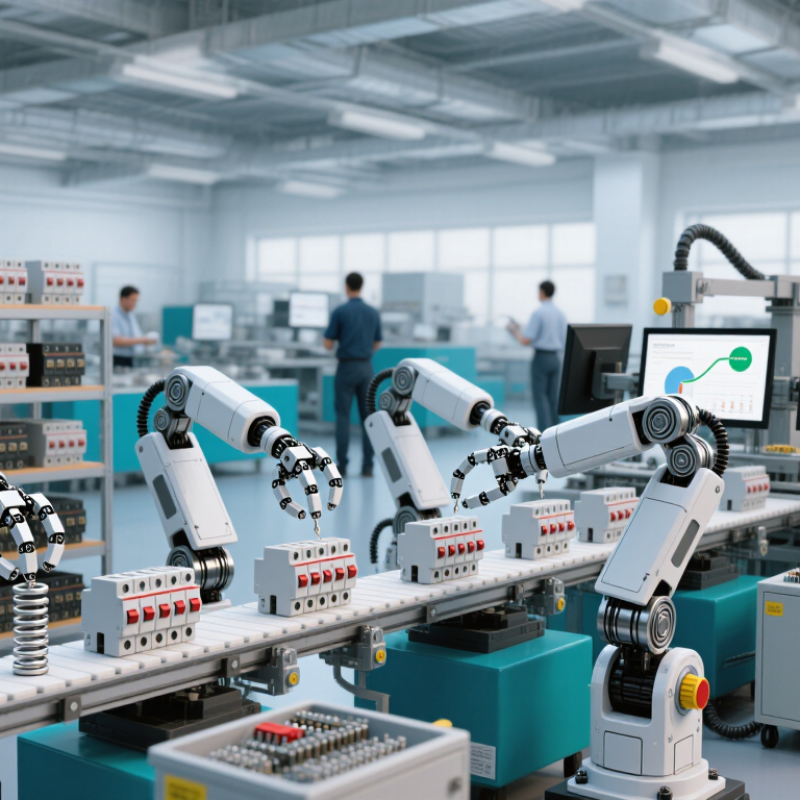
Table of Contents [Hide]
MCB Assembly Robots: Role, Scope, and Core Manufacturing Functions
MCB assembly robots support the production of miniature circuit breakers through controlled, repeatable operations. They handle small components, reduce manual handling, and maintain stable cycle times. Their scope covers component feeding, mechanism assembly, terminal installation, screw fastening, and electrical testing. In a well-designed line, each station records process data for later review. This matters.
Core manufacturing functions include precise part picking, contact placement, spring installation, and housing closure. Robots can insert arc chutes and trip mechanisms without damaging delicate surfaces. Servo-driven tools control fastening torque and help prevent loose terminals. Vision systems check component orientation, missing parts, and visible assembly defects. Electrical stations may verify continuity, insulation performance, and trip response under controlled conditions. Traceability software links test results to production batches.
During supplier evaluations, I look for stable tooling, accessible maintenance points, and clear fault messages. A reliable manufacturer should explain cycle time using real component samples, not only laboratory figures. Operators still need training for changeovers and unusual defects. That part is often underestimated. Automation is not a cure-all. Poorly calibrated sensors can create false rejects, while weak feeding systems cause repeated stoppages. The better approach combines robotic precision with practical human oversight, documented inspections, and regular process reviews.