


- Home
- A-Z Catalogue
- Products
- Valves
- Cetop
- Manual Directional Valves
- Proportional Valves
- Poppet Valves
- High-Speed Linear Servo Valves
- All High-Speed Linear Servo Valves
- Cetop 10 (NG32) Two Stage Type High Speed Linear Servo Valves – LSVHG-10
- Cetop 10 (NG32) Two Stage Type High Speed Linear Servo Valves – LSVHG-10 (With Fail-Safe)
- Cetop 8 (NG25) Two Stage Type High Speed Linear Servo Valves – LSVHG-06
- Cetop 8 (NG25) Two Stage Type High Speed Linear Servo Valves – LSVHG-06 (With Fail-Safe)
- Cetop 7 (NG16) Two Stage Type High Speed Linear Servo Valves – LSVHG-04
- Cetop 7 (NG16) Two Stage Type High Speed Linear Servo Valves – LSVHG-04 (With Fail-Safe)
- Cetop 5 (NG10) Direct Type High Speed Linear Servo Valves – LSVG-03
- Cetop 5 (NG10) OBE Type Direct Operated Linear Servo Valves – LSVG-03-EH
- Cetop 3 (NG6) OBE Type Direct Operated Linear Servo Valves – LSVG-01-EH
- Pumps
- Pressure control
- Flow Control Valves
- Pressure Control Valves
- All Pressure Control Valves
- Brake Valves
- Direct Relief Valve
- Low Noise Solenoid Controlled Relief Valves
- Low Noise Pilot Operated Relief Valves
- Pilot Operated Relief Valves
- Pressure reducing and relieving valves
- Pressure reducing and check valves
- Pressure control valves
- Remote Control Relief Valves
- Solenoid Controlled Relief Valves – BSG
- Solenoid Controlled Relief Valves – BST
- Unloading relief valves
- Check valves
- Environmental
- Valves
- Hydraulic Systems
- Power pack
- About Us
- Contact
- Blog

Top Continuous Carbon Fiber Production Line Manufacturers
Choosing among the top Continuous carbon fiber production line manufacturers requires more than comparing advertised output. A reliable evaluation considers engineering depth, material consistency, energy use, and after-sales support. The best supplier should understand the entire process, from precursor handling to carbonization, surface treatment, sizing, winding, and final inspection.
A practical production line must maintain stable tension while fibers pass through heated zones. Even small temperature changes can affect strength, modulus, and surface quality. Experienced manufacturers provide controlled furnaces, accurate tension systems, and real-time monitoring. They also explain maintenance intervals, spare-part availability, and operator training. These details matter on a factory floor.
Performance claims need evidence. Ask for verified production data, application references, factory acceptance procedures, and test reports from recognized laboratories. A supplier’s experience with aerospace, automotive, wind energy, or industrial composites can reveal useful technical capability. However, industry labels alone are not enough. Actual results depend on precursor quality, line configuration, staffing, and process discipline.
No ranking is perfect. A lower purchase price may hide higher energy consumption or difficult maintenance. A famous brand may still offer an unsuitable configuration. This guide examines leading manufacturers through a practical, evidence-based lens. It highlights production capacity, automation, customization, quality control, technical service, and lifecycle value. Readers should compare each option against their own fiber grade, target output, plant conditions, and budget. Careful questions often reveal more than polished brochures. That is where sound decisions begin.
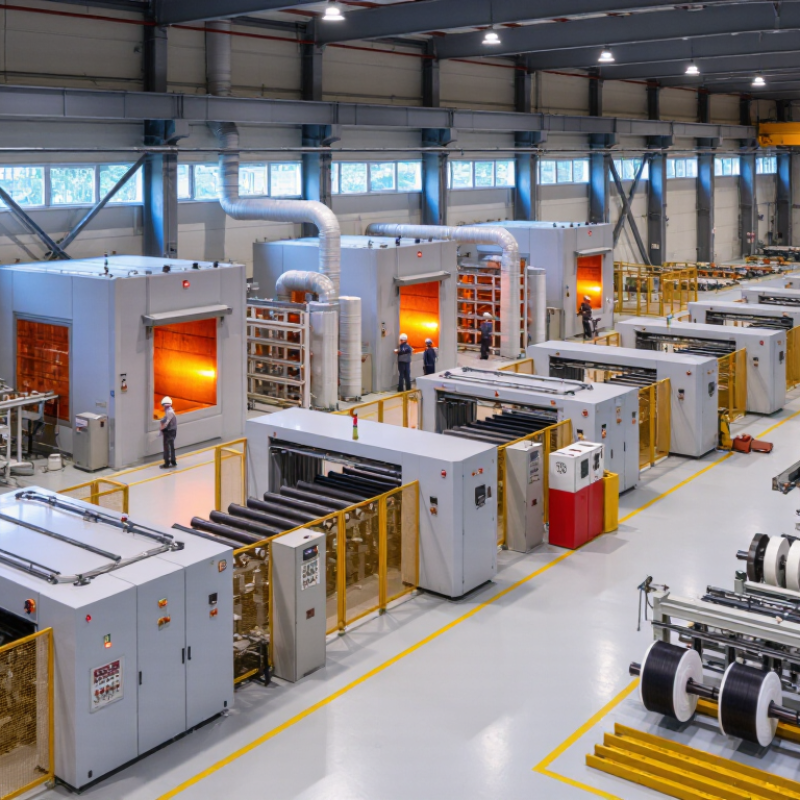
Table of Contents [Hide]
What Is Continuous Carbon Fiber Production?
Top Continuous Carbon Fiber Production Line Manufacturers
What Is Continuous Carbon Fiber Production?
Continuous carbon fiber production is a controlled, moving process. It converts a precursor, usually PAN or pitch, into carbon-rich filaments. Thousands of filaments travel together as a tow. They pass through spinning, stabilization, carbonization, surface treatment, and winding. Unlike batch processing, the material remains in motion. That movement demands steady tension.
Stabilization uses carefully controlled heat and air. Here, the precursor changes chemically before entering the furnace. Carbonization follows in an oxygen-limited environment, often above 1,000°C. Small temperature changes can alter strength, modulus, and surface chemistry.
Operators monitor line speed, furnace zones, gas flow, and tow tension. One loose guide can create fuzz or broken filaments. That is not a minor defect.
A dependable production line combines accurate controls with practical maintenance. Sensors can identify temperature drift, tension changes, and uneven winding. Quality checks may include tensile testing, filament counting, and sizing-content analysis. In real plants, cleaning matters too. Dust can affect guides, rollers, and sensor readings. The process looks continuous, but it is not effortless. I would not treat every stable reading as proof of quality. Some defects appear only during later testing. Experienced manufacturers therefore review process data, operator records, and fiber performance together.





