


- Home
- A-Z Catalogue
- Products
- Valves
- Cetop
- Manual Directional Valves
- Proportional Valves
- Poppet Valves
- High-Speed Linear Servo Valves
- All High-Speed Linear Servo Valves
- Cetop 10 (NG32) Two Stage Type High Speed Linear Servo Valves – LSVHG-10
- Cetop 10 (NG32) Two Stage Type High Speed Linear Servo Valves – LSVHG-10 (With Fail-Safe)
- Cetop 8 (NG25) Two Stage Type High Speed Linear Servo Valves – LSVHG-06
- Cetop 8 (NG25) Two Stage Type High Speed Linear Servo Valves – LSVHG-06 (With Fail-Safe)
- Cetop 7 (NG16) Two Stage Type High Speed Linear Servo Valves – LSVHG-04
- Cetop 7 (NG16) Two Stage Type High Speed Linear Servo Valves – LSVHG-04 (With Fail-Safe)
- Cetop 5 (NG10) Direct Type High Speed Linear Servo Valves – LSVG-03
- Cetop 5 (NG10) OBE Type Direct Operated Linear Servo Valves – LSVG-03-EH
- Cetop 3 (NG6) OBE Type Direct Operated Linear Servo Valves – LSVG-01-EH
- Pumps
- Pressure control
- Flow Control Valves
- Pressure Control Valves
- All Pressure Control Valves
- Brake Valves
- Direct Relief Valve
- Low Noise Solenoid Controlled Relief Valves
- Low Noise Pilot Operated Relief Valves
- Pilot Operated Relief Valves
- Pressure reducing and relieving valves
- Pressure reducing and check valves
- Pressure control valves
- Remote Control Relief Valves
- Solenoid Controlled Relief Valves – BSG
- Solenoid Controlled Relief Valves – BST
- Unloading relief valves
- Check valves
- Environmental
- Valves
- Hydraulic Systems
- Power pack
- About Us
- Contact
- Blog

How to Choose the Right Ultrasonic Disperser
Choosing the right Ultrasonic Disperser starts with the material, not the largest power rating on a product page. A water-like liquid and a thick pigment paste place very different demands on the same equipment. Batch size matters, too: a probe suited to a small beaker may not process a larger vessel evenly. Small details matter.
This guide explains how to compare processing volume, viscosity, probe size, power, and temperature control. It also considers practical questions: Can the instrument run for the required time? Is the probe easy to clean or replace? Will the vessel fit securely beneath it? These details affect daily use as much as headline specifications do. A neat specification sheet can still mislead; real samples behave less neatly. Testing a representative sample, when possible, can reveal heating, foaming, or uneven dispersion that a brochure cannot show. The right choice depends on the target particle size, formulation, workflow, and budget—not one specification alone. Use manufacturer guidance for operating limits, and leave room for adjustments after initial trials. A careful comparison helps narrow the options without promising that one machine will suit every material.
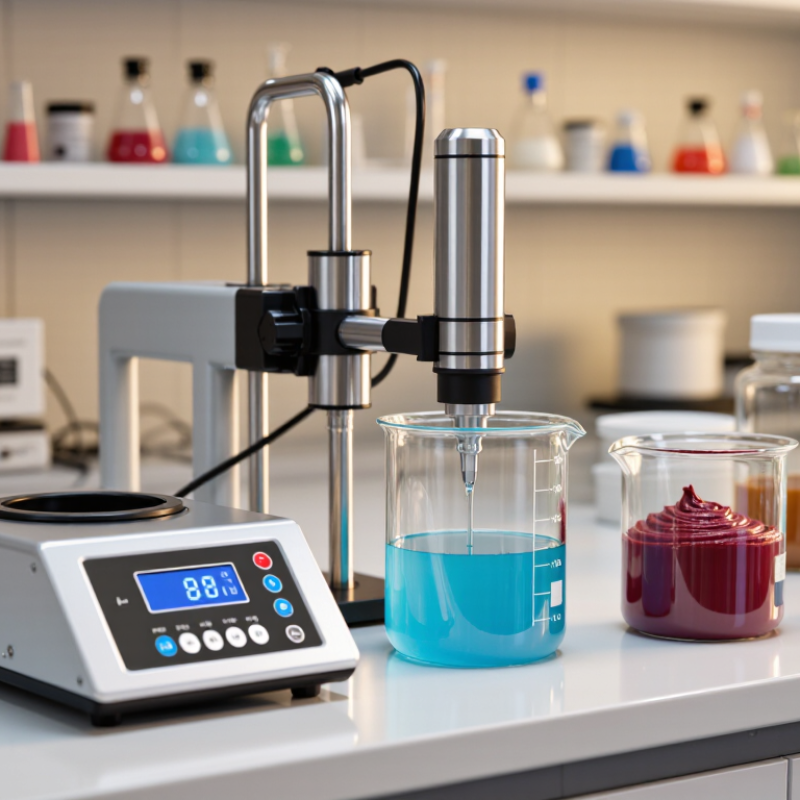
Table of Contents [Hide]
Identify the Material and Intended Dispersion Outcome
Start by identifying what the material is and what “dispersed” should mean for your process. A pigment may need even color and fewer visible specks. A ceramic slurry may need stable particles that do not settle quickly. For samples with fragile structures, preserving particle shape can matter more than reaching the smallest possible size. Record the starting particle size, solids concentration, viscosity, and temperature. Then define a measurable endpoint, such as particle-size distribution or settling rate. “Looks smooth” is not enough.
Material properties help guide equipment choice, but they do not predict the result on their own. NIST’s certificate for SRM 1898 titanium dioxide reports a specific surface area of 52.0 ± 2.0 m²/g. This reference value describes the test material, not a required disperser setting. It does show why surface area and particle characteristics matter when comparing samples. Before a full run, test a small batch and check for heating, foaming, or particle damage. I would not assume that more energy always improves dispersion; that can be an expensive mistake.
Tips: Write down the intended outcome before selecting a probe or setting. Keep sample volume, vessel shape, and temperature consistent between tests. Compare results using the same measurement method, such as laser diffraction under ISO 13320 guidance. If the outcome is unclear, refine the target before increasing processing time.
How to Choose the Right Ultrasonic Disperser - Identify the Material and Intended Dispersion Outcome
| Material or Sample | Common Processing Challenge | Intended Dispersion Outcome | Practical Starting Approach | What to Check During Trials |
|---|---|---|---|---|
| Oil and water phases | Droplets may merge after mixing, especially without suitable formulation. | Create a finer, more uniform emulsion and reduce visible droplet size. | Process the liquid mixture with any required surfactant or emulsifier. Use short trials and control temperature. | Droplet-size distribution, separation over time, temperature, and whether the formulation needs additional stabilization. |
| Pigments in a liquid carrier | Pigment agglomerates can cause uneven color, poor gloss, or settling. | Break down agglomerates and distribute pigment more evenly through the liquid. | Pre-wet the pigment where appropriate, then process the slurry using a probe suited to the batch volume and vessel. | Color uniformity, particle or agglomerate size, viscosity, temperature, and possible probe wear or contamination. |
| Nanoparticle suspensions | Fine particles can form persistent agglomerates and may reagglomerate after processing. | Reduce agglomeration and obtain a more uniform suspension. | Use controlled, incremental processing with effective cooling. Select the liquid medium and stabilizer for the particle system. | Particle-size distribution, stability over time, temperature, and any contamination from probe erosion. |
| Biological cells or soft tissue in suspension | Cells may need disruption, while excess heat or processing can damage temperature-sensitive components. | Lyse cells or release intracellular material while limiting unwanted heating. | Use pulsed operation and cooling as needed; process small test samples before scaling up. | Lysis efficiency, sample temperature, recovery of the desired material, and preservation of heat-sensitive compounds. |
| Viscous polymers, resins, or concentrated liquids | High viscosity can hinder circulation and reduce effective energy transfer through the sample. | Improve mixing or distribute an added component more uniformly. | Confirm that the disperser is suitable for the sample’s viscosity. Consider pre-mixing or dilution if compatible with the process. | Flow around the probe, uniformity throughout the vessel, temperature, and whether the sample remains processable. |
| Mineral or abrasive suspensions | Dense particles can settle; abrasive solids can wear a probe over time. | Break up soft agglomerates and distribute solids more evenly. | Keep solids suspended with appropriate vessel mixing and use brief trials to assess probe wear and sample compatibility. | Settling rate, particle distribution, probe condition, and potential metal contamination. |
| Fibers or delicate particles | Strong cavitation can shorten, fragment, or otherwise alter fragile structures. | Distribute material while retaining as much of its original structure as possible. | Begin with gentle, short processing trials and compare the sample before and after treatment. | Fiber length or particle shape, uniformity, and any loss of the properties the process is intended to preserve. |
Selection tip: Match the disperser to the sample’s volume, viscosity, solids content, and required outcome. Processing time and settings are sample-dependent; validate dispersion quality, temperature, and stability at the intended scale before routine use.





