- Home
- A-Z Catalogue
- Products
- Valves
- Cetop
- Manual Directional Valves
- Proportional Valves
- Poppet Valves
- High-Speed Linear Servo Valves
- All High-Speed Linear Servo Valves
- Cetop 10 (NG32) Two Stage Type High Speed Linear Servo Valves – LSVHG-10
- Cetop 10 (NG32) Two Stage Type High Speed Linear Servo Valves – LSVHG-10 (With Fail-Safe)
- Cetop 8 (NG25) Two Stage Type High Speed Linear Servo Valves – LSVHG-06
- Cetop 8 (NG25) Two Stage Type High Speed Linear Servo Valves – LSVHG-06 (With Fail-Safe)
- Cetop 7 (NG16) Two Stage Type High Speed Linear Servo Valves – LSVHG-04
- Cetop 7 (NG16) Two Stage Type High Speed Linear Servo Valves – LSVHG-04 (With Fail-Safe)
- Cetop 5 (NG10) Direct Type High Speed Linear Servo Valves – LSVG-03
- Cetop 5 (NG10) OBE Type Direct Operated Linear Servo Valves – LSVG-03-EH
- Cetop 3 (NG6) OBE Type Direct Operated Linear Servo Valves – LSVG-01-EH
- Pumps
- Pressure control
- Flow Control Valves
- Pressure Control Valves
- All Pressure Control Valves
- Brake Valves
- Direct Relief Valve
- Low Noise Solenoid Controlled Relief Valves
- Low Noise Pilot Operated Relief Valves
- Pilot Operated Relief Valves
- Pressure reducing and relieving valves
- Pressure reducing and check valves
- Pressure control valves
- Remote Control Relief Valves
- Solenoid Controlled Relief Valves – BSG
- Solenoid Controlled Relief Valves – BST
- Unloading relief valves
- Check valves
- Environmental
- Valves
- Hydraulic Systems
- Power pack
- About Us
- Contact
- Blog

How to Choose the Best CNC Panel Bender for Your Business?
Choosing a Cnc Panel Bender is a production decision, not just a machine purchase. The right model must suit your parts, materials, batch sizes, and available floor space. A cabinet door that bends cleanly on a showroom machine may behave differently across a full shift, especially when operators change jobs or sheet thickness varies. Small details matter: tool-change time, flange accuracy, programming effort, and how quickly the machine handles a short run.
Automation is reshaping manufacturing, but it does not remove the need for careful process planning. The International Federation of Robotics reported 541,000 industrial robot installations worldwide in 2023 in its World Robotics 2024 report. That figure provides useful context for automation investment; it does not, by itself, prove that a panel bender will pay back. Buyers should compare expected throughput with actual job data, including setup time, scrap, labor, and maintenance. Measure your own work.
A credible comparison also needs a named specialist’s verifiable words. No source articles or expert quotation were provided here, so attributing a quotation to a CNC panel-bending expert would risk inventing a claim. Before publishing, add a sourced comment from a named manufacturer or independent sheet-metal process engineer. Then test the advice against a real part: check bend sequence, tolerances, loading access, and output over a representative shift. The best choice is the one your team can run reliably—not simply the one with the longest specification sheet.
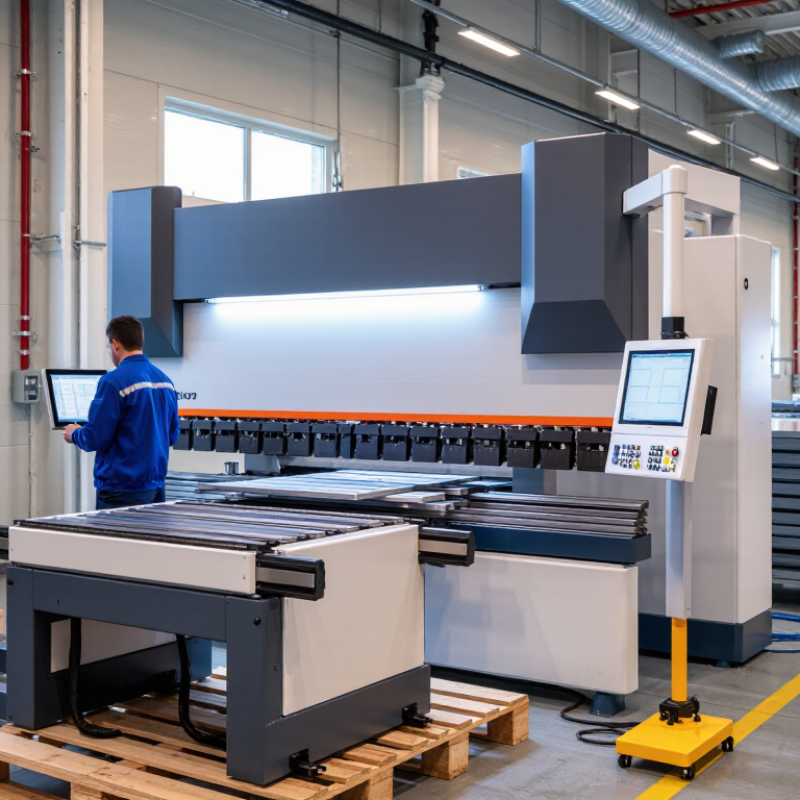
Table of Contents [Hide]
What Is a CNC Panel Bender and How Does It Work?
A CNC panel bender is a machine that forms sheet metal into flanges and channels using programmed movements. Unlike a press brake, it typically holds the sheet with clamps while bending tools move around its edges. The operator loads a flat blank onto the table. That’s the starting point.
The CNC system controls positioning, sheet rotation, clamping, and bend angles. Depending on the machine design, upper and lower tools fold the material in sequence. A sensor or programmed setting may help compensate for springback, when metal partly returns toward its original shape after bending. Results still depend on the material, thickness, and tooling. Small differences matter.
In practice, an operator enters the part dimensions and selects a suitable bending sequence. The machine feeds and repositions the blank, then makes each fold. A cabinet side panel, for example, may need several flanges at different angles. Watch the first part closely. Check its dimensions and corner alignment before running a batch. CNC automation can improve repeatability, but it does not remove the need for setup checks or skilled judgment. Honestly, unusual shapes can still require trial adjustments, and that is worth planning for.
How to Choose the Best CNC Panel Bender for Your Business? — What Is a CNC Panel Bender and How Does It Work?
| Category | Factor | Typical Information | Why It Matters When Choosing |
|---|---|---|---|
| Definition | What a CNC panel bender is | A sheet-metal machine that uses computer-controlled clamping, positioning, and bending tools to form flanges along a flat blank. | It is designed for repeatable panel production, especially when parts have multiple bends and consistent geometry is important. |
| Working principle | Clamping and positioning | The machine clamps the sheet while a manipulator or positioning system presents the workpiece to the bending tools. | Check how the machine supports, aligns, and handles the largest and heaviest blanks in your production mix. |
| Working principle | Bending sequence | Upper and lower bending blades move to form flanges. The sheet may be repositioned or rotated between bends according to the programmed sequence. | Review whether the machine can complete your parts without manual repositioning or special tooling changes. |
| Working principle | CNC control | A programmed sequence coordinates axes, clamping, positioning, and tool movement. Sensors and control functions vary by machine configuration. | Ask for a demonstration using your own part files, including setup, program changes, and recovery from common interruptions. |
| Capacity | Working length | Available working lengths vary by machine; commercial configurations commonly cover approximately 1–4 m. | Choose a working length that accommodates your largest blanks, while allowing for handling space and future product requirements. |
| Capacity | Material thickness | Many panel benders are used for thin sheet, often around 0.5–3 mm, but the allowable thickness depends on the material, bend geometry, and machine configuration. | Compare capacity for each material you use. Stainless steel and high-strength sheet may require lower thickness limits than mild steel. |
| Capacity | Material and bend geometry | Material strength, bend radius, flange height, blank size, and tool clearance all affect whether a part can be formed. | Have the supplier review representative drawings and test parts at the required material grade and thickness. |
| Production fit | Part mix and batch size | Panel benders are often considered for repeatable panels and parts with multiple bends; the benefit depends on the part design and production volume. | Compare setup time, handling, and total cycle time with your current process for both high-volume and short-run work. |
| Production fit | Automation and handling | Options may include automated loading, unloading, sheet support, and integration with upstream or downstream equipment. | Assess floor space, staffing, material flow, and whether automation will be used enough to justify its cost. |
| Quality | Accuracy and repeatability | Results depend on machine condition, material variation, part geometry, tooling, programming, and setup. Published accuracy figures may use specific test conditions. | Request a trial run on your parts and agree on how dimensions, angles, and repeatability will be measured. |
| Business case | Operating cost | Consider purchase and installation costs alongside tooling, maintenance, operator training, energy, software, and service support. | Estimate cost per accepted part using realistic utilization, changeover time, scrap rates, and labor requirements. |
| Selection checklist | Questions to ask before purchase | Can the machine form your parts and materials? What tooling is included? What training, maintenance, and service response are available? | Use sample parts and a written specification to compare machines on a like-for-like basis. |
Note: Capacity ranges are indicative, not guaranteed specifications. Confirm the machine’s rated limits and forming capability with its technical documentation and a test using your actual material and part geometry.