


- Home
- A-Z Catalogue
- Products
- Valves
- Cetop
- Manual Directional Valves
- Proportional Valves
- Poppet Valves
- High-Speed Linear Servo Valves
- All High-Speed Linear Servo Valves
- Cetop 10 (NG32) Two Stage Type High Speed Linear Servo Valves – LSVHG-10
- Cetop 10 (NG32) Two Stage Type High Speed Linear Servo Valves – LSVHG-10 (With Fail-Safe)
- Cetop 8 (NG25) Two Stage Type High Speed Linear Servo Valves – LSVHG-06
- Cetop 8 (NG25) Two Stage Type High Speed Linear Servo Valves – LSVHG-06 (With Fail-Safe)
- Cetop 7 (NG16) Two Stage Type High Speed Linear Servo Valves – LSVHG-04
- Cetop 7 (NG16) Two Stage Type High Speed Linear Servo Valves – LSVHG-04 (With Fail-Safe)
- Cetop 5 (NG10) Direct Type High Speed Linear Servo Valves – LSVG-03
- Cetop 5 (NG10) OBE Type Direct Operated Linear Servo Valves – LSVG-03-EH
- Cetop 3 (NG6) OBE Type Direct Operated Linear Servo Valves – LSVG-01-EH
- Pumps
- Pressure control
- Flow Control Valves
- Pressure Control Valves
- All Pressure Control Valves
- Brake Valves
- Direct Relief Valve
- Low Noise Solenoid Controlled Relief Valves
- Low Noise Pilot Operated Relief Valves
- Pilot Operated Relief Valves
- Pressure reducing and relieving valves
- Pressure reducing and check valves
- Pressure control valves
- Remote Control Relief Valves
- Solenoid Controlled Relief Valves – BSG
- Solenoid Controlled Relief Valves – BST
- Unloading relief valves
- Check valves
- Environmental
- Valves
- Hydraulic Systems
- Power pack
- About Us
- Contact
- Blog

How to Choose Carbon Graphite Rods for Your Application
Selecting Carbon Graphite Rods is not simply a matter of choosing the darkest or hardest material. The correct rod must match your application’s temperature, electrical load, mechanical stress, and chemical environment. A heating fixture may need excellent thermal stability, while an electrode may require dependable conductivity and controlled wear. Small differences in grade can affect service life, maintenance, and safety.
Begin with the operating conditions. Record the working temperature, atmosphere, current, pressure, and contact area. Then compare density, ash content, porosity, flexural strength, and electrical resistivity. These values reveal how a rod may behave inside a furnace, laboratory assembly, or high-temperature support system. Dimensions matter too. A thin rod can bend under load, while an oversized rod may create unnecessary cost or installation problems.
Look beyond a polished product description. A reliable supplier should provide material specifications, tolerances, inspection records, and practical application guidance. When possible, test a small sample under realistic conditions. Watch for cracking, surface oxidation, dimensional change, and unstable electrical performance. A specification sheet can still mislead.
Real applications rarely behave perfectly. Unexpected vibration, moisture, or uneven heating may change the result. That is why selection should combine published data with engineering judgment and field experience. This guide explains the main factors behind a dependable choice, while recognizing that no single Carbon Graphite Rods grade suits every application. Careful comparison reduces avoidable failures and supports safer, more consistent performance.
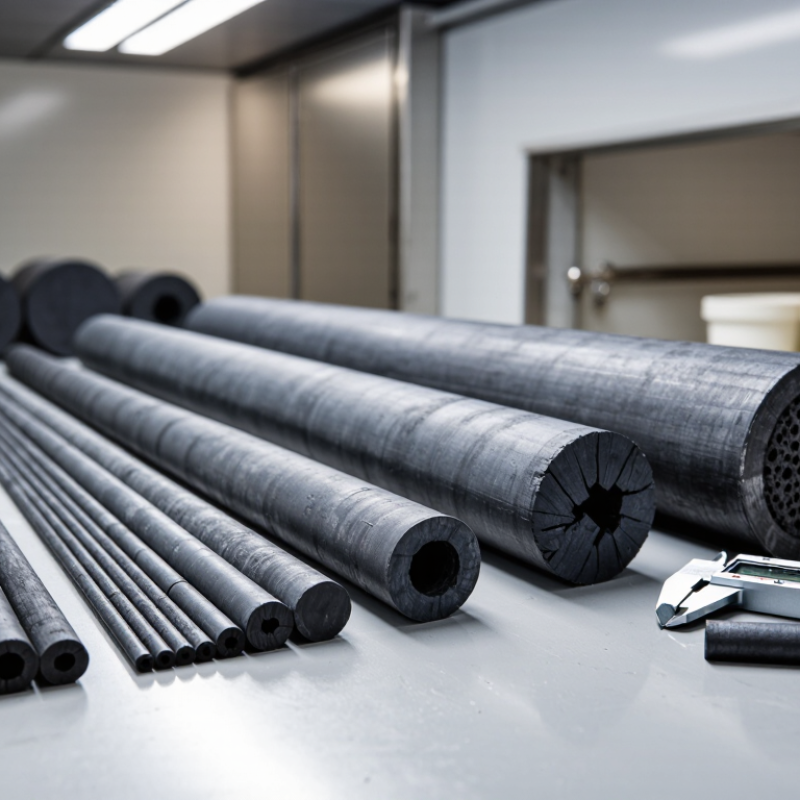
Table of Contents [Hide]
Define the Requirements of Your Carbon Graphite Rod Application
Before choosing a carbon graphite rod, define the job in measurable terms. What temperature will it face, and for how many hours? Record the operating temperature, heating cycles, and exposure to air, vacuum, molten material, or chemical vapors. A rod used inside a 1,000°C furnace needs different protection from one used in a dry electrical assembly. Small details matter.
Set the required diameter, length, straightness, and permitted tolerance before requesting samples. Calculate the load, bending risk, contact pressure, and electrical current. Also check thermal expansion, machining limits, surface finish, and connection design. A narrow rod may fit perfectly but fail under vibration. A denser grade can improve strength, yet it may change conductivity or machining behavior. The best choice depends on the complete operating picture.
In practice, request material data, inspection records, and lot traceability from the supplier. Useful data includes bulk density, electrical resistivity, flexural strength, ash content, and maximum recommended temperature. Ask how these values were tested. Test a small sample under realistic conditions, including repeated heating and cooling. One short test can mislead. I have seen designs pass initial checks but crack after several cycles. It is also worth reviewing the design after testing, because the original requirements may have missed humidity, installation stress, or uneven heating.
How to Choose Carbon Graphite Rods for Your Application - Define the Requirements of Your Carbon Graphite Rod Application
| Application Requirement | Recommended Rod Characteristics | Typical Selection Range or Target | Why It Matters | Common Application Examples |
|---|---|---|---|---|
| Operating temperature | Fine-grain or isostatically pressed graphite with low impurity content | Up to approximately 2,500–3,000°C in an inert gas or vacuum; substantially lower in air | Graphite can oxidize rapidly at elevated temperatures when exposed to oxygen. Atmosphere control is essential. | High-temperature furnace fixtures, thermal processing, laboratory heating equipment |
| Electrical conductivity | Low-electrical-resistivity grade with uniform structure and suitable cross-sectional area | Typical volume resistivity: approximately 5–20 μΩ·m, depending on grade and orientation | Electrical resistance affects heating efficiency, voltage drop, current capacity, and temperature distribution. | Resistance heating elements, electrical contacts, electrodes, current-carrying fixtures |
| Mechanical load | Higher-density, fine-grain rod with sufficient flexural and compressive strength | Typical flexural strength: approximately 20–80 MPa; select a safety factor for shock and vibration | Graphite is strong in compression but relatively brittle and sensitive to bending, impact, and concentrated loads. | Supports, furnace components, spacers, high-temperature structural parts |
| Dimensional stability | Low-thermal-expansion, homogeneous graphite with controlled grain size | Typical thermal expansion coefficient: approximately 2–8 × 10⁻⁶/K, depending on grade and direction | Lower expansion helps maintain alignment, clearances, and dimensional accuracy during thermal cycling. | Precision furnace tooling, molds, semiconductor processing fixtures |
| Thermal shock resistance | Fine-grain graphite with low thermal expansion and good thermal conductivity | Thermal conductivity commonly ranges from approximately 50–150 W/m·K for many industrial grades | Rapid heat transfer and low expansion reduce thermal gradients and the risk of cracking. | Rapid-heating fixtures, laboratory crucibles, thermal cycling equipment |
| Chemical compatibility | High-purity graphite or a compatible coated grade when contamination or chemical attack is a concern | Confirm compatibility with halogens, oxidizers, molten metals, salts, and process gases before selection | Graphite performs well in many reducing and inert environments but reacts with oxygen and certain chemicals. | Chemical processing, molten-metal handling, laboratory and vacuum systems |
| Purity and contamination control | High-purity graphite with documented ash and trace-element limits | Common industrial purity: approximately 99.5–99.99% carbon, subject to analytical method and specification | Ash and metallic impurities may contaminate products, alter electrical behavior, or affect high-temperature performance. | Semiconductor processing, analytical equipment, specialty melting applications |
| Density and porosity | Low-porosity, high-density rod for reduced gas absorption and improved mechanical consistency | Typical bulk density: approximately 1.70–1.90 g/cm³; specify open porosity when relevant | Higher density generally improves strength and reduces penetration by gases or liquids, although grade-specific data must be verified. | Vacuum components, molten-metal tooling, pressure and gas-handling fixtures |
| Machinability | Fine-grain graphite for detailed machining; select a coarser grade for lower-cost, less intricate parts | Define surface finish, hole diameter, tolerance, edge geometry, and machining allowance | Graphite is readily machined but produces conductive dust; tooling, extraction, and handling procedures are required. | Custom electrodes, furnace parts, jigs, molds, and laboratory components |
| Rod size and tolerance | Diameter and length selected according to load, current, heat transfer, and installation clearance | Specify diameter, length, straightness, concentricity, end condition, and allowable dimensional tolerance | An undersized rod may overheat or deflect, while an oversized rod can increase cost and reduce system efficiency. | Heating systems, supports, electrodes, shafts, and replacement components |
| Surface condition | Machined, ground, polished, or coated surface according to contact and cleanliness requirements | Define surface roughness, allowable chips, cracks, pits, and visible defects | Surface quality affects electrical contact, particle generation, sealing, wear, and inspection results. | Electrical contacts, precision fixtures, vacuum components, sliding or mating parts |
| Atmosphere and oxidation risk | Uncoated graphite for inert or vacuum service; protective coating or alternative material for oxidizing conditions | Specify oxygen level, pressure, gas composition, exposure time, and process temperature | Oxidation can cause mass loss, dimensional change, surface degradation, and premature failure. | Vacuum furnaces, inert-gas furnaces, controlled-atmosphere processing |
| Service life and replacement planning | Grade selected using wear rate, oxidation rate, thermal cycles, and maintenance requirements | Establish inspection intervals and acceptable limits for diameter loss, cracking, resistance change, and contamination | A defined replacement criterion improves safety, process consistency, and total operating cost. | Continuous production equipment, furnace maintenance, repeat laboratory operations |
Note: The numerical values shown are typical engineering ranges for common industrial graphite grades. Actual properties vary with raw material, grain size, forming method, heat treatment, orientation, and test standard. Always confirm the supplier’s technical data and test conditions for the intended application.