- Home
- A-Z Catalogue
- Products
- Valves
- Cetop
- Manual Directional Valves
- Proportional Valves
- Poppet Valves
- High-Speed Linear Servo Valves
- All High-Speed Linear Servo Valves
- Cetop 10 (NG32) Two Stage Type High Speed Linear Servo Valves – LSVHG-10
- Cetop 10 (NG32) Two Stage Type High Speed Linear Servo Valves – LSVHG-10 (With Fail-Safe)
- Cetop 8 (NG25) Two Stage Type High Speed Linear Servo Valves – LSVHG-06
- Cetop 8 (NG25) Two Stage Type High Speed Linear Servo Valves – LSVHG-06 (With Fail-Safe)
- Cetop 7 (NG16) Two Stage Type High Speed Linear Servo Valves – LSVHG-04
- Cetop 7 (NG16) Two Stage Type High Speed Linear Servo Valves – LSVHG-04 (With Fail-Safe)
- Cetop 5 (NG10) Direct Type High Speed Linear Servo Valves – LSVG-03
- Cetop 5 (NG10) OBE Type Direct Operated Linear Servo Valves – LSVG-03-EH
- Cetop 3 (NG6) OBE Type Direct Operated Linear Servo Valves – LSVG-01-EH
- Pumps
- Pressure control
- Flow Control Valves
- Pressure Control Valves
- All Pressure Control Valves
- Brake Valves
- Direct Relief Valve
- Low Noise Solenoid Controlled Relief Valves
- Low Noise Pilot Operated Relief Valves
- Pilot Operated Relief Valves
- Pressure reducing and relieving valves
- Pressure reducing and check valves
- Pressure control valves
- Remote Control Relief Valves
- Solenoid Controlled Relief Valves – BSG
- Solenoid Controlled Relief Valves – BST
- Unloading relief valves
- Check valves
- Environmental
- Valves
- Hydraulic Systems
- Power pack
- About Us
- Contact
- Blog

Why Choose Green Sand Casting for Your Parts?
Green Sand Cast is a practical choice when parts need dependable production, flexible geometry, and controlled costs. The process uses moist sand, clay, and water to form a mold around a pattern. At the foundry, you can see the compacted sand hold its shape before molten metal enters the cavity. After cooling, the mold breaks away, and the sand can often be prepared for reuse. The method is not magic. Moisture, sand condition, and pouring practice all affect the result.
Metallurgist John Campbell’s published work highlights how strongly casting quality depends on process design. A concise paraphrase of that guidance is: “Good castings begin with a well-designed process.” This is not a verified verbatim quotation, so confirm wording before publication. For part buyers, the practical question is whether the method fits the alloy, dimensions, surface-finish needs, and expected production volume. Green sand casting can suit many iron and nonferrous parts, but it may not be right for every tight tolerance or fine surface detail.
Look closely at the trade-offs. A rougher finish may need machining, and careless control can create defects. Ask a foundry about inspection, tooling, and dimensional capability before committing. Small details matter. Even a promising process deserves a sample run and a careful review.
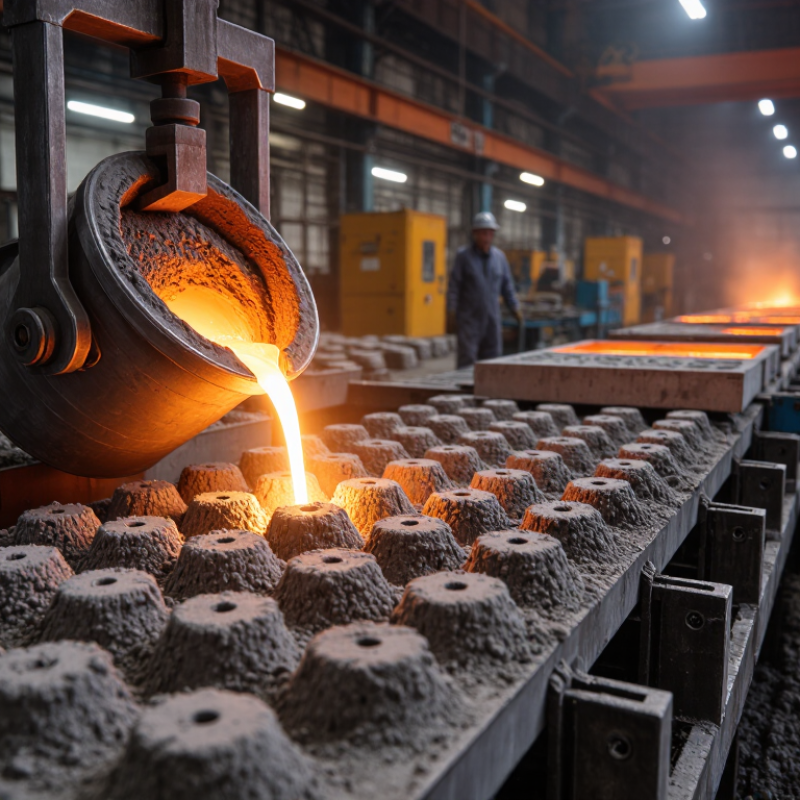
Table of Contents [Hide]
What Green Sand Casting Is and How the Process Works
Green sand casting makes a mold from sand mixed with clay and water. “Green” means the mixture is moist and uncured, not green in color. The name misleads. A reusable pattern shapes a cavity in compacted sand, often in two mold halves. Workers form channels that guide molten metal into the cavity, with extra space for feeding shrinkage as the metal cools.
Each feature has a purpose.
The halves are assembled and metal is poured through the channels. Pouring temperature and speed depend on the alloy and part design; poor control can cause incomplete filling or other defects. After the casting solidifies, the mold is broken apart and the sand can often be reclaimed.
The casting is then cleaned, and gates or excess material are removed. Foundry teams monitor sand moisture and compaction because small changes can affect mold strength and surface quality. In practice, this method suits many shapes and production volumes, but it does not deliver a perfect surface every time.
Thin walls or tight dimensional requirements may call for careful design and later machining. A casting can look sound yet still need inspection.