


- Home
- A-Z Catalogue
- Products
- Valves
- Cetop
- Manual Directional Valves
- Proportional Valves
- Poppet Valves
- High-Speed Linear Servo Valves
- All High-Speed Linear Servo Valves
- Cetop 10 (NG32) Two Stage Type High Speed Linear Servo Valves – LSVHG-10
- Cetop 10 (NG32) Two Stage Type High Speed Linear Servo Valves – LSVHG-10 (With Fail-Safe)
- Cetop 8 (NG25) Two Stage Type High Speed Linear Servo Valves – LSVHG-06
- Cetop 8 (NG25) Two Stage Type High Speed Linear Servo Valves – LSVHG-06 (With Fail-Safe)
- Cetop 7 (NG16) Two Stage Type High Speed Linear Servo Valves – LSVHG-04
- Cetop 7 (NG16) Two Stage Type High Speed Linear Servo Valves – LSVHG-04 (With Fail-Safe)
- Cetop 5 (NG10) Direct Type High Speed Linear Servo Valves – LSVG-03
- Cetop 5 (NG10) OBE Type Direct Operated Linear Servo Valves – LSVG-03-EH
- Cetop 3 (NG6) OBE Type Direct Operated Linear Servo Valves – LSVG-01-EH
- Pumps
- Pressure control
- Flow Control Valves
- Pressure Control Valves
- All Pressure Control Valves
- Brake Valves
- Direct Relief Valve
- Low Noise Solenoid Controlled Relief Valves
- Low Noise Pilot Operated Relief Valves
- Pilot Operated Relief Valves
- Pressure reducing and relieving valves
- Pressure reducing and check valves
- Pressure control valves
- Remote Control Relief Valves
- Solenoid Controlled Relief Valves – BSG
- Solenoid Controlled Relief Valves – BST
- Unloading relief valves
- Check valves
- Environmental
- Valves
- Hydraulic Systems
- Power pack
- About Us
- Contact
- Blog

What Is a CPU Liquid Cooler and How Does It Work?
A CPU Liquid Cooler is a thermal management system designed to move heat away from a processor. It uses a cold plate, pump, tubing, radiator, and fans. The cold plate sits directly on the CPU. Thermal paste fills tiny surface gaps. Coolant then carries heat through sealed tubing toward the radiator. Fans release that heat into the surrounding air.
The principle is simple. The engineering is not. ASHRAE Technical Committee 9.9 identifies liquid cooling as an important approach for managing higher equipment heat densities. Its guidance also stresses coolant quality, leak control, maintenance, and system compatibility. These details matter inside a desktop case. A blocked radiator can raise temperatures quickly. A poorly mounted cold plate can create uneven contact and noisy fan behavior.
Uptime Institute’s 2024 Global Data Center Survey also highlights rising concerns about power, cooling efficiency, and operational resilience. Although desktop systems differ from data centers, the same thermal pressures appear in smaller form. Modern CPUs can produce sharp bursts of heat during rendering, gaming, and artificial intelligence workloads. A liquid loop absorbs those spikes before the radiator disperses them. That does not make every cooler superior. Air coolers can be quieter, simpler, and easier to maintain. The better choice depends on workload, case airflow, budget, and installation skill.
The picture is not perfectly simple. Pump wear, trapped air, and dust still matter. This guide explains how a CPU Liquid Cooler works, what each component does, and where practical trade-offs appear. It also separates measurable thermal performance from marketing language, using manufacturer specifications and established thermal guidance wherever possible.
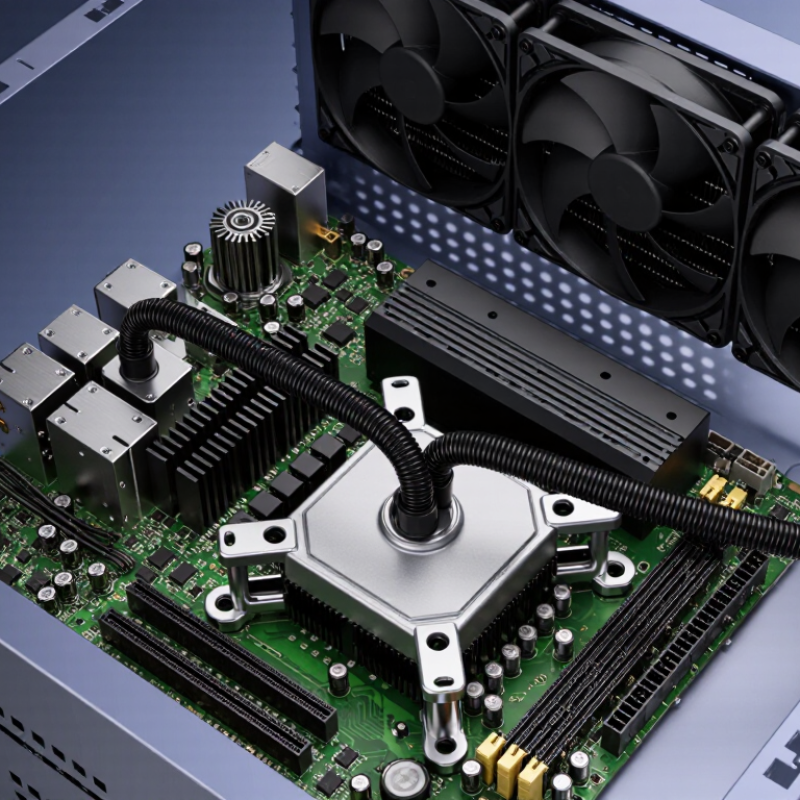
Table of Contents [Hide]
CPU Liquid Cooling Defined: AIO Parts, TDP Ratings, and Thermal Roles
What Is a CPU Liquid Cooler and How Does It Work?
CPU Liquid Cooling Defined: AIO Parts, TDP Ratings, and Thermal Roles
An all-in-one liquid cooler moves heat through a sealed cooling loop. Its cold plate touches the processor through thermal paste. Heat then travels into the coolant. The pump circulates that warmed liquid toward the radiator. Fans push air through the radiator fins, releasing heat inside the case. Tubing connects the parts, while the radiator and fans control how quickly heat leaves the system. Small details matter. Uneven mounting can create hotter areas, even with a powerful cooler.
TDP ratings offer guidance, but they are not exact power measurements. A processor may briefly consume more power than its listed TDP. Cooler ratings can also use different testing methods. Therefore, choose extra capacity for sustained workloads, warm rooms, or quiet operation. A larger radiator often provides more thermal surface area, but case clearance and airflow still matter. I have seen cooling plans fail because specifications looked impressive on paper. Real temperatures depend on firmware settings, contact pressure, fan curves, and dust buildup.
Tips: Check radiator clearance before buying. Apply a small, even layer of thermal paste. Confirm that the pump receives steady power. Watch temperatures during a long workload, not only a short benchmark. If temperatures remain high, inspect mounting pressure and airflow before blaming the coolant. It is easy to overlook the case exhaust path.





