


- Home
- A-Z Catalogue
- Products
- Valves
- Cetop
- Manual Directional Valves
- Proportional Valves
- Poppet Valves
- High-Speed Linear Servo Valves
- All High-Speed Linear Servo Valves
- Cetop 10 (NG32) Two Stage Type High Speed Linear Servo Valves – LSVHG-10
- Cetop 10 (NG32) Two Stage Type High Speed Linear Servo Valves – LSVHG-10 (With Fail-Safe)
- Cetop 8 (NG25) Two Stage Type High Speed Linear Servo Valves – LSVHG-06
- Cetop 8 (NG25) Two Stage Type High Speed Linear Servo Valves – LSVHG-06 (With Fail-Safe)
- Cetop 7 (NG16) Two Stage Type High Speed Linear Servo Valves – LSVHG-04
- Cetop 7 (NG16) Two Stage Type High Speed Linear Servo Valves – LSVHG-04 (With Fail-Safe)
- Cetop 5 (NG10) Direct Type High Speed Linear Servo Valves – LSVG-03
- Cetop 5 (NG10) OBE Type Direct Operated Linear Servo Valves – LSVG-03-EH
- Cetop 3 (NG6) OBE Type Direct Operated Linear Servo Valves – LSVG-01-EH
- Pumps
- Pressure control
- Flow Control Valves
- Pressure Control Valves
- All Pressure Control Valves
- Brake Valves
- Direct Relief Valve
- Low Noise Solenoid Controlled Relief Valves
- Low Noise Pilot Operated Relief Valves
- Pilot Operated Relief Valves
- Pressure reducing and relieving valves
- Pressure reducing and check valves
- Pressure control valves
- Remote Control Relief Valves
- Solenoid Controlled Relief Valves – BSG
- Solenoid Controlled Relief Valves – BST
- Unloading relief valves
- Check valves
- Environmental
- Valves
- Hydraulic Systems
- Power pack
- About Us
- Contact
- Blog

China Top Carbon Fiber Sheet Manufacturers How to Choose?
China’s carbon fiber industry has moved from limited domestic supply toward broader aerospace, automotive, wind energy, and sporting goods applications. The JEC Group and Estin & Co. reported continued global composites growth in their 2024 market analysis, while China Carbon Fiber Association publications have highlighted expanding Chinese production capacity. These figures matter, but capacity is not the same as dependable quality.
Choosing among China’s top manufacturers requires more than comparing prices. A reliable Carbon Fiber Sheet supplier should clearly identify fiber grade, fabric type, resin system, thickness tolerance, and intended application. Ask for current technical data, not only a polished brochure. Tensile and flexural results should reference recognized methods, such as ASTM D3039 and ASTM D7264. Check whether testing is internal or independently verified.
Look closely.
Request production samples. Examine the surface for pinholes, resin-rich edges, waviness, and uneven curing. For a 2-millimeter laminate, even small thickness variations can affect assembly fit and bending performance. Confirm batch traceability, storage temperature, shelf life, and packaging protection. ISO 9001 certification is useful, but it does not replace application-specific testing.
Industry reports sometimes use different definitions for capacity, output, and finished laminate production. That makes direct comparisons imperfect. A manufacturer listed as “top” may still lack stable export experience or suitable engineering support. My practical view is simple: shortlist suppliers by verified performance, process control, communication, and after-sales responsibility. Price should remain important, but it should not decide alone.
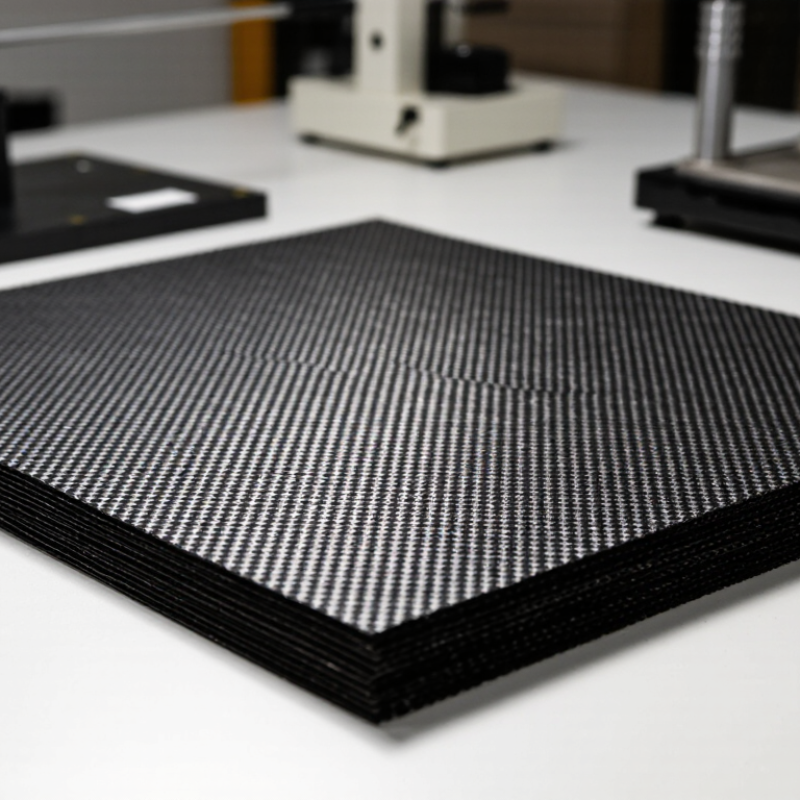
Table of Contents [Hide]
What Defines a Reliable Carbon Fiber Sheet Manufacturer in China?
A reliable carbon fiber sheet manufacturer in China proves consistency, not just production capacity. CompositesWorld’s 2024 Carbon Fiber Capacity report estimates worldwide capacity above 200,000 metric tonnes annually. Capacity alone says little about sheet quality. Buyers should inspect fiber grade, resin system, fiber orientation, thickness tolerance, and curing records.
Look for ISO 9001 procedures, but do not stop there. The ISO Survey 2022 recorded more than 1.2 million ISO 9001 certificates worldwide. Certification supports process control, yet it does not guarantee excellent carbon fiber sheets. Ask for batch-level traceability, resin-content data, and test reports using ASTM D3039 or equivalent methods. A dependable factory can show measured tensile strength, not only catalogue values.
Small details matter. Check whether each panel carries a batch number. Request samples from different production dates. Compare surface waviness, edge cutting, pinholes, and thickness with a micrometer. Production staff should explain storage temperature and moisture control without hesitation. A low quotation can hide unstable resin content or weak inspection practices. I have seen polished audit files create false confidence. That remains a sourcing risk. The strongest supplier welcomes an independent pre-shipment inspection and accepts reasonable corrective actions when data misses the agreed specification.





