


- Home
- A-Z Catalogue
- Products
- Valves
- Cetop
- Manual Directional Valves
- Proportional Valves
- Poppet Valves
- High-Speed Linear Servo Valves
- All High-Speed Linear Servo Valves
- Cetop 10 (NG32) Two Stage Type High Speed Linear Servo Valves – LSVHG-10
- Cetop 10 (NG32) Two Stage Type High Speed Linear Servo Valves – LSVHG-10 (With Fail-Safe)
- Cetop 8 (NG25) Two Stage Type High Speed Linear Servo Valves – LSVHG-06
- Cetop 8 (NG25) Two Stage Type High Speed Linear Servo Valves – LSVHG-06 (With Fail-Safe)
- Cetop 7 (NG16) Two Stage Type High Speed Linear Servo Valves – LSVHG-04
- Cetop 7 (NG16) Two Stage Type High Speed Linear Servo Valves – LSVHG-04 (With Fail-Safe)
- Cetop 5 (NG10) Direct Type High Speed Linear Servo Valves – LSVG-03
- Cetop 5 (NG10) OBE Type Direct Operated Linear Servo Valves – LSVG-03-EH
- Cetop 3 (NG6) OBE Type Direct Operated Linear Servo Valves – LSVG-01-EH
- Pumps
- Pressure control
- Flow Control Valves
- Pressure Control Valves
- All Pressure Control Valves
- Brake Valves
- Direct Relief Valve
- Low Noise Solenoid Controlled Relief Valves
- Low Noise Pilot Operated Relief Valves
- Pilot Operated Relief Valves
- Pressure reducing and relieving valves
- Pressure reducing and check valves
- Pressure control valves
- Remote Control Relief Valves
- Solenoid Controlled Relief Valves – BSG
- Solenoid Controlled Relief Valves – BST
- Unloading relief valves
- Check valves
- Environmental
- Valves
- Hydraulic Systems
- Power pack
- About Us
- Contact
- Blog

10 Tips for Choosing the Right UHF RFID Tag
Choosing the right Uhf Rfid Tag is less about finding the longest read range on a product sheet and more about matching the tag to its job. A tag that performs well on a cardboard carton may struggle on a metal tool or a liquid-filled container. Even a small change in placement can affect whether a reader captures the tag consistently.
Start with the object, the environment, and the required read distance. Check the tag’s operating frequency against your reader and the regions where the system will be used. Then consider the mounting surface, available space, exposure to heat or moisture, and expected handling. These details matter. A compact label may suit retail packaging, while a rugged hard tag may better withstand repeated contact in a warehouse. Chip memory and encoding needs also deserve attention, but more memory is not automatically better.
Specifications are a useful starting point, not a guarantee. Read the manufacturer’s test conditions, and ask how results may change on your actual materials. A brief pilot with representative items can reveal missed reads, awkward placement, or interference before a full rollout. Keep records of the test setup; otherwise, comparisons can become misleading. It is tempting to choose by price alone. That may be a mistake. The lowest-cost tag can create extra labor if staff must rescan items or replace tags. The ten tips that follow offer a practical framework for comparing options, checking evidence, and making a choice suited to your operation. Some trade-offs will remain. Good selection means understanding them.
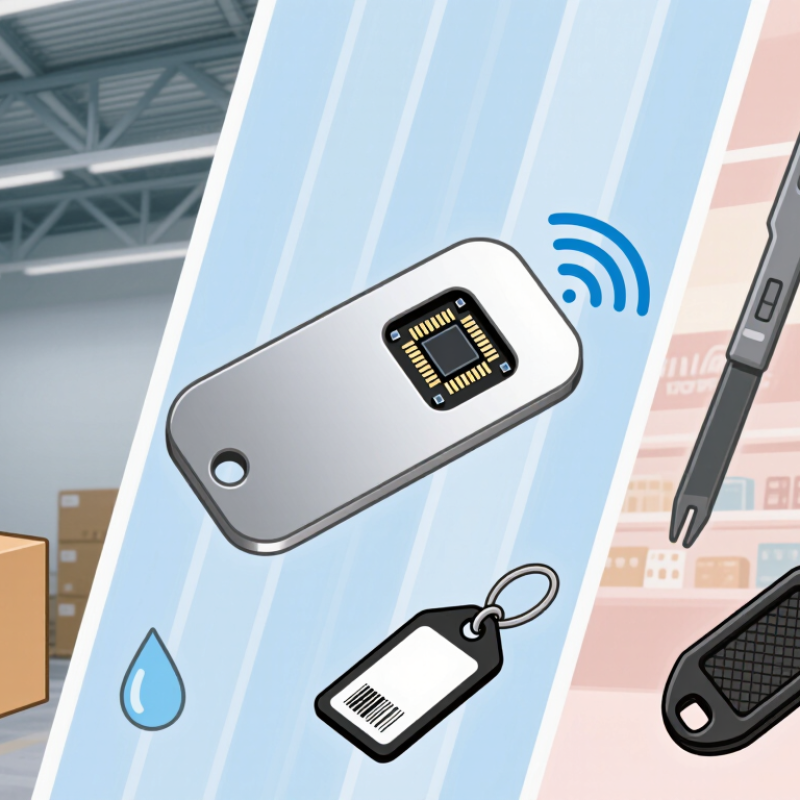
Table of Contents [Hide]
Understanding UHF RFID Tags and Their Applications
10 Tips for Choosing the Right UHF RFID Tag
Understanding UHF RFID Tags and Their Applications
UHF RFID tags use radio waves to identify objects without direct contact. They usually operate between 860 and 960 MHz, depending on regional requirements. A reader sends energy to the tag, and the tag returns stored data. Passive tags need no battery. Their performance changes with distance, orientation, metal, liquids, and surrounding materials. In a warehouse, a tag may work across a doorway but fail inside a liquid-filled container.
Tip: Test the tag on the actual item, not only on a sample table.
UHF RFID tags support inventory control, asset tracking, library management, manufacturing, and returnable transport containers. Choose the tag according to its application, not its appearance. Consider memory size, reading speed, attachment method, temperature range, and resistance to moisture. A small tag may suit cardboard packaging, while a rugged tag may better fit a metal tool.
Tip: Check the expected reading distance and movement speed. Shorter is not always worse.
Practical testing reveals uncomfortable details. A tag that performs well in open air may become unreliable near dense products. Reader settings, antenna placement, and operator habits also matter. I would not approve a large rollout after one successful demonstration. A small pilot can expose missed reads, poor placement, and confusing data. Record results in different seasons and loading conditions. Some assumptions will be wrong. That is useful evidence.
Tip: Measure real read rates before choosing the final tag.