


- Home
- A-Z Catalogue
- Products
- Valves
- Cetop
- Manual Directional Valves
- Proportional Valves
- Poppet Valves
- High-Speed Linear Servo Valves
- All High-Speed Linear Servo Valves
- Cetop 10 (NG32) Two Stage Type High Speed Linear Servo Valves – LSVHG-10
- Cetop 10 (NG32) Two Stage Type High Speed Linear Servo Valves – LSVHG-10 (With Fail-Safe)
- Cetop 8 (NG25) Two Stage Type High Speed Linear Servo Valves – LSVHG-06
- Cetop 8 (NG25) Two Stage Type High Speed Linear Servo Valves – LSVHG-06 (With Fail-Safe)
- Cetop 7 (NG16) Two Stage Type High Speed Linear Servo Valves – LSVHG-04
- Cetop 7 (NG16) Two Stage Type High Speed Linear Servo Valves – LSVHG-04 (With Fail-Safe)
- Cetop 5 (NG10) Direct Type High Speed Linear Servo Valves – LSVG-03
- Cetop 5 (NG10) OBE Type Direct Operated Linear Servo Valves – LSVG-03-EH
- Cetop 3 (NG6) OBE Type Direct Operated Linear Servo Valves – LSVG-01-EH
- Pumps
- Pressure control
- Flow Control Valves
- Pressure Control Valves
- All Pressure Control Valves
- Brake Valves
- Direct Relief Valve
- Low Noise Solenoid Controlled Relief Valves
- Low Noise Pilot Operated Relief Valves
- Pilot Operated Relief Valves
- Pressure reducing and relieving valves
- Pressure reducing and check valves
- Pressure control valves
- Remote Control Relief Valves
- Solenoid Controlled Relief Valves – BSG
- Solenoid Controlled Relief Valves – BST
- Unloading relief valves
- Check valves
- Environmental
- Valves
- Hydraulic Systems
- Power pack
- About Us
- Contact
- Blog

How to Choose a Natural Gas Steam Boiler
Choosing a Natural Gas Steam Boiler starts with the work it must perform, not the largest unit that fits the plant room. The U.S. Department of Energy’s Improving Steam System Performance: A Sourcebook for Industry reports that steam systems account for about 30% of energy used in U.S. manufacturing. That figure describes a broad industrial sector, not a guaranteed saving for any one facility. Still, it shows why boiler selection deserves careful attention.
Ray Wohlfarth, a boiler consultant and author on commercial boiler systems, offers a useful principle: “Match the boiler to the actual load, not the imagined peak.” Treat that as guidance, not a substitute for a measured load assessment. Review steam demand across shifts, pressure requirements, feedwater conditions, and expected expansion. A boiler sized too small may struggle during production peaks. One sized too large can cycle inefficiently when demand falls. The difference may appear in short burner runs, changing pressure, or a fuel bill that rises without an obvious cause.
This guide explains how to compare capacity, operating efficiency, turndown, controls, maintenance access, and supplier support. Check published performance data against your operating profile. Ask for assumptions in writing. A neat specification sheet is not enough. Real plant conditions can be messy, and estimates deserve a second look.
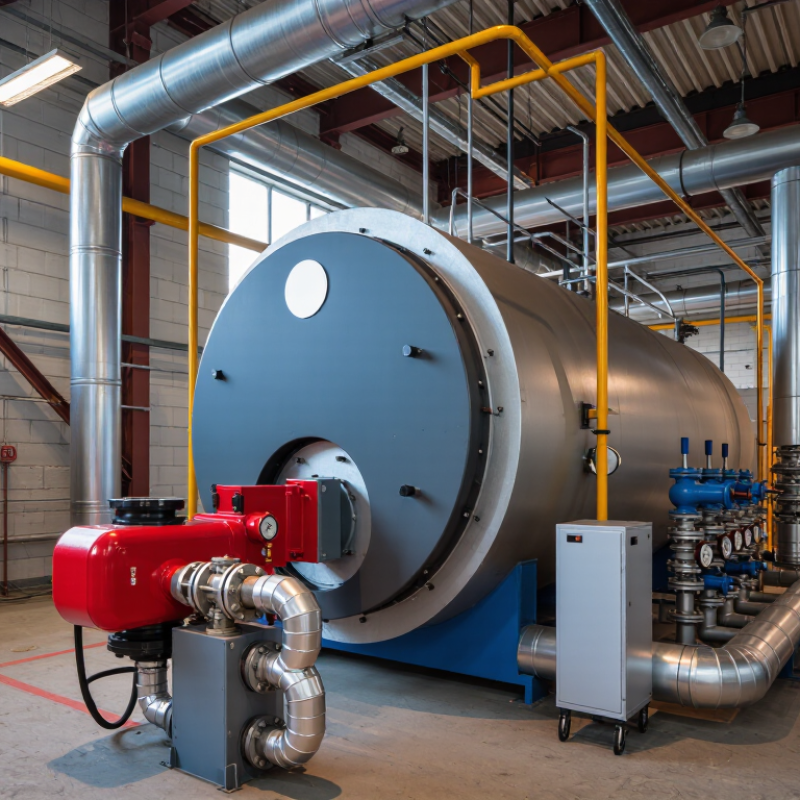
Table of Contents [Hide]
Understand How a Natural Gas Steam Boiler Works
How to Choose a Natural Gas Steam Boiler
Understand How a Natural Gas Steam Boiler Works
A natural gas steam boiler burns fuel in a combustion chamber. The flame heats water inside a pressure-rated vessel. As the water warms, it boils and produces steam. Steam moves. It travels through pipes to radiators or other heating equipment, where it releases heat. As it cools, water returns to the boiler through a condensate line. That cycle repeats while the system calls for heat.
Controls help keep this process steady. A thermostat signals when heat is needed, while a pressure control limits operating pressure. The gauge gives a quick reading, but it cannot confirm every part is working correctly. A technician should inspect safety controls, burners, vents, and condensate returns. In practice, the system is less tidy than a diagram: old pipes may hold air, and a slow return can affect performance. Boiler capacity should match the building’s heat demand, not just its floor area.
Tips: Ask how the boiler’s controls respond to changing demand. Check that the gauge is visible and the condensate line drains freely. Keep service records; small changes can be easy to miss.
| Selection Dimension | What to Check | Practical Guidance | Why It Matters |
|---|---|---|---|
| Heating or process demand | Required steam output, commonly stated in pounds per hour (lb/h), and the highest expected demand. | Size the boiler from a documented heat-loss or process-load calculation. Include normal peak demand, but avoid adding excessive capacity without justification. | An undersized boiler may not maintain steam supply; an oversized one can cycle frequently and operate less efficiently. |
| Steam pressure | Required operating pressure at the point of use, measured in pounds per square inch gauge (psig). | For U.S. heating applications, low-pressure steam boilers are generally limited to 15 psig. Process applications may require higher pressure and different equipment and code requirements. | Pressure affects equipment selection, piping design, controls, safety devices, and applicable regulations. |
| How the boiler works | Combustion chamber, heat-transfer surfaces, steam space, burner, controls, and safety devices. | A burner mixes natural gas with combustion air and ignites it. Hot combustion gases transfer heat through the boiler surfaces to the water; the heated water boils, and steam is delivered to the system. | Understanding the process helps identify the importance of burner setup, heat transfer, water level control, and regular inspection. |
| Fuel supply and gas pressure | Available natural-gas flow and pressure at the boiler connection, confirmed against the equipment requirements. | Have a qualified professional verify the gas meter, piping capacity, regulator, and supply pressure under load before installation. | Insufficient or unstable gas supply can prevent reliable firing and may affect combustion and performance. |
| Efficiency and operating cost | Manufacturer-rated efficiency, test conditions, expected annual operating hours, and local fuel price. | Compare ratings on the same basis. Ask whether a quoted figure is combustion efficiency, thermal efficiency, or an annual rating; these are not interchangeable. | A rating alone does not predict total cost. Load profile, maintenance, blowdown, and return of condensate also affect fuel use. |
| Feedwater and condensate return | Feedwater temperature, condensate-return percentage, and water-treatment requirements. | Evaluate the existing return system and follow the boiler maker’s water-quality limits. Treat makeup water as required and monitor water chemistry. | Appropriate water quality helps limit scale, corrosion, foaming, and carryover; returning hot condensate can reduce energy and water demand. |
| Turndown and load variation | Burner firing range and how closely output can follow changing steam demand. | Compare the burner’s minimum and maximum firing rates with the facility’s typical load range. Consider staging or multiple boilers where demand varies widely. | Better matching can reduce short cycling and help maintain stable pressure during changing demand. |
| Emissions and ventilation | Applicable local limits for nitrogen oxides (NOx), carbon monoxide, and other regulated emissions; combustion-air and exhaust needs. | Confirm permitting requirements and installation clearances with the local authority and a qualified installer before selecting equipment. | Requirements vary by location and installation. Proper ventilation and combustion setup are essential for safe operation. |
| Safety and code compliance | Pressure relief valve, low-water cutoff, operating limits, inspection access, and applicable boiler codes. | Use equipment certified and installed for the intended pressure and jurisdiction. Do not isolate or bypass safety controls; arrange required inspections. | Steam systems store energy under pressure. Correct safety devices and code-compliant installation help reduce the risk of injury and equipment damage. |
| Installation space and maintenance access | Boiler-room dimensions, service clearances, piping connections, flue route, and access for cleaning and inspection. | Check the installation drawings and site conditions, including doorways and the route for bringing equipment into the building. | A suitable layout supports safe installation, routine maintenance, and efficient removal of serviceable components. |
| Lifecycle support | Availability of qualified service technicians, replacement parts, maintenance instructions, and expected service intervals. | Compare support options and planned maintenance needs before purchase. Keep operating, inspection, and water-treatment records. | Reliable service and preventive maintenance help protect uptime and preserve safe, efficient operation. |
| Selection note: Boiler capacity, pressure, efficiency, and emissions depend on the specific model and installation. Confirm all design values with a qualified boiler professional and the applicable local codes. | |||





