


- Home
- A-Z Catalogue
- Products
- Valves
- Cetop
- Manual Directional Valves
- Proportional Valves
- Poppet Valves
- High-Speed Linear Servo Valves
- All High-Speed Linear Servo Valves
- Cetop 10 (NG32) Two Stage Type High Speed Linear Servo Valves – LSVHG-10
- Cetop 10 (NG32) Two Stage Type High Speed Linear Servo Valves – LSVHG-10 (With Fail-Safe)
- Cetop 8 (NG25) Two Stage Type High Speed Linear Servo Valves – LSVHG-06
- Cetop 8 (NG25) Two Stage Type High Speed Linear Servo Valves – LSVHG-06 (With Fail-Safe)
- Cetop 7 (NG16) Two Stage Type High Speed Linear Servo Valves – LSVHG-04
- Cetop 7 (NG16) Two Stage Type High Speed Linear Servo Valves – LSVHG-04 (With Fail-Safe)
- Cetop 5 (NG10) Direct Type High Speed Linear Servo Valves – LSVG-03
- Cetop 5 (NG10) OBE Type Direct Operated Linear Servo Valves – LSVG-03-EH
- Cetop 3 (NG6) OBE Type Direct Operated Linear Servo Valves – LSVG-01-EH
- Pumps
- Pressure control
- Flow Control Valves
- Pressure Control Valves
- All Pressure Control Valves
- Brake Valves
- Direct Relief Valve
- Low Noise Solenoid Controlled Relief Valves
- Low Noise Pilot Operated Relief Valves
- Pilot Operated Relief Valves
- Pressure reducing and relieving valves
- Pressure reducing and check valves
- Pressure control valves
- Remote Control Relief Valves
- Solenoid Controlled Relief Valves – BSG
- Solenoid Controlled Relief Valves – BST
- Unloading relief valves
- Check valves
- Environmental
- Valves
- Hydraulic Systems
- Power pack
- About Us
- Contact
- Blog

How to Choose the Right Hydro Jetting Machine
A blocked drain rarely announces its full difficulty. One line may hold grease near a kitchen; another may contain packed sediment far downstream. Choosing a Hydro Jetting Machine therefore starts with the work, not the biggest pressure rating on a sales sheet.
The U.S. Environmental Protection Agency’s 2022 Clean Watersheds Needs Survey estimated $630.1 billion in wastewater infrastructure needs over the following 20 years. That figure does not mean every contractor needs a larger jetter. It does show why dependable maintenance equipment matters. The report covers broad infrastructure needs, not machine performance, so treat it as context—not a buying formula.
Match the unit to pipe diameter, blockage type, access, and daily workload. Compare working pressure and water flow together; pressure alone can mislead. Check whether the water tank, hose length, and nozzle options fit the site. A compact trailer may suit residential calls, while municipal work can demand higher sustained flow and longer hose runs. Small details matter. A hose that barely reaches the cleanout can waste more time than a modest pump saves.
Ask manufacturers for clear performance specifications, service intervals, and parts availability. Confirm that operators can control the equipment safely and follow its manual. A bigger machine is not automatically better. I would still verify the claimed output under realistic operating conditions; product sheets rarely show every job-site constraint. Choose for repeatable results, not impressive numbers alone.
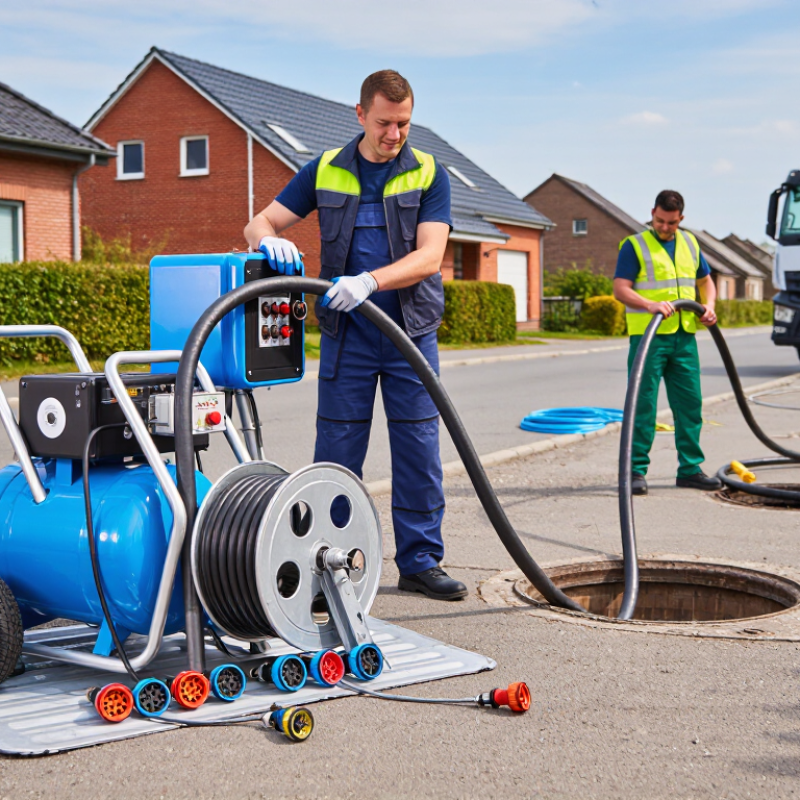
Table of Contents [Hide]
Identify the Drainage Tasks and Conditions the Machine Must Handle
Before comparing pressure ratings, define the work the machine must do. A kitchen line carrying soft grease needs a different setup from a long storm drain with compacted sediment. Note the pipe diameter, material, length, and number of bends. Small details matter. A hose that reaches the cleanout may still struggle around several tight elbows.
Check what the site can actually provide. Measure access openings, confirm a steady water supply, and consider whether the work is indoors or outdoors. Narrow basements may call for a compact unit and a manageable hose reel. Longer runs often need enough flow to carry loosened debris back toward the access point, not merely break it apart.
Roots or hardened scale may require a careful assessment before jetting; pressure alone does not solve every blockage and can damage weakened pipe. I’ve seen equipment choices focus too much on maximum pressure. That’s an easy mistake. Match pressure and flow to the pipe’s condition, the nozzle, and the debris. Also allow room for protective gear, safe hose handling, and cleanup. A simple site checklist can prevent an expensive mismatch, though it will not replace a proper pipe inspection.





