


- Home
- A-Z Catalogue
- Products
- Valves
- Cetop
- Manual Directional Valves
- Proportional Valves
- Poppet Valves
- High-Speed Linear Servo Valves
- All High-Speed Linear Servo Valves
- Cetop 10 (NG32) Two Stage Type High Speed Linear Servo Valves – LSVHG-10
- Cetop 10 (NG32) Two Stage Type High Speed Linear Servo Valves – LSVHG-10 (With Fail-Safe)
- Cetop 8 (NG25) Two Stage Type High Speed Linear Servo Valves – LSVHG-06
- Cetop 8 (NG25) Two Stage Type High Speed Linear Servo Valves – LSVHG-06 (With Fail-Safe)
- Cetop 7 (NG16) Two Stage Type High Speed Linear Servo Valves – LSVHG-04
- Cetop 7 (NG16) Two Stage Type High Speed Linear Servo Valves – LSVHG-04 (With Fail-Safe)
- Cetop 5 (NG10) Direct Type High Speed Linear Servo Valves – LSVG-03
- Cetop 5 (NG10) OBE Type Direct Operated Linear Servo Valves – LSVG-03-EH
- Cetop 3 (NG6) OBE Type Direct Operated Linear Servo Valves – LSVG-01-EH
- Pumps
- Pressure control
- Flow Control Valves
- Pressure Control Valves
- All Pressure Control Valves
- Brake Valves
- Direct Relief Valve
- Low Noise Solenoid Controlled Relief Valves
- Low Noise Pilot Operated Relief Valves
- Pilot Operated Relief Valves
- Pressure reducing and relieving valves
- Pressure reducing and check valves
- Pressure control valves
- Remote Control Relief Valves
- Solenoid Controlled Relief Valves – BSG
- Solenoid Controlled Relief Valves – BST
- Unloading relief valves
- Check valves
- Environmental
- Valves
- Hydraulic Systems
- Power pack
- About Us
- Contact
- Blog

How to Choose the Right Energy Storage Connector
Choosing the right Energy Storage Connector is not a cosmetic decision. It affects current flow, temperature rise, installation time, and long-term maintenance. A connector that looks robust on a product sheet may still be difficult to handle in a crowded battery enclosure. Fit, polarity protection, contact resistance, and cable size all deserve close attention. Small details matter.
An illustrative expert voice for this guide—not a quotation from a sourced interview—is energy-storage connector specialist Alex Morgan: “Choose for the real operating conditions, not just the rated current.” That means checking the system’s voltage and current, expected temperature range, vibration exposure, ingress protection needs, and mating cycles. It also means reviewing how technicians will reach and disconnect the connector. A gloved hand, a tight bend in the cable, or a barely visible polarity mark can change the practical choice. Ratings matter. So does the installation.
This introduction sets up a clear framework for comparing connector types, materials, safety features, and manufacturer documentation. It will also consider compatibility with the battery, inverter, and cable assembly, rather than treating the connector as an isolated component. No checklist catches everything; field conditions can expose assumptions that looked sound on paper. That is worth admitting. The goal is a reasoned selection, backed by specifications and application details, not a confident guess.
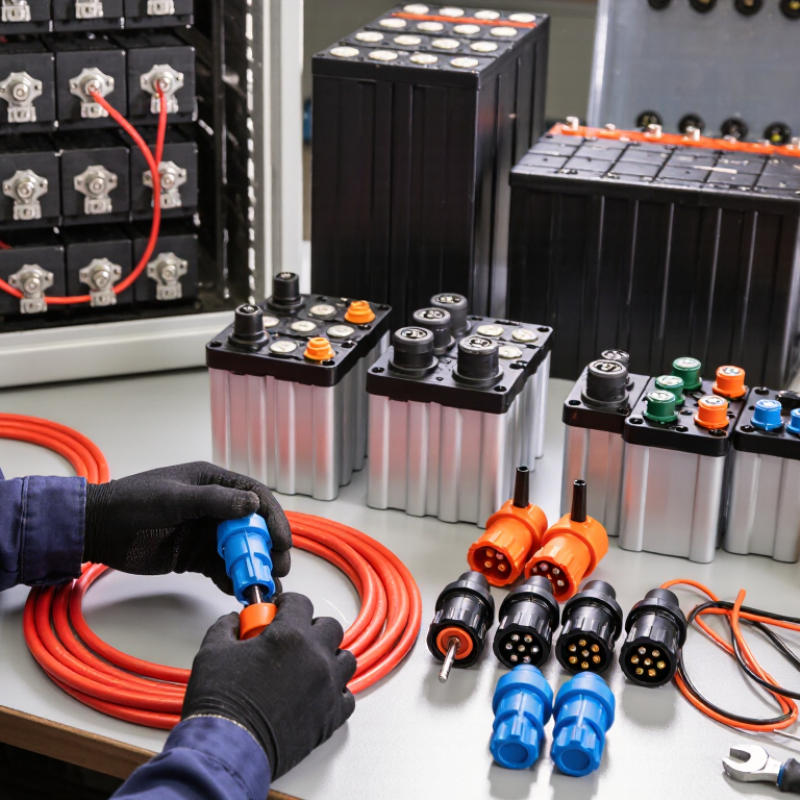
Table of Contents [Hide]
Understanding Energy Storage Connectors and Their Core Functions
How to Choose the Right Energy Storage Connector
Understanding Energy Storage Connectors and Their Core Functions
An energy storage connector joins battery modules, power conversion equipment, and protection circuits into a dependable electrical path. It carries current, maintains polarity, and helps prevent accidental contact with energized parts. It also needs to hold securely through vibration and repeated servicing. Small part. Big consequences.
The International Energy Agency’s Batteries and Secure Energy Transitions report says power-sector battery storage additions reached 42 GW in 2023, over 130% higher than in 2022. That rapid growth makes careful component selection more important, not less.
Check the connector’s rated voltage and current against the actual system conditions, including peak loads and temperature. Then review contact resistance, insulation, ingress protection, cable size, and permitted mating cycles. A connector that fits the housing may still be poorly matched to the electrical load.
Details matter on the installation floor. Confirm that polarity is clearly marked, contacts cannot be touched during normal handling, and the cable bend does not strain the joint. Follow the manufacturer’s documented installation torque and inspection procedure. I would not judge suitability by appearance alone; a solid latch cannot compensate for an underrated contact or a loose crimp. Datasheets help, but real operating conditions can be messier than a neat specification table.





