


- Home
- A-Z Catalogue
- Products
- Valves
- Cetop
- Manual Directional Valves
- Proportional Valves
- Poppet Valves
- High-Speed Linear Servo Valves
- All High-Speed Linear Servo Valves
- Cetop 10 (NG32) Two Stage Type High Speed Linear Servo Valves – LSVHG-10
- Cetop 10 (NG32) Two Stage Type High Speed Linear Servo Valves – LSVHG-10 (With Fail-Safe)
- Cetop 8 (NG25) Two Stage Type High Speed Linear Servo Valves – LSVHG-06
- Cetop 8 (NG25) Two Stage Type High Speed Linear Servo Valves – LSVHG-06 (With Fail-Safe)
- Cetop 7 (NG16) Two Stage Type High Speed Linear Servo Valves – LSVHG-04
- Cetop 7 (NG16) Two Stage Type High Speed Linear Servo Valves – LSVHG-04 (With Fail-Safe)
- Cetop 5 (NG10) Direct Type High Speed Linear Servo Valves – LSVG-03
- Cetop 5 (NG10) OBE Type Direct Operated Linear Servo Valves – LSVG-03-EH
- Cetop 3 (NG6) OBE Type Direct Operated Linear Servo Valves – LSVG-01-EH
- Pumps
- Pressure control
- Flow Control Valves
- Pressure Control Valves
- All Pressure Control Valves
- Brake Valves
- Direct Relief Valve
- Low Noise Solenoid Controlled Relief Valves
- Low Noise Pilot Operated Relief Valves
- Pilot Operated Relief Valves
- Pressure reducing and relieving valves
- Pressure reducing and check valves
- Pressure control valves
- Remote Control Relief Valves
- Solenoid Controlled Relief Valves – BSG
- Solenoid Controlled Relief Valves – BST
- Unloading relief valves
- Check valves
- Environmental
- Valves
- Hydraulic Systems
- Power pack
- About Us
- Contact
- Blog

How to Choose an Automotive Motor Tester for Your Needs?
Choosing an Automotive Motor Tester is not simply a matter of buying the most advanced instrument. The right choice depends on the motor, the fault you need to find, and the conditions in your workshop. A compact 12-volt starter motor and a high-voltage traction motor demand different test methods, safety provisions, and measurement ranges. Get that match wrong, and even a sophisticated display can offer little useful guidance.
Electric-machine researcher K. T. Chau provides a relevant engineering perspective through his published work on electric machines. The following is a paraphrased selection principle, not a direct quotation: “Choose test equipment around the motor’s characteristics and the evidence your diagnosis requires.” That distinction matters. A useful tester should support the measurements you actually need, such as winding resistance, insulation condition, current draw, or speed. Check that its voltage range, leads, clamps, and instructions fit your intended applications. If your team tests several motor types, compare adaptability with setup time and training needs.
Look closely at the details. A clear display helps when readings must be taken beside a vehicle, under uneven shop lighting. Durable leads and accessible replacement accessories can matter more than a long feature list. Confirm calibration options, data storage, and technical support before purchase. No tester is perfect. Some models may be capable but cumbersome; others may be simple yet limited. This guide will help you compare those trade-offs and choose an Automotive Motor Tester that provides practical, repeatable results for your work.
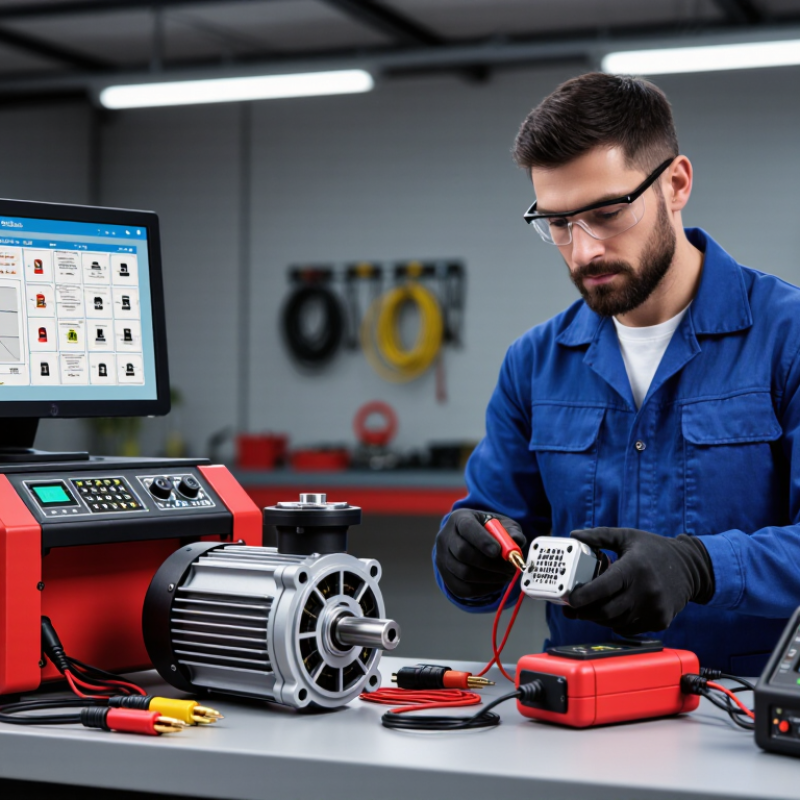
Table of Contents [Hide]
Determine Your Diagnostic Needs and Testing Goals
Before choosing an automotive motor tester, define the failures you need to diagnose. Are you checking starter motors, alternators, or high-voltage traction motors? A bench test for a removed motor differs from an in-vehicle diagnosis. Write down the symptoms you see: slow cranking, excess heat, vibration, or inconsistent output. Then match the tester to the measurements those faults require, such as winding resistance, insulation condition, current draw, speed, or torque.
The market is changing. The IEA’s Global EV Outlook 2025 reports that electric car sales exceeded 17 million in 2024, accounting for more than 20% of global car sales. That growth makes voltage range, phase testing, and suitable safety provisions important when evaluating equipment for traction motors.
Still, a broad specification sheet does not prove a tester fits your daily work. That matters.
Consider a real workflow. A technician may need to compare readings across three motor phases, record a temperature rise, and repeat the test after repair. Check whether the instrument supports the required voltage and load, stores results, and produces readings your team can interpret. For a busy shop, setup time and clear fault indications count too.
A small caveat: test conditions can distort results. A cold motor and a warm motor may not behave alike, so document temperature and test procedure before comparing readings.





